Projectiles in Dynamics
1.गतिविज्ञान में प्रक्षेप्य (Projectiles in Dynamics),प्रक्षेप्य (Projectiles):
गतिविज्ञान में प्रक्षेप्य (Projectiles in Dynamics) के इस आर्टिकल में किसी पिण्ड के प्रक्षेप गति पर आधारित सवालों को हल करके समझने का प्रयास करेंगे।
आपको यह जानकारी रोचक व ज्ञानवर्धक लगे तो अपने मित्रों के साथ इस गणित के आर्टिकल को शेयर करें।यदि आप इस वेबसाइट पर पहली बार आए हैं तो वेबसाइट को फॉलो करें और ईमेल सब्सक्रिप्शन को भी फॉलो करें।जिससे नए आर्टिकल का नोटिफिकेशन आपको मिल सके।यदि आर्टिकल पसन्द आए तो अपने मित्रों के साथ शेयर और लाईक करें जिससे वे भी लाभ उठाए।आपकी कोई समस्या हो या कोई सुझाव देना चाहते हैं तो कमेंट करके बताएं।इस आर्टिकल को पूरा पढ़ें।
Also Read This Article:- Horizontal Motion in Resisting Medium
2.गतिविज्ञान में प्रक्षेप्य पर आधारित उदाहरण (Illustrations Based on Projectiles in Dynamics):
Illustration:1.एक m द्रव्यमान का कण क्षैतिज से \alpha कोण बनाते हुए हवा में u वेग से प्रक्षेपित किया जाता है तो पथ के किसी बिन्दु पर वेग का क्षैतिज घटक लिखिए तथा क्या सम्पूर्ण पथ पर यह अचर है अथवा नहीं?
(A particle of mass m is projected from a fixed point into the air with velocity u in a direction making an angle \alpha with the horizontal,Write the horizontal components of velocity at any point of its path,whether it is constant or not throughout the path.)
Solution:पथ के किसी बिन्दु पर वेग का क्षैतिज घटक
\dot{x}=\frac{d x}{d t}=u \cos \alpha जो सम्पूर्ण पथ पर अचर है।
Illustration:2.अधिकतम ऊँचाई पर किसी कण का वेग,अधिकतम की आधी ऊँचाई पर वेग का \sqrt{\left(\frac{2}{5}\right)} गुणा है।प्रक्षेप कोण ज्ञात करो।
(The velocity of a projectile at its greatest height is \sqrt{\left(\frac{2}{5}\right)} of its velocity at half the greatest height.Find the angle of projection.)
Solution:अधिकतम ऊँचाई परः
H=\frac{u^2 \sin ^2 \alpha}{2 g} \cdots(1)
अधिकतम ऊँचाई की आधी ऊँचाई पर वेग:
v^2=u^2-2gh \\ \Rightarrow v^2=u^2-g(2 h) \\ =u^2-g(H) \quad[\because H=2h] \\ \Rightarrow v^2=u^2-g H \cdots(2)
समीकरण (1) व (2) सेः
v^2=u^2-g\left(\frac{u^2 \cdot \sin ^2 \alpha}{2 g}\right) \\ \Rightarrow v^2 =u^2\left(1-\frac{\sin ^2 \alpha}{2}\right) \cdots(3)
अधिकतम ऊँचाई पर वेग का क्षैतिज वेग कण का वेग होता है क्योंकि उर्ध्वाधर वेग शून्य हो जाता है:
\sqrt{\frac{2}{5}} v=u \cos \alpha \\ \Rightarrow \frac{2}{5} v^2=u^2 \cos ^2 \alpha \cdots(4)
समीकरण (4) में समीकरण (3) का भाग देने परः
\frac{\frac{2}{5} v^2}{v^2}=\frac{u^2 \cos ^2 \alpha}{u^2\left(1-\frac{\sin^2 \alpha}{2}\right)} \\ \Rightarrow \frac{2}{5}=\frac{\cos ^2 \alpha}{1-\frac{\sin ^2 \alpha}{2}} \\ \Rightarrow \frac{2}{5}-\frac{2}{5}\left(\frac{\sin ^2 \alpha}{2}\right)=\cos ^2 \alpha \\ \Rightarrow-\frac{1}{5} \sin ^2 \alpha-\cos ^2 \alpha=-\frac{2}{5} \\ \Rightarrow-\frac{1}{5}\left(1-\cos ^2 \alpha\right)-\cos ^2 \alpha=-\frac{2}{5} \\ \Rightarrow-\left[\frac{1}{5}-\frac{1}{5} \cos ^2 \alpha+\cos ^2 \alpha\right]=-\frac{2}{5} \\ \Rightarrow \left(\frac{-1+5}{5}\right) \cos ^2 \alpha=\frac{2}{5}-\frac{1}{5} \\ \Rightarrow \frac{4}{5} \cos ^2 \alpha=\frac{1}{5} \\ \Rightarrow \cos \alpha=\frac{1}{4} \Rightarrow \cos ^2 \alpha=\frac{1}{2} \\ \Rightarrow \cos \alpha=\cos 60^{\circ} \Rightarrow \alpha=60^{\circ}
Illustration:3.एक प्रक्षेप्य की गति दिशा किसी समय क्षैतिज से कोण \alpha बनाती है,t सैकण्ड के पश्चात वह क्षैतिज से कोण \beta बनाती है।सिद्ध करो कि वेग का क्षैतिज घटक होगा:
(The direction of motion of a particle at a certain instant is inclined at an angle \alpha to the horizon,after t seconds it is inclined at an angle \beta . Prove that the horizontal component of velocity of projection is)
\frac{g t}{\tan \alpha-\tan \beta}
Solution:यदि कण गति की प्रक्षेप दिशा के t समय बाद कोण \beta बनाता है तब
\tan \beta=\frac{\dot{y}}{\dot{x}}-\frac{u \sin \alpha-g t}{u \cos \alpha} \\ \Rightarrow \tan \beta=\tan \alpha-\frac{g t}{u \cos \alpha} \\ \Rightarrow \tan \alpha-\tan \beta=\frac{g t}{u \cos \alpha} \\ \Rightarrow u \cos \alpha=\frac{g t}{\tan \alpha-\tan \beta}
Illustration:4.एक कण उन्नयन कोण \alpha पर प्रक्षेपित किया जाता है और t सैकण्ड पश्चात प्रक्षेप बिन्दु से देखने पर उसका उन्नयन कोण \beta प्रतीत होता है।सिद्ध कीजिए कि उसका प्रारम्भिक वेग होगा:
(A particle is projected at an elevation \alpha and after t seconds it appears to have an elevation \beta as seen from the point of projection.Prove that the initial velocity of the paricle was)
\frac{g t \cos \beta}{2 \sin (\alpha-\beta)}
Solution:यदि P(x,y),t समय बाद कण की स्थिति है तब
\tan \beta=\frac{y}{x}=\frac{t u \sin \alpha-\frac{1}{2} g t^2}{u t \cos \alpha} \\ =\frac{u \sin \alpha-\frac{1}{2} g t}{u \cos \alpha} \\ \Rightarrow \frac{\sin \beta}{\cos \beta}=\frac{u \sin \alpha- \frac{1}{2}gt}{u \cos \alpha} \\ \Rightarrow u \sin \beta \cos \alpha=u \sin \alpha \cos \beta-\frac{1}{2} g t \cos \beta \\ \Rightarrow u \sin \alpha \cos \beta-u \sin \beta \cos \alpha=\frac{1}{2} g t \cos \beta \\ \Rightarrow u(\sin \alpha \cos \beta-\sin \beta \cos \alpha)=\frac{1}{2} gt\cos \beta \\ \Rightarrow u \sin (\alpha-\beta)=\frac{1}{2} g t \cos \beta \\ \Rightarrow u=\frac{g t \cos \beta}{2 \sin (\alpha-\beta)}
Illustration:5.एक तोप के गोले का क्षैतिज तल पर परास R है।यदि उन दोनों पथों की,जिनके लिए यह सम्भव है,महत्तम ऊँचाईयों h तथा h’ हों,तो सिद्ध करो कि
(A cannon ball has a range R on the horizontal plane.If h and h’ be the greatest heights in the two paths for which this is possible,prove that)
R=4 \sqrt{\left(h h^{\prime}\right)}
Solution:महत्तम ऊँचाई पर
H=\frac{u^2 \sin ^2 \alpha}{2 g} \\ \Rightarrow h =\frac{u^2 \sin ^2 \alpha}{2 g} \cdots(1) \\ h^{\prime} =\frac{u^2 \sin ^2\left(90^{\circ}-\alpha\right)}{2 g} \\ \Rightarrow h^{\prime}=\frac{u^2 \cos ^2 \alpha}{2 g} \cdots(2)
(1) व (2) को गुणा करने परः
h h^{\prime}=\frac{u^2 \sin ^2 \alpha}{2 g} \times \frac{u^2 \cos ^2 \alpha}{2 g} \\ =\frac{u^u \sin ^2 \alpha \cos ^2 \alpha}{u g^2} \\ \Rightarrow \sqrt{\left(h h^{\prime}\right)} =\frac{u^2 \sin \alpha \cos \alpha}{2 g} \\ =\frac{2 u^2 \sin \alpha \cos \alpha}{4 g} \\ =\frac{u^2 \sin 2 \alpha}{4 g} \\ \Rightarrow 4 \sqrt{\left(h h^{\prime}\right)}=\frac{u^2 \sin 2 \alpha}{g} \cdots(1)
परास R=\frac{u^2 \sin 2 \alpha}{g} \cdots(2)
(1) व (2) से:
R=4 \sqrt{\left(h h^{\prime}\right)}
Illustration:6.यदि प्रक्षेप बिन्दु से गुजरने वाले क्षैतिज धरातल से किसी प्रक्षेप्य की महत्तम ऊँचाई h तथा प्रक्षेप्य कोण \alpha है,तो वह अन्तराल ज्ञात कीजिए जब प्रक्षेप्य की ऊँचाई h \sin ^2 \alpha है।
(If the maximum height of a projectile above a horizontal plane through the point of projection be h and \alpha be the angle of projection,find the interval between the instants at which the height of the projectile is h \sin ^2 \alpha )
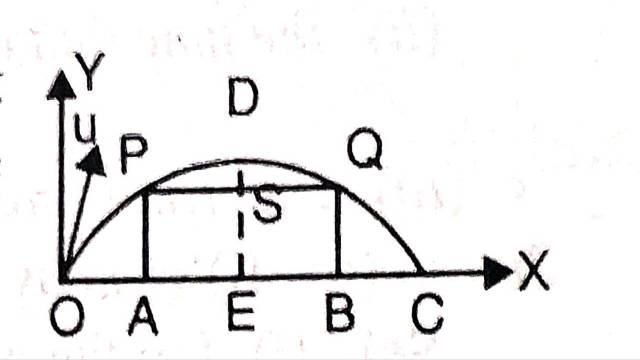
Solution:माना प्रक्षेप बिन्दु O है तथा प्रक्षेप वेग u है और P तथा Q समान ऊँचाई h \sin ^2 \alpha पर है इसलिए PA=PQ=h \sin ^2 \alpha
माना प्रक्षेप्य द्वारा ऊँचाई h \sin ^2 \alpha तक पहुँचने में लिया गया समय t है,तब
h \sin ^2 \alpha=t u \sin \alpha-\frac{1}{2} g t^2 \\ \Rightarrow g t^2-2 u t \sin \alpha+2 h \sin ^2 \alpha=0 \cdots(1)
पुनः h=उच्चतम ऊँचाई=\frac{u^2 \sin ^2 \alpha}{2 g} \\ \Rightarrow u \sin \alpha=\sqrt{(2 g h)} \cdots(2)
(2) का समीकरण (1) में प्रयोग करने परः
\Rightarrow g t^2-2 t(2 g h)^{\frac{1}{2}}+2 h \sin ^2 \alpha=0
माना प्रक्षेप्य द्वारा O से P तथा O से Q तक लिया गया समय t_{1} तथा t_{2} है,तब समीकरण (5) के मूल है:
\therefore t_1+t_2=\frac{2(2 g h)^{\frac{1}{2}}}{g} तथा t_1 t_2=\frac{\left(2 h \sin ^2 \alpha\right)}{g}
अतः अभीष्ट समय=t_1-t_2=\sqrt{\left(t_1+t_2\right)^2-4 t_1 t_2} \\ =\sqrt{\frac{8 g h}{g^2}-\frac{4 \times 2 h \sin ^2 \alpha}{g}} \\ =\sqrt{\frac{8 h}{g}\left(1-\sin ^2 \alpha\right)}=\sqrt{\frac{8 h}{g} \cos ^2 \alpha} \\ \Rightarrow t_1-t_2=2 \sqrt{\left(\frac{2 h}{g}\right) \cos \alpha}
Illustration:7.सिद्ध करो कि न्यूनतम वेग जिससे एक पिण्ड फेंका जाता है तथा जिसका क्षैतिज परास R है, \sqrt{(g R)} मीटर प्रति सैकण्ड है तथा इस स्थिति में उसके द्वारा प्राप्त महत्तम ऊँचाई \frac{R}{4} है।
(Show that the least velocity with which the body can be projected to a horizontal range R is \sqrt{(g R)} meter per second and the greatest height attained in this case is \frac{R}{4} )
Solution:प्रक्षेप्य गति (projectile motion) में,क्षैतिज परास R तक किसी वस्तु को प्रक्षेपित करने के लिए आवश्यक न्यूनतम वेग u=\sqrt{(g R)} मीटर प्रति सेकण्ड होता है और उच्चतम ऊँचाई H=\frac{R}{4} होती है।
प्रथम स्थिति:क्षैतिज परास (Horozontal Range) R के लिए प्रक्षेप्य के प्रारम्भिक वेग (u) और प्रक्षेप कोण \alpha के बीच सम्बन्ध है
R=\frac{u^2 \sin 2 \alpha}{g} \\ \Rightarrow u^2=\frac{R g}{\sin 2 \alpha}
वेग u को न्यूनतम करने के लिए, \sin 2 \alpha का अधिकतम होना चाहिए। \sin 2 \alpha का अधिकतम मान 1 होता है,जो, 2 \alpha=90^{\circ} (अर्थात् \alpha=45^{\circ}) पर होता है।अतः न्यूनतम वेग u_{min} के लिए
u^2=\frac{R g}{1} \Rightarrow u=\sqrt{(g R)}
स्थिति द्वितीय:उच्चतम ऊँचाई (H) सूत्र हैः
H=\frac{u^2 \sin \alpha}{2 g}
न्यूनतम वेग वाली स्थिति (\alpha=45^{\circ} और u^2=gR) को इस सूत्र में रखने परः
H=\frac{g R \sin ^2 45^{\circ}}{2 g} \\ \sin 45^{\circ}=\frac{1}{\sqrt{2}} \Rightarrow \sin ^2 45^{\circ}=\frac{1}{2} \\ H=\frac{g R \times \frac{1}{2}}{2 g}=\frac{1}{4} R
Illustration:8.एक कण गुरुत्वाकर्षण के अन्तर्गत u वेग से फेंका जाता है तथा जो क्षैतिज के साथ कोण \alpha बनाता है।सिद्ध करो कि कण के गति की दिशा में विचलन D होगा:
(A particle is projected under gravity with a velocity u in a direction making an angle \alpha with the horizon.Show that the amount deviation D is the direction of motion of the particle is given by)
\tan D=\frac{g t \cos \alpha}{u-g t \cos \alpha} \cdots(1)
Solution:प्रश्न 3 से
u \cos \alpha=\frac{g t}{\tan \alpha-\tan \beta}
यदि D विचलन है तो
\alpha=\beta+D \\ \therefore \tan D=\tan (\alpha-\beta) =\frac{\tan \alpha-\tan \beta}{1+\tan \alpha \tan \beta}\\ =\frac{\frac{g t}{u \cos \alpha}}{1+\tan \alpha\left(\tan \alpha-\frac{t}{u \cos \alpha}\right)} [(1) से]
=\frac{\frac{g t}{u \cos \alpha}}{\sec ^2 \alpha-\frac{g t \sin \alpha}{u \cos ^2 \alpha}} \\ =\frac{g t \cos \alpha}{u-g t \sin \alpha} \\ \Rightarrow \tan D=\frac{g t \cos \alpha}{u-g t \sin \alpha}
Illustration:9(a).दिए हुए प्रक्षेप कोण के लिए एक प्रक्षेप का क्षैतिज तल पर परास R है तथा महत्तम ऊँचाई h है,सिद्ध करो कि उसी प्रक्षेप वेग से महत्तम क्षैतिज परास 2 h+\frac{R^2}{8 h} होगा।यह भी सिद्ध करो कि प्रक्षेप वेग \sqrt{\left[2 g \cdot\left(h+\frac{R^2}{16 h}\right)\right]} होगा।
(If R be the range of a projectile on a horizontal plane and h its maximum horizontal range with the same velocity of projection is 2 h+\frac{R^2}{8 h} . Also prove that the velocity of projection is \sqrt{\left[2 g \cdot\left(h+\frac{R^2}{16 h}\right)\right]} .)
Solution:हम जानते हैं कि
h=\frac{u^2 \sin ^2 \alpha}{2 g} तथा R=\frac{2 u^2 \sin \alpha \cos \alpha}{g} \\ \therefore 2 h+\frac{R^2}{8 h}=\frac{2 u^2 \sin ^2 \alpha}{2 g}+\frac{4 u^4 \sin ^2 \alpha \cos ^2 \alpha}{g^2} \times \frac{1}{8} \frac{2 g}{u^2 \sin ^2 \alpha} \\ =\frac{u^2 \sin ^2 \alpha}{g}+\frac{u^2 \cos ^2 \alpha}{g} \\ =\frac{u^2}{g}\left(\sin ^2 \alpha+\cos ^2 \alpha\right)=\frac{u^2}{g}
महत्तम परास 2 h+\frac{R^2}{8 h}=\frac{u^2}{g} \\ u^2=g\left(2 h+\frac{R^2}{8 h}\right) \\ \Rightarrow u^2=2 g\left(h+\frac{R^2}{16}\right) \\ \Rightarrow \therefore u=\sqrt{\left[2 g\left(h+\frac{R^2}{16}\right)\right]}
Illustration:9(b).दो पिण्ड एक ही बिन्दु से समान वेग से दो विभिन्न दिशाओं में प्रक्षेप करते हैं।यदि दोनों का एक ही परास R हो और उड्डयन काल t तथा t’ हो तो सिद्ध कीजिए कि R=\frac{1}{2} g t t^{\prime}
(Two bodies are projected from the same point with the same velocity but in different dimensions.If the range in each case be R and times of flight be t and t’,prove that R=\frac{1}{2} g t t^{\prime} .)
Solution:हम जानते हैं कि दी गई परास R की दो प्रक्षेप दिशाएँ होती है,और कहते हैं \alpha और \frac{\pi}{2} -\alpha यहाँ पर दो उड्डयन काल हैं अतः
t = \frac{2 u \sin \alpha}{g} तथा t^{\prime}=\frac{2 u \sin \left(90^{\circ}-\alpha\right)}{g}=\frac{2 u \cos \alpha}{g} \\ \therefore \frac{1}{2} g t t^{\prime}=\frac{1}{2} \times g \frac{4 u^2 \sin \alpha \cos \alpha}{g^2} \\ =\frac{2 u^2 \sin \alpha \cos \alpha}{2 g} \\ =R \\ \Rightarrow R=\frac{1}{2} g t t^{\prime}
उपर्युक्त उदाहरणों के द्वारा गतिविज्ञान में प्रक्षेप्य (Projectiles in Dynamics),प्रक्षेप्य (Projectiles) को समझ सकते हैं।

Also Read This Article:- Rectilinear Motion With Acceleration
3.गतिविज्ञान में प्रक्षेप्य (Frequently Asked Questions Related to Projectiles in Dynamics),प्रक्षेप्य (Projectiles) से सम्बन्धित अक्सर पूछे जाने वाले प्रश्न:
प्रश्न:1.प्रक्षेप पथ का समीकरण लिखो। (Write Down the Projectile Trajectory):
उत्तर: y=x \tan \alpha-\frac{1}{2} g \frac{x^2}{u^2 \cos ^2 \alpha}
प्रश्न:2.किसी समय t पर क्षैतिज के साथ कोण का सूत्र लिखो। (At Any Point t Write the Formula of the Angle with Horizontal):
उत्तर:यदि किसी समय t पर क्षैतिज के साथ कोण \theta हो तो
\tan \theta=\frac{u \sin \alpha-g t}{u \cos \alpha}
प्रश्न:3.अधिकतम ऊँचाई का सूत्र लिखो। (Write the Formula for the Greatest Height):
उत्तर:अधिकतम ऊँचाई पर उर्ध्वाधर वेग v=0 है तो सूत्र v^2=u^2+2fs सेः
0^2=u^2 \sin ^2 \alpha-2 g H \\ \Rightarrow H=\frac{u^2 \sin ^2 \alpha}{2g}
प्रश्न:4.उच्चतम ऊँचाई तक जाने का सूत्र (The Formula for Time to the Greatest Height):
उत्तर: 0=u \sin \alpha-g t \\ \Rightarrow t=\frac{u \sin \alpha}{g}
उपर्युक्त प्रश्नों के उत्तर द्वारा गतिविज्ञान में प्रक्षेप्य (Projectiles in Dynamics),प्रक्षेप्य (Projectiles) के बारे में और अधिक जानकारी प्राप्त कर सकते हैं।
प्रश्न:5.उड्डयन काल और क्षैतिज परास का सूत्र (Formulas for Time to Flight and Horizontal Range):
उत्तर:(1.)उड्डयन कालसमय T=\frac{2 u \sin \alpha}{g}
(2.)क्षैतिज परास (R)=\frac{u^2 \sin 2 \alpha}{g}
प्रश्न:6.महत्तम क्षैतिज परास का सूत्र लिखो। (Formula for Maximum Horizontal Range):
उत्तर:महत्तम क्षैतिज परास पर \sin 2 \alpha=1
महत्तम क्षैतिज परास=\frac{u^2}{g}
उपर्युक्त प्रश्नों के उत्तर द्वारा गतिविज्ञान में प्रक्षेप्य (Projectiles in Dynamics),प्रक्षेप्य (Projectiles) के बारे में और अधिक जानकारी प्राप्त कर सकते हैं।
| No. | Social Media | Url |
|---|---|---|
| 1. | click here | |
| 2. | you tube | click here |
| 3. | click here | |
| 4. | click here | |
| 5. | Facebook Page | click here |
| 6. | click here | |
| 7. | click here |
Projectiles in Dynamics
गतिविज्ञान में प्रक्षेप्य
(Projectiles in Dynamics)
Projectiles in Dynamics

गतिविज्ञान में प्रक्षेप्य (Projectiles in Dynamics) के इस आर्टिकल में किसी पिण्ड के
प्रक्षेप गति पर आधारित सवालों को हल करके समझने का प्रयास करेंगे।





About Author

Satyam
Lekhak Ke Baare Mein (About the Author) **Satyam Narain Kumawat** **Website Name:Satyam Mathematics** *Owner:satyamcoachingcentre.in* *Sthan:Manoharpur,Jaipur (Rajasthan)* **Teaching Mathematics aur Anya Anubhav** ***Shiksha:**B.sc.,B.Ed.,(M.sc. star Ke Mathematics Ko Padhane ka Anubhav),B.com.,M.com. Ke vishayon Ko Padhane ka Anubhav,Philosophy,Psychology,Religious,sanskriti Mein Gahri Ruchi aur Adhyayan ***Anubhav:**phichale 23 varshon se M.sc.,M.com.,Angreji aur Vigyan Vishayon Mein Shikshaka Ka Lamba Anubhav ***Visheshagyata:*Maths,Adhyatma (spiritual),Yog vishayon ka vistrit Gyan* ****In Brief:I have read about M.sc. books,psychology,philosophy,spiritual, vedic,religious,yoga,health and different many knowledgeable books.I have about 23 years teaching experience upto M.sc. ,M.com.,English and science. Updated on 18.06.2026

