Projectile Motion Solved Problems
1.प्रक्षेप्य गति साधित समस्याएँ (Projectile Motion Solved Problems):
प्रक्षेप्य गति साधित समस्याएँ (Projectile Motion Solved Problems) के इस आर्टिकल में हम कुछ महत्त्वपूर्ण और जटिल सवालों को हल करेंगे।जैसा कि आपको ज्ञात होगा कि प्रक्षेप्य गतिविज्ञान का महत्त्वपूर्ण टाॅपिक है।इस पार्ट-4 में कुछ हटकर सीखेंगे।
आपको यह जानकारी रोचक व ज्ञानवर्धक लगे तो अपने मित्रों के साथ इस गणित के आर्टिकल को शेयर करें।यदि आप इस वेबसाइट पर पहली बार आए हैं तो वेबसाइट को फॉलो करें और ईमेल सब्सक्रिप्शन को भी फॉलो करें।जिससे नए आर्टिकल का नोटिफिकेशन आपको मिल सके।यदि आर्टिकल पसन्द आए तो अपने मित्रों के साथ शेयर और लाईक करें जिससे वे भी लाभ उठाए।आपकी कोई समस्या हो या कोई सुझाव देना चाहते हैं तो कमेंट करके बताएं।इस आर्टिकल को पूरा पढ़ें।
Also Read This Article:- Projectiles
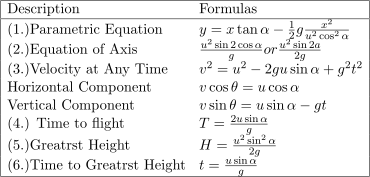
2.समस्याओं को हल करने के लिए मुख्य सूत्र (Key Formulas for Solving Problems):
3.प्रक्षेप्य गति:साधित अभ्यास पार्ट-4 (Projectile Motion:Solved Exercise Part-4):
Illustration:1.एक गोली v वेग से \alpha उन्नतांश पर फेंकी जाने पर,प्रक्षेप बिन्दु में होकर जाने वाले क्षैतिज तल पर एक बिन्दु P को टकराती है।यदि बिन्दु P,u वेग से बन्दूक की पीछे की तरफ हटता है,तो सिद्ध करो कि उन्नतांश \theta में परिवर्तित होगा,जहाँ
(A shot with a velocity v at an elevation \alpha strikes a point P on a horizontal plane through the point of projection.If the point P is receding from the gun with velocity u,show that the elevation must be changed to \theta ,where)
\sin 2 \theta=\sin 2 \alpha+\frac{2 u}{u} \sin \theta
Solution:यदि O प्रक्षेप बिन्दु है,तब प्रथम स्थिति में
OP=\frac{2(v \cos \alpha)(v \sin \alpha)}{g}=\frac{2 H \times v}{g}
द्वितीय स्थिति में जब बिन्दु P,u वेग से पीछे हटता है और उन्नतांश कोण \theta है,तब क्षैतिज घटक v \cos \theta-u जहाँ उर्ध्वाधर घटक v \sin \theta होगाः
\frac{2 v^2 \sin \alpha \cos \alpha}{g}=\frac{2 u^2 \sin \theta \cos \theta}{g}-\frac{2 u v \sin \theta}{g} \\ \Rightarrow v \sin 2 \alpha=u \sin 2 \theta-2 u \sin \theta \\ \Rightarrow \sin 2 \theta=\sin 2 \alpha+ \frac{2 u}{v} \sin \theta
Illustration:2.एक गोली V वेग से तथा \alpha उन्नतांश पर इस प्रकार दागी जाती है कि h ऊँचाई के खम्भे की चोटी पर बैठी चिड़िया से टकराती है।अब चिड़िया तुरन्त क्षैतिज की दिशा में बन्दूक से दूर v वेग से उड़ना चालू करती है।सिद्ध करो कि यह टकराने से नहीं बच सकती,यदि
(A shot is fired with velocity V at an elevation \alpha so as to hit a bird sitting at the top of a pole of height h.However the bird immediately starts flying horizontally away from the gun with velocity u,show that it will not escape being hit if)
(2 v \cos \alpha-v)\left(v^2 \sin ^2 \alpha+2 g h\right)^{\frac{1}{2}}=v \sin \alpha
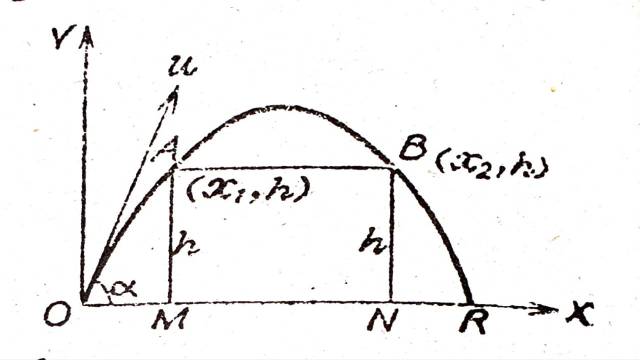
Solution:यदि गोली चिड़िया से टकरा जाती यदि वह स्थिर रहती,जब गोली दागी जाती है और गोली दागने के समय तो चिड़िया की स्थिति गोली दागने के पथ पर होनी चाहिए माना A\left(x_1 ,h \right) है।अब चिड़ियाँ उड़ती है और गोली B\left(x_2 ,h \right) पर टकराती है।यहाँ समय के मान है अतः A ऊँचाई पर गोली होगी
h=v \sin \alpha+t-\frac{1}{2} g t^2 \\ \Rightarrow g t^2-2 v \sin \alpha \cdot t+2 h=0
माना t_2 बड़ा मान है और t_1 छोटा मान है तब
धनात्मक के लिए t_2 , मान के लिए t_1
t=\frac{u \sin \alpha \pm \sqrt{v^2 \sin ^2 \alpha-2 g h}}{g} \\ t_2=\frac{u \sin \alpha+\sqrt{v^2 \sin ^2 \alpha-2 g h}}{g} \\ t_1=\frac{u \sin \alpha-\sqrt{v^2 \sin ^2 \alpha-2 g h}}{g} \\ t_2-t_1=\frac{2 \sqrt{v^2 \sin ^2 \alpha-2 g h}}{g} \cdots(2)
समय t_2 के दौरान गोली O से B जबकि चिड़ियाँ A से B को उड़ती है i.e. दूरी x_2-x_1 \\ \therefore x_2-x_1=v t_2 [जहाँ v चिड़िया का वेग है]
पुनः x_1=v \cos \alpha \cdot t_1 तथा x_2=v \cos \alpha \cdot t_2 \\ \Rightarrow x_2-x_1=4 \cos \alpha \left(t_2-t_1\right) \\=\frac{2 V \cos \alpha}{g}\left[V^2 \sin \alpha-2 g h\right]^{\frac{1}{2}}=\frac{v}{g}\left[v \sin \alpha + \sqrt{V^2 \sin ^2 \alpha-2 g h}\right] [(2) से]
\Rightarrow (2 V \cos \alpha-v)\left(V^2 \sin ^2 \alpha-2 g h\right)^{\frac{1}{2}}=Vv \sin \alpha
Illustration:3.एक पत्थर इस प्रकार फेंका जाता है कि एक पेड़ की चोटी पर बैठी चिड़िया को ठीक टकराता है तथा बाद में पेड़ की दुगुनी ऊँचाई तक पहुँचता है।यदि पत्थर चिड़िया पर फेंकने के क्षण पर चिड़िया क्षैतिज की दिशा में उड़ती है तो सिद्ध करो कि पत्थर,चिड़िया को टकरायेगा यदि इसका क्षैतिज वेग तथा चिड़िया के वेग का अनुपात (\sqrt{2}+1): 2 हो।
(A stone is thrown in such a manner that it would just hit a bird at the top of a tree and afterwards reach a height double that of the tree.If at the moment of throwing the stone the bird flies away horizontally,show that not withstanding this,the stone will hit the bird if its horizontal velocity be to that of the bird as (\sqrt{2}+1): 2 )
Solution:माना चिड़िया का क्षैतिज वेग v है।हम जानते हैं कि प्रक्षेप्य पथ की दो स्थितियाँ हैं जिस समय पत्थर समान ऊँचाई पर होगा।पत्थर चिड़िया से B’ पर टकरायेगा।जब पत्थर B पर है तो समय t_1 और B’ पर है तो समय t_2 है और इन स्थितियों की क्षैतिज दूरी चिड़िया द्वारा तय की गई BB’=b-a क्षैतिज वेग V के साथ।
\therefore (b-a)=V t_2 \cdots(1)
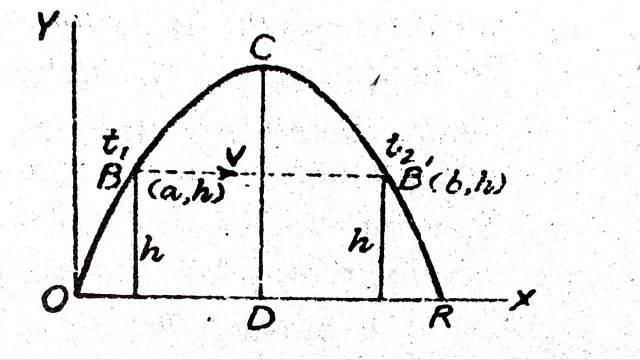
पुनः माना कि u और v पत्थर के क्षैतिज घटक हैं
\therefore a=u t_1 तथा b=u t_2 \\ \Rightarrow(b-a)=u\left(t_2-t_1\right) \cdots(2) \\ \Rightarrow u\left(t_2-t_1\right)=v t_2 [(1) व (2) से]
अभीष्ट अनुपात=\frac{\text{पत्थर का क्षैतिज वेग}}{\text{पक्षी का वेग}} \\ =\frac{u}{v}=\frac{t_2}{t_2-t_1} [(3) से] …..(4)
हमें व ज्ञात करना है।h ऊँचाई पर ये समय हैं और t_1 व t_2 द्विघात समीकरण h=v t-\frac{1}{2} g t^2 के मूल हैं (v वेग का उर्ध्वाधर घटक है।)
\Rightarrow g t^2-2 v t+2 h=0 \\ \Rightarrow t=\frac{v \pm \sqrt{\left(v^2-2 g h\right)}}{g}
पत्थर की अधिकतम ऊँचाई 2h है अर्थात् पेड़ से दुगुनी ऊँचाई है,हम प्राप्त करते हैं:
2h=\frac{v^2}{2 g} ; v^2=u g h \Rightarrow v=2 \sqrt{(g h)} \\ \therefore t=\frac{2 \sqrt{g h} \pm \sqrt{(2 g h)}}{g}=(2 \pm \sqrt{2}) \sqrt{\left(\frac{h}{g}\right)} \\ \therefore t_1=(2-\sqrt{2}) \sqrt{\left( \frac{h}{g}\right)} तथा t_2=(2+\sqrt{2}) \sqrt{\left(\frac{h}{g}\right)} \\ \left(t_2>t_1\right) \\ \therefore t_2-t_1=2 \sqrt{2} \sqrt{\left(\frac{h}{g}\right)}
(4) से:
\frac{u}{v}=\frac{t_2}{t_2-t_1}=\frac{2+\sqrt{2}}{2 \sqrt{2}}=\frac{(\sqrt{2}+1)}{2}
Illustration:4.कुछ कण एक ही बिन्दु से वह समान वेग से एक ही उर्ध्वाधर तल में एक साथ भिन्न-भिन्न दिशाओं में फेंके जाते हैं।सिद्ध करो कि सभी पथों की नाभियाँ एक ऐसे पथ पर स्थित हैं जिसका केन्द्र प्रक्षेप बिन्दु पर है।
(A number of projectiles are projected simultaneously from the same point with equal velocities in the same vertical plane in different directions. Prove that the foci of all the paths lie on a circle with the point of projection as centre.)
Solution:माना मूलबिन्दु प्रक्षेप बिन्दु है तो फोकस के निर्देशांक (x,y) है और क्षैतिज तथा उर्ध्वाधर अक्ष हैं तब
x=\frac{u^2 \sin \alpha \cos \alpha}{g}=\frac{1}{2} \frac{u^2 \sin 2 \alpha}{g} \cdots(1) \\ y=-\frac{u^2 \cos 2 \alpha}{2 g} \cdots(2)
दोनों में u समान है परन्तु अलग है अतः (1) व (2) से \alpha का विलोपन करने पर:
x^2+y^2=\frac{u}{4 g^2}\left(\sin ^2 2 \alpha+\cos ^2 2 \alpha\right) \\ \Rightarrow x^2+y^2=\frac{u^2}{4 g^2}
जो कि एक वृत्त है जिसका केन्द्र (0,0) है अर्थात् प्रक्षेप बिन्दु
Illustration:5.कुछ कण एक ही बिन्दु से एक ही उर्ध्वाधर तल में एक साथ फेंके जाते हैं।सिद्ध करो कि प्रक्षेप पथ की नाभि का बिन्दुपथ परवलय होगा,जबकि प्रत्येक प्रक्षेप पथ के लिए
(a)क्षैतिज वेग समान है,
(b)प्रारम्भिक उर्ध्वाधर वेग समान है,
(c)उड्डयन काल समान है।
(Particle are projected simultaneously in the same vertical plane from the same point.Show that the locus of the foci of all the trajectories is a parabola,when for each trajectory there is the same:
(a)Horizontal velocity,
(b)Initial vertical velocity,and
(c)Time of flight
Solution:उपर्युक्त उदाहरण के अनुसार नाभि के निर्देशांक हैं:
x=\frac{u^2 \sin \alpha \cos \alpha}{g} \\ y=-\frac{u^2}{2 g}\left(\cos ^2 \alpha-\sin ^2 \alpha\right)
(a)जब u \cos \alpha=k \\ \therefore \frac{g x}{k}=u \sin \alpha तथा 2 g y=-\left(k^2-u^2 \sin ^2 \alpha\right) \\ \Rightarrow 2 g y=-\left(k^2-\frac{g^2 x^2}{k^2}\right) \\ \Rightarrow x^2=\frac{2 k^2}{g}\left(y+\frac{k^2}{2 g}\right)
जो कि परवलय है।
(b)जब u \sin \alpha=k \\ x=\frac{u k \cos \alpha}{g} तथा y=-\frac{u^2}{2 g}\left(\cos ^2 \alpha-\frac{k^2}{u^2}\right) \\ \Rightarrow x \cos \alpha=\frac{g x}{k} तथा y=-\frac{1}{2 g}\left(u^2 \cos ^2 \alpha-k^2\right) \\ \Rightarrow y=-\frac{1}{2 g}\left(\frac{g^2 x^2}{k^2}-k^2\right) \\ \Rightarrow 2 g y=-\frac{g^2 x^2}{k^2}+k^2 \\ \Rightarrow \frac{g^2 x^2}{k^2}=k^2-2 g y \\ \Rightarrow x^2=\frac{k^2}{g^2} x-2 g\left(y-\frac{k^2}{2 g}\right) \\ \Rightarrow x^2=-\frac{2 k^2}{g}\left(y-\frac{k^2}{2 g}\right)
जो कि परवलय है।
(c)अब T=\frac{2 u \sin \alpha}{g}=\text { constant } \\ \therefore u \sin \alpha=k
अतः द्वितीय भाग की तरह परवलय होगा।
Illustration:7.सिद्ध करो कि दो दिये हुए बिन्दुओं से गुजरने वाले सारे प्रक्षेप पथों की नाभियों का बिन्दुपथ एक अतिपरवलय होगा।
(Prove that the locus of the foci of all trajectories passing through two given points is a hyperbola.)
Solution:माना कि परवलय दिए हुए बिन्दुओं P और Q से गुजरता है और S नाभि (focus) है।परिभाषा से हम जानते हैं कि किसी बिन्दु P की नियता (directrix) से दूरी PM ;नाभि (focus) S से दूरी PS के बराबर है।
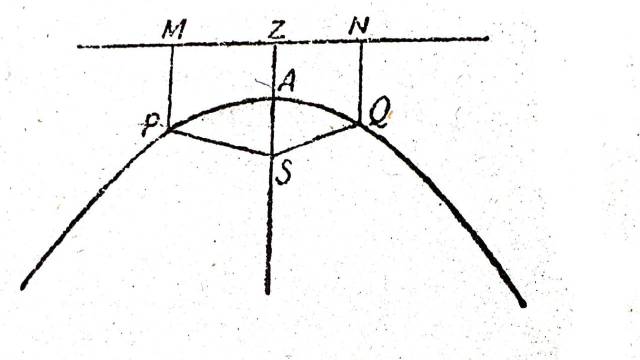
SP=PM और SQ=QN
SP-SQ=PM-QN=दो दिए गए बिन्दुओं के बीच उर्ध्वाधर दूरी
पुनः हम जानते हैं कि अतिपरवलय में नाभीय दूरी किसी दिए हुए बिन्दुओं से अन्तर समान है।यहाँ S ऐसा बिन्दु है जिसकी दो दिए हुए बिन्दुओं से दूरियों का अन्तर अचर है।अतः S का बिन्दुपथ अतिपरवलय है,जिसका नाभिचाप P और Q बिन्दुओं पर है।
उपर्युक्त उदाहरणों के द्वारा प्रक्षेप्य गति साधित समस्याएँ (Projectile Motion Solved Problems) को समझ सकते हैं।
4.छात्रों के लिए अभ्यास के सवाल (Practice Questions for Students):

(1.)एक प्रक्षेप्य को ऐसे कोण पर दागा जाता है कि अधिकतम ऊंचाई (H) और क्षैतिज परास (R) बराबर होती है।प्रक्षेपण कोण ज्ञात कीजिए। (संकेत \tan \theta=4) (A Projectile is fired at such as angle that the maximum height (H) and the horizontal range (R) are equal.Find the angle of projection.)
(Hint \tan \theta=4))
(2.) एक गेंद को क्षैतिज से 30° के कोण पर 20 m/s के वेग से फेंका जाता है। गणना करें:
(a) उड़ान का समय
(b) प्राप्त अधिकतम ऊँचाई (H)
A ball is threnen with a velocity of 20 m/s at an anale of 30° with the horizontal.Calculate
(a)The time of flight
(b)the manimum height attained(H) (Take g=10 m/s^2)
(3.)साबित करें कि किसी दिए गए वेग के लिए, क्षैतिज परास कोणों \theta और 90° के लिए समान है। यदि परास R_1 and R_2 क्रमशः 30° और 60° के लिए है, तो उनका अनुपात दिखाएं। (Prove that for a given velocity,the horizontal range is the same for angles \theta and 90°.If the range are R_1 और R_2 for 30° and 60° respectively,show their ratio.)
उपर्युक्त सवालों को हल करने पर प्रक्षेप्य गति साधित समस्याएँ (Projectile Motion Solved Problems) को ठीक से समझ सकते हैं।
Also Read This Article:- Projectile in Dynamics
5.प्रक्षेप्य गति साधित समस्याएँ (Frequently Asked Questions Related to Projectile Motion Solved Problems) से सम्बन्धित अक्सर पूछे जाने वाले प्रश्न:
प्रश्न:1.प्रक्षेप्य की अधिकतम परास कब होती है? (Projectile ki maximum range kab hoti hai?):
उत्तर:जब प्रक्षेप कोण 45° हो।
प्रश्न:2.क्या क्षैतिज वेग बदलता है? (Kya horizontal velocity badalti hai?):
उत्तर:नहीं,वायु के प्रतिरोध के बिना ये अचर रहती है।
प्रश्न:3.प्रक्षेप्य का प्रक्षेप पथ क्या है? (What is the trajectory of a parabola?):
उत्तर:यह हमेशा परवलय होता है।
प्रश्न:4.प्रक्षेप गति में क्षैतिज त्वरण कितना होता है? (Horizontal acceleration projectile motion mein kitni hoti hai?):
उत्तर:शून्य,क्योंकि सिर्फ गुरुत्वाकर्षण उर्ध्वाधर कम करती है।
उपर्युक्त प्रश्नों के उत्तर द्वारा प्रक्षेप्य गति साधित समस्याएँ (Projectile Motion Solved Problems) के बारे में और अधिक जानकारी प्राप्त कर सकते हैं।
| No. | Social Media | Url |
|---|---|---|
| 1. | click here | |
| 2. | you tube | click here |
| 3. | click here | |
| 4. | click here | |
| 5. | Facebook Page | click here |
| 6. | click here | |
| 7. | click here |
Projectile Motion Solved Problems
प्रक्षेप्य गति साधित समस्याएँ
(Projectile Motion Solved Problems)
Projectile Motion Solved Problems

प्रक्षेप्य गति साधित समस्याएँ (Projectile Motion Solved Problems) के इस आर्टिकल में
हम कुछ महत्त्वपूर्ण और जटिल सवालों को हल करेंगे।जैसा कि आपको ज्ञात होगा कि प्रक्षेप्य
गतिविज्ञान का महत्त्वपूर्ण टाॅपिक है।इस पार्ट-4 में कुछ हटकर सीखेंगे।




About Author

Satyam
Lekhak Ke Baare Mein (About the Author) **Satyam Narain Kumawat** **Website Name:Satyam Mathematics** *Owner:satyamcoachingcentre.in* *Sthan:Manoharpur,Jaipur (Rajasthan)* **Teaching Mathematics aur Anya Anubhav** ***Shiksha:**B.sc.,B.Ed.,(M.sc. star Ke Mathematics Ko Padhane ka Anubhav),B.com.,M.com. Ke vishayon Ko Padhane ka Anubhav,Philosophy,Psychology,Religious,sanskriti Mein Gahri Ruchi aur Adhyayan ***Anubhav:**phichale 23 varshon se M.sc.,M.com.,Angreji aur Vigyan Vishayon Mein Shikshaka Ka Lamba Anubhav ***Visheshagyata:*Maths,Adhyatma (spiritual),Yog vishayon ka vistrit Gyan* ****In Brief:I have read about M.sc. books,psychology,philosophy,spiritual, vedic,religious,yoga,health and different many knowledgeable books.I have about 23 years teaching experience upto M.sc. ,M.com.,English and science. Updated on 18.06.2026

