Simple Average of Price Relative Method
1.मूल्यानुपात सरल माध्य रीति (Simple Average of Price Relative Method),सरल समूही रीति से सूचकांक कैसे ज्ञात करें? (How to Find Index Number by Simple Aggregative Method?):

क्या आप मूल्य सूचकांक ज्ञात करने में कठिनाई महसूस करते हैं तो हम इस लेख में मूल्यानुपात सरल माध्य रीति (Simple Average of Price Relative Method) के द्वारा सरल तरीके से सूचकांक ज्ञात करना सीखेंगे।
Also Read This Article:- Correlation Examples with Solution in Statistics
2.मूल्यानुपात सरल माध्य रीति (Illustrations Based on Simple Average of Price Relative Method):
Illustration:1.निम्न आंकड़ों से सूचकांक निर्माण कीजिए।(i) 1968 को आधार वर्ष मानकर,(ii) 1975 को आधार-वर्ष मानकर और (iii) पहले पाँच वर्षों के औसत मूल्यों को आधार मानकर:
(Prepare index numbers from the following data taking (i) 1968 as base year,(ii) 1975 as base year and (iii) average of prices for first five years as base):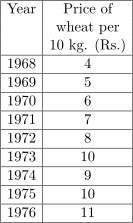
Solution:Calculation Table of Price Index
Similarly we find other price index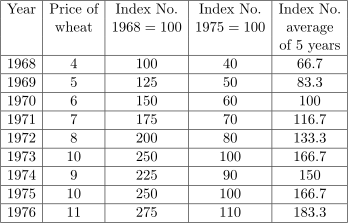
\text{ 1968 : for 1969 }= \frac{100}{4} \times 5 = 125 \\
\text{Similarly we find other price index} \\
1975 \text{ Base} = 100 \quad \text{Index No for 1968 }\\
=\frac{100}{10} \times 4 = 40 \\
\text{Average of first five year base} \\=\frac{4+5+6+7+8}{5} \\=\frac{30}{5} =6 \\ \text{Index Number for 1968}=\frac{100}{6} \times 4 \approx 66.7
Illustration:2.निम्न आंकड़ों से (i) सरल समूही रीति,और (ii) मूल्यानुपात माध्य रीति द्वारा 1970 के आधार पर 1976 के साधारण सूचकांकों की रचना कीजिए:
(From the following data,construct simple index numbers for 1976 taking 1970 as base year by (i) simple aggregative method and (ii) simple average of price relatives method):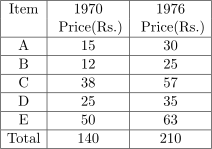
Solution:Calculation of Index Number (Simple Aggregative Method) (fixed base 1970=100)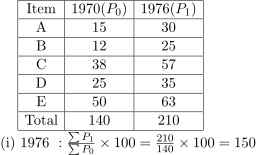
(ii)Simple Average of Price Relatives Method
R(\text{price relatives}) = \frac{\text{प्रचलित वर्ष का मूल्य}}{\text{आधार वर्ष का मूल्य}} \times 100 \\
= \frac{P_1}{P_0} \times 100 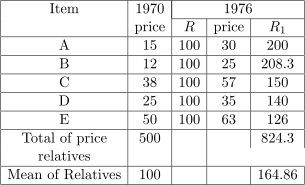
Illustration:3.1951 और 1955 में कुछ वस्तुओं के निम्नांकित मूल्यों से 1951 को आधार-वर्ष मानकर 1955 का मूल्य-सूचकांक परिगणित कीजिए:
(From the following data of commodity prices in 1951,compute the Index Number for 1955 with 1951 as base):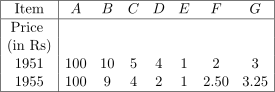
Solution:Simple Average of Price Relative Method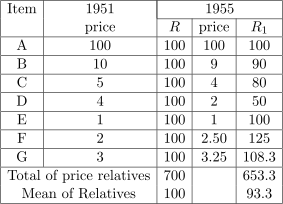
Illustration:4.1971 को आधार-वर्ष मानकर मूल्यानुपातों का (i) समान्तर माध्य,(ii) मध्यका,और (iii) गुणोत्तर माध्य प्रयोग करते हुए 1976 का मूल्य सूचकांक ज्ञात कीजिए।
(Calculate the index number for 1976 with 1971 as base year,using (1) arithmetic mean,(ii) median, and (iii) geometric mean of relatives):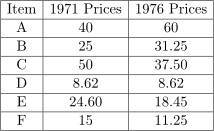
[B. Com.,Jabalpur,1962]
Solution:Calculation of Index Number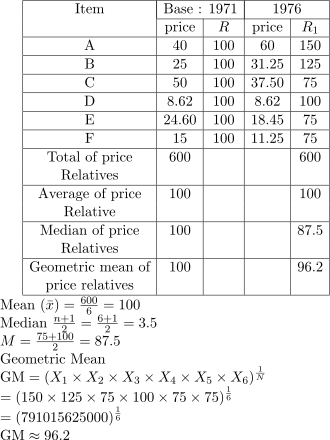
Example:5.निम्नलिखित आंकड़ों की सहायता से (ⅰ) 1971 को आधार-वर्ष मानकर,और (ii) तीनों वर्षों के औसत मूल्यों को आधार मानकर सूचकांकों की रचना कीजिए।
(With the help of following data,construct index numbers taking (i) 1971 as the base, (ii) average prices for 3 years as base):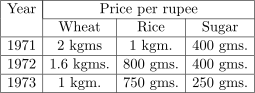
Solution: \frac{1}{2} \times 100 = 50 \text{ Rs. per quintel} \\
\frac{1}{1.6} \times 100 = 62.5 \text{ Rs. } \dots \\
1 \times 100 = 100 \text{ Rs. per quintel} \\
\text{Rice के मूल्य : } \frac{1}{1} \times 100 = 100 \text{ Rs. per quintel} \\
\frac{1000}{800} \times 100 = 125 \text{ Rs. per quintel} \\
\frac{1000}{750} \times 100 = 133.3 \text{ Rs. per quintel} \\
\text{Sugar के मूल्य :} \\
\frac{1000}{400} \times 100 = 250 \text{ Rs. per quintel} \\
\frac{1000}{400} \times 100 = 250 \text{ Rs. per quintel} \\
\frac{1000}{250} \times 100 = 400 \text{ Rs. per quintel}
Calculation Table of Index Number by Simple Average Price Relatives Method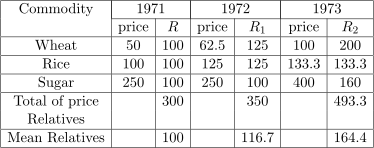
(ii)तीन वर्षों के औसत मूल्यों को आधार मानकर
Calculation of Index Number Taking Average Price=100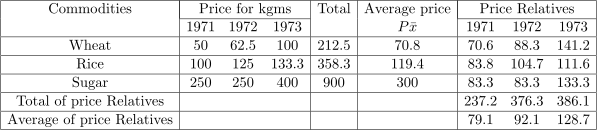
Illustration:6.माध्य मूल्यों को आधार मानकर तीन वर्षों के मूल्यों के सूचकांक बनाइए:
(Prepare price index numbers for the three years,taking average prices as base):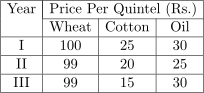
[B. Com.,Gorakhpur,1971]
Solution:Calculation Table of Index Number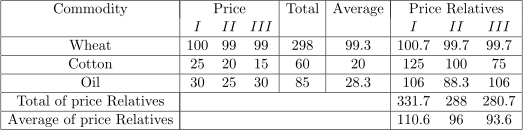
Illustration:7.निम्न सूचकांकों से नए सूचकांक ज्ञात कीजिए। (a) 1962 को आधार वर्ष मानकर,और (b) श्रृंखला आधार विधि द्वारा:
(From the following index numbers,construct new indices, (a) with 1962 as base year, and (b) by chain base method):
[B. Com.,Poona,1966]
Solution:Calculation Table of Index Number
Conversion from fixed base index number to chain index number (with 1962=100)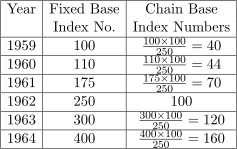
(b)by chain base method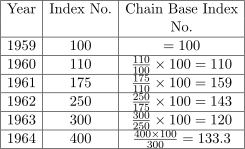
Illustration:7.1961,62 व 63 के लिए श्रृंखला आधार रीति द्वारा 1960 को आधार मानकर सूचकांक ज्ञात कीजिए:
(Prepare index numbers for 1961,62 and 63 chained to 1960, by chain base method):
[1.C.W.A.,1969]
Solution:Conversion from fixed base index number to chain index number (with 1960=100)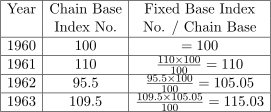
मूल्यानुपात सरल माध्य रीति भारित सूचकांक और श्रृंखला सूचकांक से तुलना (Simple Average of Price Relative Method in the Real World):
A.Real-World Uses
मुद्रास्फीति और बाजार के रुझान (Market Trends):जब अलग-अलग वस्तुओं के शुरुआती दाम बहुत भिन्न हों,तब बिना किसी जटिलता के यह देखना कि औसतन दामों में कितने प्रतिशत की वृद्धि या कमी आई है।
वित्तीय समीक्षा (Financial Snapshot):जहाँ विभिन्न उत्पादों के वजन (Weight/Importance) का डेटा उपलब्ध न हो, वहाँ त्वरित तुलना के लिए इसका प्रयोग किया जाता है।
B.Weighted Index Number और Chain Index Number से तुलना (Denomination Simple Average of Price Relative Method Comparison with Weighted Index Number and Chain Index Number):
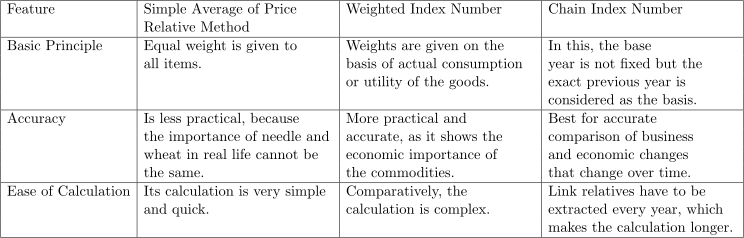
उपर्युक्त उदाहरणों के द्वारा मूल्यानुपात सरल माध्य रीति (Simple Average of Price Relative Method),सरल समूही रीति से सूचकांक कैसे ज्ञात करें? (How to Find Index Number by Simple Aggregative Method?) को समझ सकते हैं।
Also Read This Article:- Relative price
3.छात्र-छात्राओं के लिए मूल्यानुपात सरल माध्य रीति के प्रैक्टिस क्वेश्चंस (Practice Question of Simple Average of Price Relative Method for Students):

(1.)निम्न समंकों की सहायता से समंक श्रेणी A में 1996 व श्रेणी B में 2000 को तथा श्रेणी C में 2005 को आधार वर्ष मानते हुए मूल्य सूचकांक तैयार कीजिए:
(From the following data prepare index numbers of prices taking 1996 as base in series A 2000 as base in series B and 2005 as base in series C):
(2.)निम्न समंकों से (i)प्रथम पाँच वर्षों के आधार पर तथा (ii)दस वर्षों के औसत मूल्य के आधार पर सूचकांकों की परिगणना कीजिए:
(From the data given below,calculate index numbers taking (i)the average price of first five years as base, (ii)the average price of ten years as base):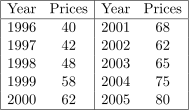
उत्तर (Answers):(1.)Series A:100,125,175,182,200,220,216,225,240,250,
Series B:75,90,70,95,100,110,125,135,150,175
Series C:43.4,50,52.4,58,61.2,81.4,81.8,91.4,97.4,100
(2.)(i)80,84,96,116,124,136,124,130,150,160
(ii)66.67,70,80,96.67,103.33,113.33,103.33,108.33,125.00,133.33
उपर्युक्त सवालों को हल करने पर आप मूल्यानुपात सरल माध्य रीति (Simple Average of Price Relative Method),सरल समूही रीति से सूचकांक कैसे ज्ञात करें? (How to Find Index Number by Simple Aggregative Method?) को अच्छी तरह से समझ सकते हैं क्योंकि स्वयं प्रैक्टिकल रूप से हल करने पर कांसेप्ट अच्छी तरह समझ में आती है।
### 📢 यदि आपको यह गणित का आर्टिकल पसंद आया हो:
* 👥 **मित्रों के साथ शेयर करें:** ज्ञान बांटने से बढ़ता है,इसलिए इसे अपने दोस्तों के साथ ज़रूर साझा करें।
* 🔔 **वेबसाइट को फॉलो करें:** अगर आप यहाँ पहली बार आए हैं, तो हमारे **ईमेल सब्सक्रिप्शन** को फॉलो करें।साथ ही, **Push Notification (घंटी के आइकॉन) को भी अलाउ (Allow) करें** ताकि हर नए ज़रूरी आर्टिकल और टेस्ट सीरीज़ का नोटिस आपके मोबाइल पर तुरंत मिल जाए!
* 💬 **अपने सुझाव दें:** यदि आपकी कोई समस्या है या कोई सुझाव देना चाहते हैं,तो नीचे **कमेंट** करके हमें ज़रूर बताएं।
**पूरा आर्टिकल पढ़ने के लिए आपका स्वागत है!** 🙏
Also Read This Article:- Correlation Coefficient by Karl Pearson:The Ultimate Guide with Formulas and Solved Examples
4.मूल्यानुपात सरल माध्य रीति (Frequently Asked Questions Related to Simple Average of Price Relative Method),सरल समूही रीति से सूचकांक कैसे ज्ञात करें? (How to Find Index Number by Simple Aggregative Method?) से सम्बन्धित अक्सर पूछे जाने वाले प्रश्न:
प्रश्न:1.सरल समूही विधि से सूचकांक ज्ञात करने का सूत्र लिखो। (Write a Formula to Find the Index Number Using Simple Aggregative Method):
उत्तर: P_{01} = \frac{\text{current year's aggregate}}{\text{base year's aggregate}} \times 100 \\ \Rightarrow P_{01} = \frac{\sum P_1}{\sum P_0} \times 100
P_{01}=आधार वर्ष (0) के मूल्यों के आधार पर प्रचलित वर्ष (1) के मूल्यों के सूचकांक है।
P_{1} =चालू वर्ष के मूल्य और
P_{0} =आधार वर्ष के मूल्य हैं।
प्रश्न:2.मूल्यानुपात सरल माध्य रीति से सूचकांक ज्ञात करने का सूत्र लिखो। (Write Formulas to Find the Index Number Using Simple Average of Price Method):
उत्तर:एक वर्षीय आधार
मूल्यानुपात= \frac{\text{प्रचलित वर्ष का मूल्य}}{\text{आधार वर्ष का मूल्य}} \times 100 \\
\Rightarrow R = \frac{P_1}{P_0} \times 100
माध्य अवधि आधार:मूल्यानुपात R = \frac{\text{चालू वर्ष का मूल्य}}{\text{औसत मूल्य}}\\ = \frac{P_1}{P_{\bar{x}}} \times 100
R = Price Relative मूल्यानुपात
P_1 = प्रचलित वर्ष के मूल्य (price for the current year)
P_0 = आधार वर्ष के मूल्य (price for base year)
P_{\bar{x}} = माध्य मूल्य (average price for base year)
प्रश्न:3.विभिन्न वस्तुओं के लिए सूचकांक
उत्तर: No. of current year=\frac{\Sigma R}{N}
उपर्युक्त प्रश्नों के उत्तर द्वारा मूल्यानुपात सरल माध्य रीति (Simple Average of Price Relative Method),सरल समूही रीति से सूचकांक कैसे ज्ञात करें? (How to Find Index Number by Simple Aggregative Method?) की प्राइमरी टर्म्स और सूत्रों के बारे में जान सकते हैं।
**छात्र-छात्राओं से आज का प्रश्न**
🎯विनर्स कॉर्नर:क्या आप इस सवाल का सही जवाब दे सकते हैं? अपने नाम के साथ नीचे कमेंट करें!सही जवाब देने वाले Top Students के नाम हमारी आगे post/is article ke update में Photo ya Special Mention के साथ publish की जाएगी। अपना जवाब अभी भी दर्ज करें!👇
*”किसी विद्यालय में विद्यार्थियों की 7,11 और 15 की टोलियाँ बनाने पर शेष क्रमशः 2,3 और 4 बचते हैं।विद्यालय में विद्यार्थियों की कुल संख्या क्या है?”*
**Today’s Question to Students**
*”If a school has groups of 7,11 and 15,the remaining 2, 3 and 4 are left respectively. What is the total number of students in the school?”*
*पिछली प्रश्नोत्तरी का उत्तर*
माना संख्या= x \\ x^2 \times 1 \frac{4}{5} = (\sqrt{x})^3 \\ \Rightarrow x^2 \times \frac{9}{5} = x^{\frac{3}{2}} \\
\Rightarrow x^{2 - \frac{3}{2}} = \frac{5}{9} \\ \Rightarrow x^{\frac{1}{2}} = \frac{5}{9} \\ \Rightarrow x = \frac{25}{81} \\ \frac{25}{81} \times \frac{81}{100} = 0.25 = \frac{1}{4}
**Previous Quiz Solution*
let Number= x \\ x^2 \times 1 \frac{4}{5} = (\sqrt{x})^3 \\ \Rightarrow x^2 \times \frac{9}{5} = x^{\frac{3}{2}} \\
\Rightarrow x^{2 - \frac{3}{2}} = \frac{5}{9} \\ \Rightarrow x^{\frac{1}{2}} = \frac{5}{9} \\ \Rightarrow x = \frac{25}{81} \\ \frac{25}{81} \times \frac{81}{100} = 0.25 = \frac{1}{4}
*”यह आर्टिकल **Satyam Mathematics** ब्लॉग पर **Satyam Coaching Centre** के द्वारा तैयार किया गया है।”*




About Author

Sanjay Kumawat
(1.)**Satyam Narain Kumawat** **Website Name:Satyam Mathematics** *Owner:satyamcoachingcentre.in* *Sthan:Manoharpur,Jaipur (Rajasthan)* **Teaching Mathematics aur Anya Anubhav** ***Shiksha:**B.sc.,B.Ed.,(M.sc. star Ke Mathematics Ko Padhane ka Anubhav),B.com.,M.com. Ke vishayon Ko Padhane ka Anubhav,Philosophy,Psychology,Religious,sanskriti Mein Gahri Ruchi aur Adhyayan ***Anubhav:**phichale 23 varshon se M.sc.,M.com.,Angreji aur Vigyan Vishayon Mein Shikshaka Ka Lamba Anubhav ***Visheshagyata:*Maths,Adhyatma (spiritual),Yog vishayon ka vistrit Gyan* ****In Brief:I have read about M.sc. books,psychology,philosophy,spiritual, vedic,religious,yoga,health and different many knowledgeable books.A dedicated math expert with 23+ years of teaching experience upto M.sc. ,M.com.,English and science.After guiding thousands of students through Satyam Coaching Center,now share Mathematics,Trigonometry (Upto M.sc) and Educational Strategies in simple language on this blog from December 2018.* (2.)**(Technical Expert & Co-Admin):** ***Name:Sanjay Kumawat* *Qualification:Graduate in Mechanical Engineering (B.Tec) in 2013* *Profession:Physics Lecturer* *Teaching Experience:15 Years and Teaching to NEET,JEE Students* *Technical Experience:5 Years Coding and Article Editing,Classic Photo Editing by Laptop in Satyam Coaching Centre Blog* *A school lecturer and digital content strategist.On this blog,he handles all the responsibility of coding,image editing,SEO, and technical management,so that the mathematical content reaches the readers in a very accurate and beautiful form.* Updated on 15.06.2026

