Properties of Absolute Values and Conjugates in Complex Numbers: Exercise Solutions
1.Properties of Absolute Values and Conjugates in Complex Numbers: Exercise Solutions
In this anticle,”Conjugates in Complex Numbers: Exercise Solutions”,we will solve questions of above topics.We will use properties of complex numbers to solve questions.
Theory (थ्योरी भाग):
Complex Analysis Chapter 1: Prove that by Contour Integration (Part 1)
Complex Analysis Chapter 1: Geometrical Construction of Complex Numbers on Argand Plane (Part 2)
Complex Analysis Chapter 1: Stereographic Projection and Inverse Points of Complex Numbers (Part 3)
Exercise (अभ्यास प्रश्न):
Complex Analysis Chapter 1: Complex Numbers Properties: Absolute Values and Conjugates Solved Problems (Part 1)
Also Read This Article:- Complex conjugate
2.Conjugates in Complex Numbers: Exercise Solutions
Example: 12. Find the locus of  , when
Example: 12(i). ![\arg\left[\left(\frac{z-1}{z+1}\right)\right]=\frac{\pi}{3}](https://www.satyamcoachingcentre.in/wp-content/ql-cache/quicklatex.com-ccf2477a4c8acbe63fe908fea7b14c4d_l3.svg "Rendered by QuickLaTeX.com")
Solution:
we have




After separating into real and imaginary parts![\arg\left(\frac{z-1}{z+1}\right)=\tan^{-1}\left[\frac{\frac{2y}{(x+1)^2+y^2}}{\frac{x^2+y^2-1}{(x+1)^2+y^2}}\right]](https://www.satyamcoachingcentre.in/wp-content/ql-cache/quicklatex.com-eeb534f3af2b4f708f81c44fe45ca985_l3.svg "Rendered by QuickLaTeX.com")
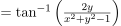
Hence 




which is the required locus and is a circle.
Example: 12(ii). 
Solution: 











which represents the interior and boundary of the circle 
Example: 12(iii). 
Solution: 





Putting 




which represents the interior of the curve 
Example: 13. Show that
all the numbers involved being complex.
Solution: Let  ,
,
![\frac{1}{2}[|z_1+z_2|^2+|z_1-z_2|^2]=|z_1|^2+|z_2|^2](https://www.satyamcoachingcentre.in/wp-content/ql-cache/quicklatex.com-7dbe47c414007a336f508ff35a475741_l3.svg "Rendered by QuickLaTeX.com") (By parallelogram law)
(By parallelogram law)




![[|z_1|+|z_2|]^2=|z_1|^2+|z_2|^2+2|z_1||z_2|](https://www.satyamcoachingcentre.in/wp-content/ql-cache/quicklatex.com-31fd8da93cf2cddfd7460c5d32cbd5cb_l3.svg "Rendered by QuickLaTeX.com")
 [From (1) and (2)]
 (using parallelogram law)
![=[|\alpha+\beta|+|\alpha-\beta|]^2](https://www.satyamcoachingcentre.in/wp-content/ql-cache/quicklatex.com-1b1c17531a792088d8ed8a3a2e65c008_l3.svg "Rendered by QuickLaTeX.com")


Example: 14. If  and
and  are complex numbers, find numbers
  and
and  so that
  and
and  are opposite vertices of a square.
Solution: Let be the point opposite vertices of a square.


Again,  is a square so that




From (1) and (2), we get



![\Rightarrow z=\frac{1}{2}[(a+b)\pm i(a-b)]](https://www.satyamcoachingcentre.in/wp-content/ql-cache/quicklatex.com-ba673286b8aca4d4519eeacac3d966a0_l3.svg "Rendered by QuickLaTeX.com")
![z_1=\frac{1}{2}[(a+b)+i(a-b)]](https://www.satyamcoachingcentre.in/wp-content/ql-cache/quicklatex.com-29d27af70b469aba38c29375ce023634_l3.svg "Rendered by QuickLaTeX.com")
The above two values of are the values of and .
Example: 15. Given a point  on the Riemann sphere of unit radius, find its corresponding point on the complex plane.
Solution: Let the sphere be
and the plane of projection be
Give be co-ordinates of any point  on the sphere and
  the co-ordinates of the corresponding point p* where the line NP* meets the plane of projection.
Since the points  and
and  are in a straight line, therefore we have

where  is a real number, but the point lies on a unit sphere, whose equation is given by (1), therefore
Solving for , we obtain
In view of (3), the complex number (x,y,0) on the plane is the point 
on the sphere. Rewriting (4), we identify the complex number  with the point
on the sphere. Also from (3) we have
and
Example: 16. On the Riemann sphere, what are the images of 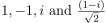 .
.
Solution: Image of 
Image of 
Image of 
Image of 
Example: 17. Show that a circle on the sphere that does not pass through the north pole corresponds to a circle in the complex plane.
Solution: Any circle on the Riemann sphere is the intersection of the unit sphere
with some plane:
In view of (5) in equation (6), the corresponding points of the plane satisfy the equation:
Equation (2) represents a circle if  and does not pass through north pole.
Example: 18. Show that a circle on the sphere passing through the north pole Complex plane.
Solution: Equation of unit circle
with some plane:
In view of (3) of question 16, if
then the plane (2) passes through the north pole (0,0,1).

Example: 19. Show that we may identify, by stereographic projection, the complex plane with the sphere
Solution: Consider a sphere in 3D space (u,v,w) or (x,y,z) tangent to the complex plane at the origin. Set the sphere equation such that its diameter corresponds to 1 along the vertical axis, giving the shifted circle/sphere equation:
(or in standard coordinates)
By projecting a point (x,y) from the complex plane through the north pole of this sphere onto the surface (u,v,w), algebraic substitution of the line equation mapping the north pole to the plane coordinates establishes this exact implicit quadratic locus.
Example: 20. Describe the stereographic projection of points on the unit sphere  in
in  to the extended complex plane under , show that under this projection, the point corresponds to the point
on the sphere. What corresponds on the sphere to
(i) straight lines in the -plane,
(ii) circles in the -plane with the origin as centre.
Solution: The line passing through  and
and  can be written in parametric form using a parameter
  :
:
Since the point lies on the unit sphere, its coordinates must satisfy the equation of the sphere.
Substitute the parametric forms of  and :
and :


since  (which represents the North pole itself), we can divide by :
Now substitute this value of back into the expressions for and :


Thus, the point corresponds to the point on the sphere:
Geometric corresponding geometric figures on the sphere
A general circle or straight line in the -plane can be represented by the equation
Using two coordinates, we can express  and
and  in terms of the spherical coordinates latex[/latex]:
Substituting these into the general equation.
yields the intersection of a plane with the sphere

This shows that all circles and lines in the plane correspond to circles to the sphere.
(1) Straight line passing through the origin in the -plane.
Equation in plane:

Equation on sphere: substituting into the plane formula gives
Geometric description: This is a vertical plane passing through the -axis. Its intersection with the sphere is a great circle passing through both the North pole (0,0,1) and the South pole (0,0,-1) .
(2) Circles in the -plane with the origin as center.
Equation in plane:
where 
Equation on sphere:



Geometric description:
since is a constant value between -1 and 1, this represents a plane parallel to the  -plane. Its intersection with the sphere is a horizontal circle (a parallel of latitude) that does not pass through the poles.
Example: 21. Write the equation of a straight line joining two points and of a complex plane.
Solution: Geometric condition for collinearity
Let be any arbitrary point lying on the straight line passing through the fixed points and .
For these three points to be collinear, the vector  must be a real multiple of the vector
  .
.
Mathematically, this means the ratio of these two complex numbers must be a purely real number.
Using complex conjugate properties, since a number is purely real if and only if it equals its own complex conjugate  , we can equate the expression to its conjugate: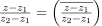
Distributing the conjugate operator over the division and subtraction gives: 
(3) Cross multiplication: Cross multiply the denominators to eliminate the fractions: 
(4) Cross-multiplication expansion: Expand both sides carefully: 
Since  appears identically on both sides of the equation, cancel it out:
(5) Grouping and Rearranging Move all terms to one side of the equation to match the form given in the textbook’s answers:
Group the terms by factoring out and  :
:
To exactly match the target signs, multiply the entire equation by  :
:

By solving the above examples,one can understand the Properties of Absolute Values and Conjugates in Complex Numbers: Exercise Solutions.
3.Practice Questions Conjugates in Complex Numbers: Exercise Solutions for Students
(1.)In an Argand plane the centre of the circle |4z-8+12i|=7 has the affix
(a) 2-3i (b) 8-12i (c) 2+3i (d) 8+12i
(2.)In an Argand plane the radius of the circle |5z+15-16i|=20 is
(a) 20 (b) 2 (c) 4 (d) 10
Answers: (1) (a) (2) (c)
By solving the above questions,you can understand the Properties of Absolute Values and Conjugates in Complex Numbers: Exercise Solutions well because the concept is well understood when you solve it practically.
4.Frequentaly Asked Questions Related to Properties of Absolute Values and Conjugates in Complex Numbers: Exercise Solutions
Q:1.Between what is the principal value of the argument number of a complex number?
Ans: -\pi < \theta \le \pi
Q:2.What is the argument of the complex number zero?
Ans:Undefined
Q:3.Is the angle of a complex number unique?
Ans:No
By answering the above questions,you can know about the primary terms of Properties of Absolute Values and Conjugates in Complex Numbers: Exercise Solutions.
5.छात्र-छात्राओं से आज का प्रश्न (Today’s Question to Students):
🎯 विनर्स कॉर्नर:क्या आप इस सवाल का सही जवाब दे सकते हैं?अपने नाम के साथ नीचे कमेंट करें!सही जवाब देने वाले Top Students के नाम हमारी आगे post/is article ke update में Photo ya Special Mention के साथ publish की जाएगी।अपना जवाब अभी दर्ज करें!👇
*”एक व्यक्ति का परिचय कराते हुए एक महिला ने कहा,”मेरी पुत्री इस व्यक्ति के पिता की एकमात्र पुत्री है।” वह व्यक्ति उस महिला से कैसे सम्बन्धित है?”*
(Introducing a man, a woman said, “My daughter is the only daughter of this man’s father.” How is the person related to the woman?)
*पिछली प्रश्नोत्तरी का हल*
माना तीसरे प्रकार की चीनी का मूल्य x रुपये प्रति किग्रा था
या 
या 
C की धनराशि
=54 रुपये
*Previous Quiz Solution*
Let the price of the third type of sugar be Rs. x per kg
or 
or
C’s amount
=Rs. 54
*”This article has been prepared by **Satyam Coaching Centre** on the **Satyam Mathematics** blog.”*
About Author

Sanjay Kumawat
(1.)**Satyam Narain Kumawat** **Website Name:Satyam Mathematics** *Owner:satyamcoachingcentre.in* *Sthan:Manoharpur,Jaipur (Rajasthan)* **Teaching Mathematics aur Anya Anubhav** ***Shiksha:**B.sc.,B.Ed.,(M.sc. star Ke Mathematics Ko Padhane ka Anubhav),B.com.,M.com. Ke vishayon Ko Padhane ka Anubhav,Philosophy,Psychology,Religious,sanskriti Mein Gahri Ruchi aur Adhyayan ***Anubhav:**phichale 23 varshon se M.sc.,M.com.,Angreji aur Vigyan Vishayon Mein Shikshaka Ka Lamba Anubhav ***Visheshagyata:*Maths,Adhyatma (spiritual),Yog vishayon ka vistrit Gyan* ****In Brief:I have read about M.sc. books,psychology,philosophy,spiritual, vedic,religious,yoga,health and different many knowledgeable books.A dedicated math expert with 23+ years of teaching experience upto M.sc. ,M.com.,English and science.After guiding thousands of students through Satyam Coaching Center,now share Mathematics,Trigonometry (Upto M.sc) and Educational Strategies in simple language on this blog from December 2018.* (2.)**(Technical Expert & Co-Admin):** ***Name:Sanjay Kumawat* *Qualification:Graduate in Mechanical Engineering (B.Tec) in 2013* *Profession:Physics Lecturer* *Teaching Experience:15 Years and Teaching to NEET,JEE Students* *Technical Experience:5 Years Coding and Article Editing,Classic Photo Editing by Laptop in Satyam Coaching Centre Blog* *A school lecturer and digital content strategist.On this blog,he handles all the responsibility of coding,image editing,SEO, and technical management,so that the mathematical content reaches the readers in a very accurate and beautiful form.* Updated on 15.06.2026

