Projectile Questions with Solution
1.प्रक्षेप्य सवाल हल सहित (Projectile Questions with Solution):
प्रक्षेप्य सवाल हल सहित (Projectile Questions with Solution) दिए जा रहे हैं।ये सवाल विशिष्ट प्रकार के हैं जिनके आधार पर प्रक्षेप्य पथ पर कण का समय,ऊँचाई और किसी समय पर उसका वेग तथा प्रक्षेप कोण ज्ञात करेंगे।
Also Read This Article:- Projectile Motion Solved Problems
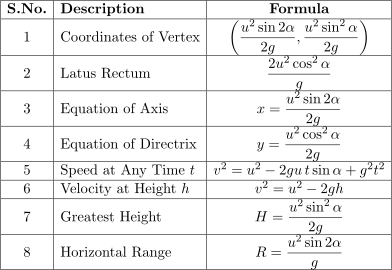
2.प्रक्षेप्य के महत्त्वपूर्ण सूत्रों की सारणी (Table of Important Formulae of Projectile):
3.प्रक्षेप्य गति:साधित अभ्यास पार्ट-5 (Projectile Motion:Solved Exercise Part-5):
Illustration:1.एक कण u वेग से तथा \alpha (<\frac{1}{4} T) उन्नतांश पर बिन्दु O से फेंका जाता है जो कि क्षैतिज तल से h ऊँचाई पर स्थित है।यदि कण t समय बाद तल को प्रक्षेप की दिशा के लम्बवत दिशा में गति करता हुआ टकराता है तो सिद्ध करो कि
t=\frac{u}{g\sin\alpha} तथा h=\frac{u^{2}\cos^{2}\alpha}{2g\sin^{2}\alpha}
(A particle is projected with velocity u and elevation \alpha (<\frac{1}{4} T) from a point O situated at a height h above the horizontal plane.If the particle is moving at right angles to the direction of projection when it hits the plane after time t,show that)
t=\frac{u}{g\sin\alpha} and h=\frac{u^{2}\cos^{2}\alpha}{2g\sin^{2}\alpha}
Solution:कण u वेग से \alpha कोण के साथ प्रक्षेपित किया जाता है।इसका किसी समय t पर प्रारम्भिक वेग
\vec{u}=u\cos\alpha \hat{i}+u\sin\alpha \hat{j}
पर उसी क्षण लम्बवत सदिश वेग \vec{v}=u\cos\alpha \hat{i}+(u\sin\alpha-gt) \hat{j}
इनका अदिश गुणनफल शून्य होना चाहिए
(u\cos\alpha \hat{i}+u\sin\alpha \hat{j})\cdot\left(u\cos\alpha\,\hat{i}+(u\sin\alpha-gt) \hat{j} \right)=0 \\ \Rightarrow u^{2}\cos^{2}\alpha+u^{2}\sin^{2}\alpha-ugt\sin\alpha=0 \\ \Rightarrow u^{2} (\cos^{2}\alpha+ \sin^{2}\alpha)-ugt\sin\alpha=0 \\ \Rightarrow u^{2}=ugt\sin\alpha \Rightarrow t=\dfrac{u}{g\sin\alpha}
ऊँचाई की गणना
y=u_y t-\frac{1}{2}gt^2
कण h ऊँचाई से प्रारम्भ होता है और क्षैतिज समतल पर टकराता है अतः विस्थापन (-h) होगाः
-h=(u\sin\alpha)t-\frac{1}{2}gt^2 \\ t=\frac{u}{g\sin\alpha} रखने पर
-h=(u\sin\alpha)\left(\frac{u}{g\sin\alpha}\right)-\frac{1}{2}g\left(\frac{u}{g\sin\alpha}\right)^2 \\ -h=\frac{u^2}{g}-\frac{u^2}{2g\sin^2\alpha} \\ h=\frac{u^2}{2g\sin^2\alpha}-\frac{u^2}{g} \\ h=\frac{u^2-2u^2\sin^2\alpha}{2g\sin^2\alpha} \\ =\frac{u^2(1-2\sin^2\alpha)}{2g\sin^2\alpha} \\ \frac{u^2(1-\sin^2\alpha-\sin^2\alpha)}{2g\sin^2\alpha} \\ =\frac{u^2(\cos^2\alpha-\sin^2\alpha)}{2g\sin^2\alpha} \\ =\frac{u^2\cos^2\alpha}{2g\sin^2\alpha}-\frac{u^2}{2g}
(एक विशिष्ट स्थिति पर \frac{u^2}{2g} शून्य हो जाएगा)
\therefore h=\frac{u^2\cos^2\alpha}{2g\sin^2\alpha}
Illustration:2.तीन कण एक साथ एक बिन्दु से u,v,w वेग से क्षैतिज के साथ (\alpha,\beta,\gamma) कोण बनाते हुए एक ही उर्ध्वाधर तल में फेंके जाते हैं।सिद्ध करो कि t समय पर कणों द्वारा बनाये गये त्रिभुज का क्षेत्रफल,प्रक्षेप के समय से बीते गये समय का वर्ग समानुपाती होता है।यह भी सिद्ध करो कि तीनों कण सदैव एक सरल रेखा में होंगे,यदि
(Three particle are projected simultaneously in the same vertical plane from the same point with velocities u,v,w making angles (\alpha,\beta,\gamma) with the horizontal;show that the area of the triangles formed by the time elapsed from the instant of projection.Also show that the three particles will always lie in the same straight line,if)
\frac{\sin(\beta-\gamma)}{u} +\frac{\sin(\gamma-\alpha)}{v}+\frac{\sin(\alpha-\beta)}{w}=0
Solution:यहाँ तीन कणों के प्रक्षेप के लिए माना तीनों कण t=0 पर मूलबिन्दु से फेंके जाते हैं।t समय पर,कणों के निर्देशांक (x,y) होंगे:
प्रथम कण:
x_1=(u\cos\alpha ) t \\ y_1=(u\sin\alpha)t-\frac{1}{2}gt^2
द्वितीय कण:
x_2=(v\cos\beta)t,\quad y_2=(v\sin\beta)t-\frac{1}{2}gt^2
तृतीय कण:
x_3=(w\cos\gamma)t,\quad y_3=(w\sin \gamma)t-\frac{1}{2}gt^2
सर्वप्रथम त्रिभुज का क्षेत्रफल समय के वर्ग (t^2) के समानुपाती सिद्ध करना है:
तीनों बिन्दुओं (x_1,y_1),(x_2,y_2) और (x_3,y_3) से बने त्रिभुज का क्षेत्रफल (Area):
A=\frac{1}{2} \left[ x_1(y_2-y_3) +x_2(y_3-y_1) +x_3(y_1-y_2)\right] \\ (x_1,y_1),(x_2,y_2) और (x_3,y_3) का मान रखने परः
y_2-y_3=t (v\sin\beta-w\sin\gamma) \\ y_1-y_2 =t (u\sin\alpha-v\sin\beta) \\ y_3-y_1 =t (w\sin\gamma-u\sin\alpha)
क्षेत्रफल के सूत्र में रखने परः
A=\frac{1}{2}t^{2}\Big[ u\cos\alpha\,(v\sin\beta-w\sin\gamma) +v\cos\beta\,(w\sin\gamma-u\sin\alpha) +w\cos\gamma\,(u\sin\alpha-v\sin\beta) \Big]
चूँकि कोष्ठक के अन्दर की सभी राशियाँ (u,v,w,\alpha,\beta,\gamma) स्थिर (Constant ) हैं इसलिए
Area=Ct^{2} जहाँ C एक स्थिर राशि है।
\Delta \propto t^{2}
अतः त्रिभुज का क्षेत्रफल समय के वर्ग (\Delta \propto t^{2}) के समानुपाती है।
द्वितीय भाग सिद्ध करने के लिए तीन बिन्दु समरेखीय (Collinear) होते हैं यदि त्रिभुज का क्षेत्रफल शून्य के बराबर है अतः A=0 रखने परः
u\cos\alpha\,(v\sin\beta-w\sin\gamma) +v\cos\beta\,(w\sin\gamma-u\sin\alpha) +w\cos\gamma\,(u\sin\alpha-v\sin\beta)=0 \\ \Rightarrow uv\cos\alpha\sin\beta -uw\cos\alpha\sin\gamma +vw \cos\beta\sin\gamma -uv\cos\beta\sin\alpha +uw\cos\gamma\sin\alpha -vw\cos\gamma\sin\beta =0 \\ \Rightarrow uv\cos\alpha\sin\beta -uv\sin\alpha\cos\beta+uw\sin\alpha\cos\gamma -uw\cos\alpha \sin\gamma +vw\cos\beta\sin\gamma -vw\cos\gamma\sin\beta =0 \\ \Rightarrow uv\sin(\beta-\alpha) -uw\sin(\gamma-\alpha) -vw\sin(\beta-\gamma) =0 \\ \Rightarrow uv\sin(\alpha-\beta) +uw\sin(\gamma-\alpha) +vw\sin(\beta-\gamma) =0
uvw का भाग देने पर
\frac{uv\sin(\alpha-\beta)}{uvw} +\frac{uw\sin(\gamma-\alpha)}{uvw} +\frac{vw\sin(\beta-\gamma)}{uvw} =0 \\ \frac{\sin(\beta-\gamma)}{u} +\frac{\sin(\gamma-\alpha)}{v} +\frac{\sin(\alpha-\beta)}{w}=0
अतः तीनों कण एक ही रेखा में हैं:
Illustration:3.यदि परवलयिक पथ के दो बिन्दुओं P तथा Q पर वेग v_1 तथा v_2 है,PT तथा QT इनके संगत स्पर्श रेखाएँ हैं तो सिद्ध करो कि
V_1:V_2 =PT:QT
(If v_1 and v_2 be the velocities at two points P and Q on a parabolic trajectory.PT and QT be the coressponding tangents,Prove that):
V_1:V_2 =PT:QT
Solution:प्रक्षेप्य गति में वेग का क्षैतिज घटक ( u \cos \theta) हमेशा स्थिर रहता है।यदि P पर कोण \theta_1 और Q पर कोण \theta_2 है,तो
v_1\cos\theta_1=v_2\cos\theta_2 \cdots(1)
ज्या नियम से \triangle PTQ में
\frac{PT}{\sin(\angle TQP)} = \frac{QT}{\sin(\angle TPQ)} \cdots(2)
चूँकि वेग का क्षैतिज घटक नियत रहता है तथा स्पर्श रेखाएँ वेग की दिशाओं को दर्शाती है अतः
\frac{V_1}{\sin(\angle TQP)} = \frac{V_2}{\sin(\angle TPQ)} \cdots(3)
(3) में (2) का भाग देने परः
\frac{V_1}{PT}= \frac{V_2}{QT} \\ \Rightarrow \frac{V_1}{V_2} = \frac{PT}{QT} \\ \Rightarrow V_1:V_2 =PT:QT
Illustration:4.एक गेंद इस प्रकार फेंकी जाती है कि वह दो दीवारों को ठीक पार कर सके,पहली a ऊँचाई की है तथा जिसकी प्रक्षेप बिन्दु से दूरी b है तथा दूसरी b ऊँचाई की है जिसकी प्रक्षेप बिन्दु से दूरी a है।सिद्ध करो कि क्षैतिज तल पर परास \frac{a^{2}+ab+b^{2}}{a+b} तथा प्रक्षेप कोण से बड़ा है।
(A ball is projected so as to just clear two walls,the first of height a and distance b from the point of projection and the second of height b and at a distance a from the point of projection.Show that the range on the horizontal plane is \frac{a^{2}+ab+b^{2}}{a+b} and the angle of projection exceeds.)
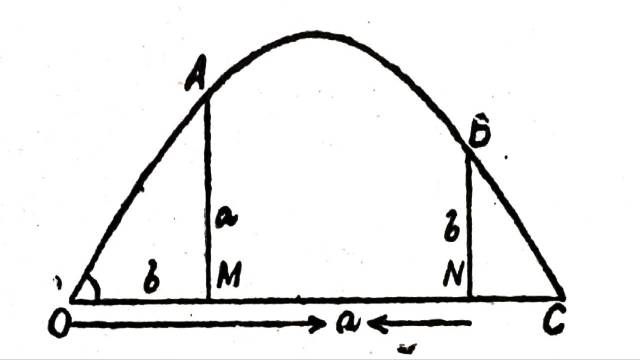
Solution:बिन्दु A और B के निर्देशांक क्रमशः (b,a) और (a,b) हैं तो ये प्रक्षेप पथ के समीकरण को सन्तुष्ट करेंगे:
y=x \tan \alpha-\frac{1}{2} g \frac{x^2}{u^2 \cos^2 \alpha} \\ \therefore 2au^{2}\cos^{2}\alpha =2b u^{2}\sin\alpha\cos\alpha - gb^{2} \cdots(1) \\ 2bu^{2}\cos^{2}\alpha = 2a u^{2}\sin\alpha\cos\alpha - ga^{2} \cdots(2)
(1) को b तथा (2) को a से गुणा करके घटाने पर:
2u^{2}\sin\alpha\cos\alpha (b^{2}-a^{2}) = g (b^{3}-a^{3}) \\ \Rightarrow \frac{2u^{2}\sin\alpha \cos\alpha}{g} =\frac{b^{3}-a^{3}}{b^{2}-a^{2}} =\frac{a^{2}+ab+b^{2}}{a+b}
जो कि क्षैतिज तल पर परास है अर्थात्
\Rightarrow \text{Range}=\frac{2u^{2}\sin\alpha\cos\alpha}{g}= \frac{a^{2}+ab+b^{2}}{a+b}
अब पुनः (1) को a^2 तथा (2) को b^2 से गुणा करके घटाने परः
2u^{2}\cos^{2}\alpha\,(a^{2}-b^{2})= 2u^{2}\sin\alpha\cos\alpha (a-b) ab \\ \Rightarrow \tan\alpha = \frac{a^{3}-b^{3}}{ab(a-b)} = \frac{a^{2}+ab+b^{2}}{ab} \\ \Rightarrow a^{2}+b^{2}\ge 2ab \\ \therefore \tan\alpha \ge \frac{2ab+ab}{ab} i.e. > 3 \\ \therefore \alpha \ge \tan^{-1}(3)
Illustration:5.एक गोली उन्नतांश पर दागी जाती है तब यह पाया जाता है कि वह प्रक्षेप बिन्दु से गुजरने वाले क्षैतिज तल पर खड़ी मीनार के पाद से टकराती है।यदि मीनार द्वारा इस बिन्दु पर अन्तरित कोण \theta हो,तो सिद्ध करो कि गोली को मीनार की चोटी से टकराने के लिए \frac{1}{2} \left[\theta + \sin^{-1} \left( \sin\theta+\sin2\alpha \cos\theta \right) \right] उन्नतांश की आवश्यकता पड़ेगी।
(A shot fired at an elevation is observed to strike the foot of a tower which rises a horizontal plane through the point of projection.If \theta be the angle subtended by the tower at this points,show that the elevation required to make the shot strike the top of the tower is \frac{1}{2} \left[\theta + \sin^{-1} \left( \sin\theta+\sin2\alpha \cos\theta \right) \right]
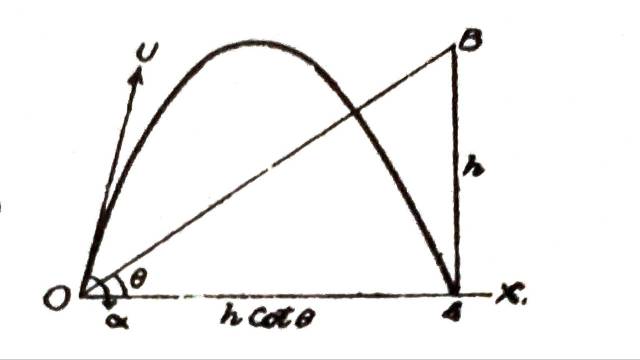
Solution:परास OA=h\cot\theta \\ \therefore \quad \frac{u^{2}\sin 2\alpha}{g} = h\cot\theta \\ \Rightarrow u^{2}\sin 2\alpha = gh\cot\theta \\ \Rightarrow u^{2} = \frac{gh\cot\theta}{\sin 2\alpha}
माना कि नया प्रक्षेप कोण है ताकि गोली शीर्ष (h\cot\theta,h) पर टकराती है।
पथ का समीकरण
y=x\tan\beta-\frac{g\,x^{2}}{2u^{2}\cos^{2}\beta} तथा P इस पर स्थित है।
h=h\cot\theta\,\tan\beta -\frac{1}{2}g \frac{h^{2}\cot^{2}\theta}{\cos^{2}\beta} \left( \frac{\sin2\alpha}{gh\cot\theta} \right) [ (1) से ]
1=\frac{\cos\theta \sin\beta}{\sin\theta \cos\beta}-\frac{\cos \theta \sin2\alpha}{2\sin\theta \cos^{2}\beta} \\ \therefore 2\cos^{2}\beta \sin\theta =2\cos\theta \sin\beta \cos\beta-\cos\theta \sin2 \alpha \\ \cos\theta \sin2\alpha= 2\cos\beta \left( \sin\beta\,\cos\theta -\cos\beta \sin\theta \right) \\ = 2\cos\beta\,\sin(\beta-\theta)=\sin(2\beta-\theta)-\sin\theta \\ \therefore \sin(2\beta-\theta)= (\sin\theta+\sin2\alpha \cos\theta) \\ \therefore \beta =\frac{1}{2} \left[\theta + \sin^{-1} \left( \sin\theta+\sin2\alpha \cos\theta \right) \right]
Illustration:6.एक त्रिभुज APB जो P पर समकोणिक है,AB क्षैतिज अवस्था में तथा P सबसे ऊपर की ओर एक उर्ध्वाधर समतल में रखा है।एक कण A से इस प्रकार फेंका जाता है जो ठीक P तथा B में होकर जाता है।सिद्ध करो कि प्रक्षेप कोण \alpha तथा वेग u निम्न द्वारा दिये जाते हैं।जहाँ AB=c तथा त्रिभुज की ऊँचाई p है:
(A triangle right angled at P is placed in a vertical plane with AB horizontal and P upper most.A particle fired from A passed exactly through P and B.Show that the angle of projection \alpha and velocity u are given by)
\tan\alpha=\frac{c}{p},\quad u^{2}=\frac{g(c^{2}+p^{2})}{2p}
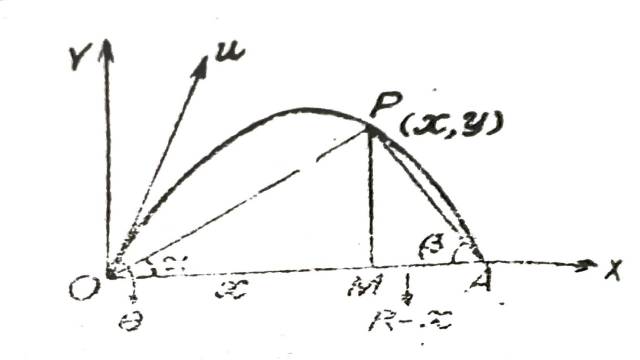
Solution:माना u प्रारम्भिक वेग तथा \alpha प्रक्षेप कोण है
P(x,y) शीर्ष है तब
y=p तथा R=c= PM+MA
OM=x,AM=R-x=p \cot (90-\theta)
AM=p \tan \theta [ P( p \cot \theta,p) है]
MP=y
\tan \theta + \tan \beta=\frac{y}{x}+\frac{y}{R-x}=\frac{y}{x} \cdot \frac{R}{R-x}
पथ पर (x,y) कोई बिन्दु है:
y=x\tan \alpha -\frac{1}{2}g\frac{x^{2}}{u^{2}\cos^{2}\theta} \\ \therefore \frac{y}{x}= \tan \alpha -\frac{1}{2}g\frac{x}{u^{2}\cos^{2} \alpha} \\ \Rightarrow \frac{y}{x}=\tan \alpha \left[ 1-\frac{gx}{u^{2}\sin \alpha \cos \alpha} \right] \\ \Rightarrow \frac{y}{x}= \tan \alpha \left[ 1-\frac{2gx}{u^{2}\sin2\theta} \right] \\ \Rightarrow \frac{y}{x}= \tan\theta \left[ 1-\frac{x}{R} \right], \qquad \left( R=\frac{u^{2}\sin2 \alpha}{g} \right) \\ \therefore \frac{y}{x}\cdot\frac{R}{R-x} = \tan \alpha \cdots(1)
जब x=p\cot\theta ,y=p तथा R=PM+MA
\Rightarrow c = p\cot\theta + p\tan\theta=\sin \theta \cos \theta
(1) से
\tan\alpha = \frac{p}{p\cot\theta} = \frac{c}{p\tan\theta} = \frac{c}{p} \cdots(2) \\ R = \frac{u^{2} \sin2\alpha}{g} = \frac{u^{2}}{g} \frac{2\tan\alpha}{1+\tan^{2}\alpha} \\ \\ \Rightarrow c = \frac{u^{2}}{g} \frac{2cp}{c^{2}+p^{2}} [(2) से]
\therefore u^{2} = \frac{g\,(c^{2}+p^{2})}{2p}
Illustration:7.h ऊँचाई से एक पत्थर u वेग से फेंका जाता है जिससे वह प्रक्षेप बिन्दु की सतह पर इससे क्षैतिज दूरी R पर एक बिन्दु से टकराता है।सिद्ध करो कि प्रक्षेप कोण निम्न से दिया जाता है:
(A stone is projected with velocity u from a height h to hit a point in the level at a horizontal distance R from the point of projection.Show that the angle of projection is given by
R^{2}\tan^{2}\alpha -\frac{2u^{2}}{g}\,R\tan\alpha +R^{2} -\frac{2hu^{2}}{g} = 0
अतः निगमन करो कि इस वेग के लिए सतह पर अधिकतम परास \sqrt{\left(\dfrac{u^{4}}{g^{2}}+\dfrac{2hu^{2}}{g}\right)} होगा तथा यदि अधिकतम परास R’ व अधिकतम परास के लिए \alpha प्रक्षेप कोण हो,तो
\tan\alpha=\frac{u^{2}}{gR^{\prime}} तथा \tan 2\alpha=\frac{R^{\prime}}{h} आगे,यदि u=\sqrt{2ag} ,सिद्ध करो कि R^{\prime}=\sqrt{a(a+h)} तथा \tan \alpha=\sqrt{\frac{a}{a+h}}
Hence deduce that the maximum range on the level for this velocity is \sqrt{\left(\dfrac{u^{4}}{g^{2}}+\dfrac{2hu^{2}}{g}\right)} and that if R’ is the maximum range and \alpha the angle of projection to give the maximum range,then \tan\alpha=\frac{u^{2}}{gR^{\prime}} and \tan 2\alpha=\frac{R^{\prime}}{h}. Further,if u=\sqrt{2ag} ,prove that R^{\prime}=\sqrt{a(a+h)} and \tan \alpha=\sqrt{\frac{a}{a+h}}
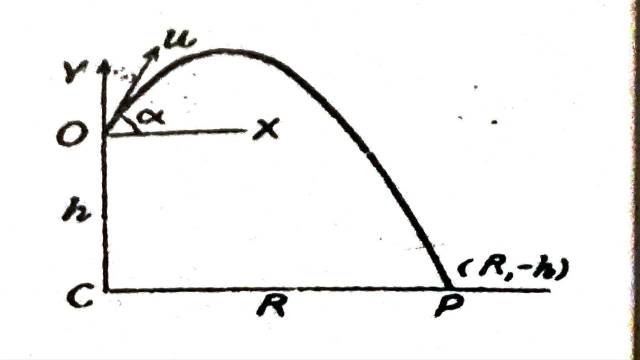
Solution:यदि पत्थर P पर टकराता है तो P के निर्देशांक O मूलबिन्दु के सापेक्ष (R,-h) है जो पथ पर स्थित है जिसकी समीकरण है
y=x\tan\alpha-\frac{1}{2}g \frac{x^{2}}{u^{2}\cos^{2}\alpha} \\ \therefore\quad -h =R\tan\alpha -\frac{1}{2}g \frac{R^{2}}{u^{2}} \left(1+\tan^{2}\alpha\right) \\ \therefore R^{2}\tan^{2}\alpha -\frac{2u^{2}}{g} R\tan\alpha +R^{2} -\frac{2hu^{2}}{g} = 0 \cdots(1)
ऊपर की समीकरण से प्रक्षेप कोण ज्ञात कर सकते हैं।अधिकतम परास के लिए (1) का \alpha के सापेक्ष अवकलन करने परः
\frac{dR}{d \alpha}=0 तब R=Max.
\therefore\quad R'^2 (2\tan\alpha \sec^2\alpha) -\frac{2u^2}{g} R'\sec^2\alpha =0 \\ \therefore \frac{2R' \sec^2\alpha}{g} \left( gR'\tan\alpha-u^2 \right) =0 \\ \therefore \tan\alpha = \frac{u^2}{gR'} \cdots(2)
समीकरण (1) में \tan \alpha का मान रखने परः
R'^2 \left( \frac{u^2}{gR'} \right)^2 -\frac{2u^2}{g} R' \left( \frac{u^2}{gR'} \right) +R'^2 -\frac{2hu^2}{g} =0 \\ \therefore R'^2 = \frac{u^4}{g^2} +\frac{2hu^2}{g} \\ \therefore R' = \sqrt{ \frac{u^4}{g^2} +\frac{2hu^2}{g} } \cdots(3)
पुनः \tan 2\alpha = \frac{2\tan\alpha}{1-\tan^{2}\alpha} \\= \frac{2\left(\dfrac{u^{2}}{gR'} \right)}{1-\left( \dfrac{u^{2}}{gR'} \right)^{2}} \ = \frac{2u^{2}(gR')}{g^{2}R'^{2}-u^{4}} \\ = \frac{2u^{2}gR'}{g^{2} \left(\dfrac{u^{4}}{g^{2}}+\dfrac{2hu^{2}}{g}\right)-u^{4}} \\ =\frac{2u^{2}gR'}{2ghu^{2}} \\ \therefore \tan 2\alpha = \frac{R'}{h}
यदि u=\sqrt{2ag} हो तो
\tan\alpha = \frac{u^{2}}{gR'} = \frac{2ag}{gR'} = \frac{2a}{R'} \\ \tan 2\alpha=\frac{R'}{h} \\ \frac{2\tan\alpha}{1-\tan^2\alpha}= \frac{R'}{h} \\ \Rightarrow \frac{2\left(\dfrac{2a}{R'}\right)} {1-\dfrac{4a^2}{R'^2}}=\frac{R'}{h} \\ \Rightarrow \frac{4aR'}{R'^2-4a^2}= \frac{R'}{h} \\ \Rightarrow 4ah = R'^2-4a^2 \\ \Rightarrow R'^2 = 4a^2+4ah = 4a(a+h) \\ \therefore R'=2\sqrt{a(a+h)} \\ \tan\alpha = \frac{2a}{R'} = \frac{2a}{2\sqrt{a(a+h)}} = \frac{a}{\sqrt{a(a+h)}} = \sqrt{\frac{a}{a+h}} \\ \therefore \tan\alpha=\sqrt{\frac{a}{a+h}}
उपर्युक्त प्रश्नों के उत्तर द्वारा प्रक्षेप्य सवाल हल सहित (Projectile Questions with Solution) के बारे में और अधिक जानकारी प्राप्त कर सकते हैं।
### 📢 यदि आपको यह गणित का आर्टिकल पसंद आया हो:
* 👥 **मित्रों के साथ शेयर करें:** ज्ञान बांटने से बढ़ता है,इसलिए इसे अपने दोस्तों के साथ ज़रूर साझा करें।
* 🔔 **वेबसाइट को फॉलो करें:** अगर आप यहाँ पहली बार आए हैं, तो हमारे **ईमेल सब्सक्रिप्शन** को फॉलो करें ताकि हर नए आर्टिकल का नोटिफिकेशन आपको तुरंत मिले।
* 💬 **अपने सुझाव दें:** यदि आपकी कोई समस्या है या कोई सुझाव देना चाहते हैं,तो नीचे **कमेंट** करके हमें ज़रूर बताएं।
*पूरा आर्टिकल पढ़ने के लिए आपका वेलकम है!*
Also Read This Article:- Projectiles
4.प्रक्षेप्य सवाल हल सहित (Projectile Questions with Solution) से सम्बन्धित अक्सर पूछे जाने वाले प्रश्न:
प्रश्न:1.उच्चतम ऊँचाई पर वेग का उर्ध्वाधर घटक क्या होता है? (What is the vertical component of velocity at the greatest height?):
उत्तर:उच्चतम ऊँचाई पर वेग का उर्ध्वाधर घटक शून्य होता है।
प्रश्न:2.क्या नियता का समीकरण एल्फा पर निर्भर होता है? (Does the equation of directrix depend on alpha?):
उत्तर:नियता का समीकरण प्रक्षेप कोण से स्वतन्त्र होता है। y=\frac{u^2}{2g}
प्रश्न:3.एक कण क्षैतिज से 30° पर प्रक्षेपित किया जाता है जिसका वेग 1962 cm/sec है।उड्डयन काल है:(A particle is project at an angle 30° to the horizon with a velocity of 1962 cm/sec.The time of flight is):
उत्तर: (a) 1 sec (b) 2 sec (c) 2.5 sec (d) 3 sec
Students Se Ek Sawal
“Questions number 3 ko hal aapke anusar kya hoga.Iske char option diye gaye hai.aapake anusar konasa uttar hoga? Comment karake batayein.”
उपर्युक्त प्रश्नों के उत्तर द्वारा प्रक्षेप्य सवाल हल सहित (Projectile Questions with Solution) के बारे में और अधिक जानकारी प्राप्त कर सकते हैं।
| No. | Social Media | Url |
|---|---|---|
| 1. | click here | |
| 2. | you tube | click here |
| 3. | click here | |
| 4. | click here | |
| 5. | Facebook Page | click here |
| 6. | click here |
Projectile Questions with Solution
प्रक्षेप्य सवाल हल सहित
(Projectile Questions with Solution)
Projectile Questions with Solution
प्रक्षेप्य सवाल हल सहित (Projectile Questions with Solution) दिए जा रहे हैं।ये सवाल
विशिष्ट प्रकार के हैं जिनके आधार पर प्रक्षेप्य पथ पर कण का समय,ऊँचाई और किसी
समय पर उसका वेग तथा प्रक्षेप कोण ज्ञात करेंगे।



About Author

Sanjay Kumawat
(1.)**Satyam Narain Kumawat** **Website Name:Satyam Mathematics** *Owner:satyamcoachingcentre.in* *Sthan:Manoharpur,Jaipur (Rajasthan)* **Teaching Mathematics aur Anya Anubhav** ***Shiksha:**B.sc.,B.Ed.,(M.sc. star Ke Mathematics Ko Padhane ka Anubhav),B.com.,M.com. Ke vishayon Ko Padhane ka Anubhav,Philosophy,Psychology,Religious,sanskriti Mein Gahri Ruchi aur Adhyayan ***Anubhav:**phichale 23 varshon se M.sc.,M.com.,Angreji aur Vigyan Vishayon Mein Shikshaka Ka Lamba Anubhav ***Visheshagyata:*Maths,Adhyatma (spiritual),Yog vishayon ka vistrit Gyan* ****In Brief:I have read about M.sc. books,psychology,philosophy,spiritual, vedic,religious,yoga,health and different many knowledgeable books.A dedicated math expert with 23+ years of teaching experience upto M.sc. ,M.com.,English and science.After guiding thousands of students through Satyam Coaching Center,now share Mathematics,Trigonometry (Upto M.sc) and Educational Strategies in simple language on this blog from December 2018.* (2.)**(Technical Expert & Co-Admin):** ***Name:Sanjay Kumawat* *Qualification:Graduate in Mechanical Engineering (B.Tec) in 2013* *Profession:Physics Lecturer* *Teaching Experience:15 Years and Teaching to NEET,JEE Students* *Technical Experience:5 Years Coding and Article Editing,Classic Photo Editing by Laptop in Satyam Coaching Centre Blog* *A school lecturer and digital content strategist.On this blog,he handles all the responsibility of coding,image editing,SEO, and technical management,so that the mathematical content reaches the readers in a very accurate and beautiful form.* Updated on 15.06.2026

