Illustrations of Contour Integration
1.परिरेखा समाकलन के उदाहरण का परिचय (Introduction to Illustrations of Contour Integration),परिरेखा समाकलन (Contour Integration):

परिरेखा समाकलन के उदाहरण (Illustrations of Contour Integration) के इस आर्टिकल में परिरेखा समाकलन के द्वारा सवालों को सिद्ध करेंगे और उनका अध्ययन करेंगे।
आपको यह जानकारी रोचक व ज्ञानवर्धक लगे तो अपने मित्रों के साथ इस गणित के आर्टिकल को शेयर करें।यदि आप इस वेबसाइट पर पहली बार आए हैं तो वेबसाइट को फॉलो करें और ईमेल सब्सक्रिप्शन को भी फॉलो करें।जिससे नए आर्टिकल का नोटिफिकेशन आपको मिल सके।यदि आर्टिकल पसन्द आए तो अपने मित्रों के साथ शेयर और लाईक करें जिससे वे भी लाभ उठाए।आपकी कोई समस्या हो या कोई सुझाव देना चाहते हैं तो कमेंट करके बताएं।इस आर्टिकल को पूरा पढ़ें।
Also Read This Article:- Roots of Equation in Complex Analysis
2.परिरेखा समाकलन के उदाहरण (Illustrations of Contour Integration):
Illustration:1.यदि a>0,सिद्ध करें कि (If a>0,Prove that)
\int_0^{\infty} \frac{d x}{\left(x^2+a^2\right)^2}=\frac{\pi}{4 a^3}
Solution: \int_c f(z) d z=\int_c \frac{dz}{\left(a^2+z^2\right)^2}
जहाँ C परिरेखा है जिसमें त्रिज्या R के एक बड़े अर्ध-वृत्त \Gamma के साथ -R से R तक वास्तविक अक्ष है।
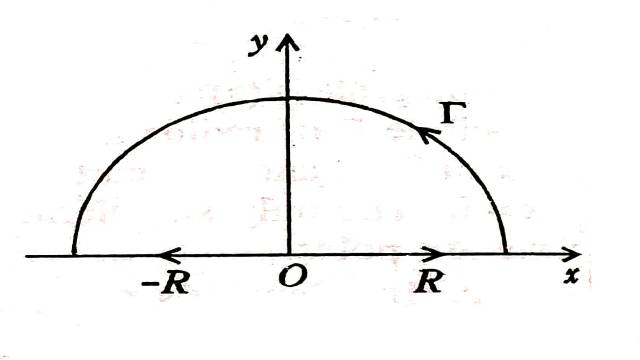
z=ai,-ai द्वितीय क्रम के f(z) के अनन्तक हैं।
इनमें से केवल C के अन्दर स्थित हैं।
z=ai पर अवशेष हैः
\phi^{\prime}(a i)=\left[\frac{d}{d z}(z+a i)^{-2}\right]_{z=a i} \\ = \left[-2(z+a i)^{-3}\right]_{z=a i}=\frac{1}{4 a^3 i}
कोशी अवशेष प्रमेय द्वारा
\int_c f(z) d z=\int_{-R}^R \frac{d x}{\left(a^2+x^2\right)^2}+\int_{\Gamma} \frac{d z}{\left(a^2 +z^2\right)^2}=2 \pi i \Sigma R^{+} \cdots(1) \\ \underset{R \rightarrow \infty}{\lim} z f(z)=\lim _{z \rightarrow \infty} \frac{z}{\left(a^2+z^2\right)^2}=0 \\ \underset{R \rightarrow \infty}{\lim} \int_{\Gamma} \frac{d z}{\left(a^2+z^2\right)^2}=0
तथा \underset{R \rightarrow \infty}{\lim} \int_{-R}^R \frac{d x}{\left(a^2+x^2\right)^2}=\int_{-\infty}^{\infty} \frac{d x}{\left(a^2+x^2\right)^2}
इस प्रकार सम्बन्ध (1) सेः
\int_{-\infty}^{\infty} \frac{d x}{\left(a^2+x^2\right)^2}=2 \int_0^{\infty} \frac{d x}{\left(a^2 +x^2\right)^2} \\ =2 \pi i \cdot \frac{1}{4 a^3 i}=\frac{\pi}{2 a^3} \\ \Rightarrow \int_0^{\infty} \frac{d x}{\left(a^2+x^2\right)^2}=\frac{\pi}{4 a^3}
Illustration:2.सिद्ध कीजिए कि (Prove that)
\int_{-\infty}^{\infty} \frac{d x}{\left(x^2+1\right)^3}=\frac{3 \pi}{8}
Solution:माना \int_C f(z) d z=\int_c \frac{d z}{\left(z^2+1\right)^3}
जहाँ C परिरेखा है जिसमें त्रिज्या R के एक बड़े अर्ध-वृत्त \Gamma के साथ -R से R तक वास्तविक अक्ष है।
कोशी अवशेष प्रमेय द्वारा
\int_C f(z) d z=\int_{-R}^R f(x) d x+\int_{\Gamma} f(z) d z=2 \pi i \Sigma R^{+} \\ \underset{R \rightarrow \infty}{\lim} z f(z)=\underset{R \rightarrow \infty}{\lim} \frac{z}{\left(z^2+1\right)^3}=0
इसलिए R \rightarrow \infty \int_{\Gamma} f(z) d z=0
z =\pm i तीन कोटि का f(z) के अनन्तक हैं।केवल z=i,C के अन्दर स्थित है।
z=i पर अवशेष=\frac{1}{2 i} \phi^{\prime \prime}(i) जहाँ \phi(z)=\frac{1}{(z+i)^3} \\ =\left[\frac{1}{2 i} \cdot \frac{12}{(z+i)^5}\right]_{z=i} \\ =\frac{3}{16 i}
इस प्रकार सम्बन्ध (1) सेः
\int_{-\infty}^{\infty} \frac{d x}{\left(1+x^2\right)^3}=2 \pi i \cdot \frac{3}{16 i}=\frac{3 \pi}{8}
Illustration:3.मान ज्ञात करें (Evaluate)
\int_0^{\infty} \frac{x^2}{\left(1+x^2\right)} d x
Solution:समाकलन पर विचार करें
\int_C f(z) d z=\int_C \frac{z^2}{\left(1+z^2\right)^3} d z
जहाँ C परिरेखा है जिसमें त्रिज्या R के एक बड़े अर्ध-वृत्त \Gamma के साथ -R से R तक वास्तविक अक्ष है।
कोशी अवशेष प्रमेय द्वारा
\int_C f(z) d z=\int_{-R}^R \frac{ x^2}{\left(1+x^2\right)^3} d x+\int_{\Gamma} \frac{z^2 d z}{\left(1+z^2\right)^3}=2 \pi i \Sigma R^{+} \cdots(1) \\ \underset{R \rightarrow \infty}{\lim} z f(z)=\underset{R \rightarrow \infty}{\lim} z \cdot \frac{z^2}{\left(1+z^2\right)^3}=0 \\ \underset{R \rightarrow \infty}{\lim} \int_{\Gamma} \frac{z^2}{\left(1+z^2\right)^3} d z=0
z =\pm i कोटि 3 का f(z) के अनन्तक हैं।इनमें से केवल z=i, C के अन्दर स्थित है।
z=i पर अवशेष=\frac{1}{2!} \phi^{\prime \prime}(i) \\ =\frac{1}{2!}\left[\frac{d^2}{d z^2} \frac{z^2}{(z+i)^3}\right]_{z=i} \\ =\frac{1}{2} \cdot \frac{4}{32 i}=\frac{1}{16 i}
इस प्रकार सम्बन्ध (1) सेः
\int_{-\infty}^{\infty} \frac{x^2}{\left(1+x^2\right)^3} d x=2 \pi i \times \frac{1}{16 i} = \frac{\pi}{8} \\ 2 \int_0^{\infty} \frac{x^2}{\left(1+x^2\right)^3} d x=\frac{\pi}{8} \\ \Rightarrow \int_0^{\infty} \frac{x^2}{\left(1+x^2\right)^3} d x=\frac{\pi}{16}
Illustration:4.दर्शाइए कि (Show that)
\int_{-\infty}^{\infty} \frac{x^2 d x}{\left(x^2+1\right)\left(x^2+4\right)}=\frac{\pi}{3}
Solution: \int_C f(z) d z=\int_C \frac{z^2}{\left(z^2+1\right)\left(z^2+4\right)} d z
जहाँ C परिरेखा है जिसमें त्रिज्या R के एक बड़े अर्ध-वृत्त \Gamma के साथ -R से R तक वास्तविक अक्ष है।
कोशी अवशेष प्रमेय द्वारा
\int_C f(z) d z=\int_{-R}^R \frac{x^2}{\left(x^2+1\right)\left(x^2+4\right)} d x+\int_{\Gamma} \frac{z^2}{\left(z^2+1\right)(z+4)} d z = 2 \pi i \Sigma R^{+} \cdots(1) \\ \underset{R \rightarrow \infty}{\lim} z f(z)=\underset{Z \rightarrow \infty}{\lim} z \cdot \frac{z^2}{\left(z^2+1\right) \left(z^2+4\right)}=0
Z= \pm i, \pm 2 i , f(z) के साधारण अनन्तक हैं।इनमें से z=i,2i, C के अन्दर स्थित हैं।
z=i पर अवशेष
\underset{z \rightarrow i}{\lim} f(z)=\underset{z \rightarrow i}{\lim} \frac{z^2}{(z+i) \left(z^2+4\right)}=-\frac{1}{6 i}
z=2i पर अवशेष
\underset{z \rightarrow 2i}{\lim}(z-2 i) f(z)=\underset{z \rightarrow 2i}{\lim} \frac{z^2}{\left(z^2 +1\right)(z+2 i)} \\ =\frac{1}{3 i}
C के अन्दर अनन्तकों पर अवशेषों का योग=-\frac{1}{6 i}+\frac{1}{3 i}=\frac{1}{6 i}
इस प्रकार सम्बन्ध (1) सेः
\int_{-\infty}^{\infty} \frac{x^2}{\left(x^2+1\right)\left(x^2+4\right)} d x=2 \pi i \cdot \frac{1}{6 i} =\frac{\pi}{3}
Illustration:5.सिद्ध करो कि (Prove that)
\int_0^{\infty} \frac{d x}{x^4+1}=\frac{\pi \sqrt{2}}{4}
Solution:\int_C f(z) d z=\int_C \frac{d z}{z^4+1} समाकल पर विचार करें
जहाँ C परिरेखा है जिसमें त्रिज्या R के एक बड़े अर्ध-वृत्त \Gamma के साथ -R से R तक वास्तविक अक्ष है।
कोशी अवशेष प्रमेय द्वारा
\int_C f(z) d z=\int_{-R}^R \frac{d x}{x^4+1}+\int_{\Gamma} \frac{d z}{z^4+1}=2 \pi i \Sigma R^{+} \\ \underset{R \rightarrow \infty}{\lim} z f(z)=0 \\ \Rightarrow \underset{R \rightarrow \infty}{\lim} \frac{d z}{z^4+1}=0
अतः \underset{R \rightarrow \infty}{\lim} \int_{-R}^R \frac{d x}{x^4+1}=2 \pi i \Sigma R^{+} \\ \Rightarrow \int_{-\infty}^{\infty} \frac{d x}{x^4+1}=2 \pi i \Sigma R^{+} \cdots(1)
f(z) के अनन्तक दिए जाते हैं: z^4+1=0 \\ \Rightarrow z=e^{(2 n+1) \frac{\pi i}{4}} जहाँ n=0,1,2,3
z=e^{\frac{i \pi}{4}}, e^{\frac{3 i \pi}{4}}, e^{\frac{5 i \pi}{4}}, e^{\frac{7 i \pi}{4}}, f(z) के साधारण अनन्तक हैं।
इनमें से z=e^{\frac{i \pi}{4}}, e^{\frac{i 3 \pi}{4}} ,C के अन्दर स्थित हैं।
यदि इनमें से किसी अनन्तक को दर्शाता है तो पर अवशेष है:
\underset{Z \rightarrow \infty}{\lim}(z-\alpha) f(z)=\underset{Z \rightarrow \infty}{\lim} \frac{z-\alpha}{z^4+1}\left[\frac{0}{0}\text { ( रूप) }\right] \\ =\underset{Z \rightarrow \alpha}{\lim} \frac{1}{4 z^3}=\frac{1}{4 \alpha^3}=\frac{\alpha}{4 \alpha^4}=-\frac{\alpha}{4}\left[\alpha^4=-1\right]
C के अन्दर अनन्तकों पर अवशेषों का योग
=-\frac{1}{4}\left[e^{\frac{i \pi}{4}}+e^{\frac{i 3 \pi}{4}}\right] \\ =-\frac{1}{4} \cdot \frac{2 i}{\sqrt{2}}=-\frac{i \sqrt{2}}{4}
इस प्रकार सम्बन्ध (1) सेः
\int_{-\infty}^{\infty} \frac{d x}{x^4+1}=2 \pi i\left(-\frac{i \sqrt{2}}{4}\right)=\frac{\pi \sqrt{2}}{2} \\ \Rightarrow \int_0^{\infty} \frac{d x}{x^4+1}=\frac{\pi \sqrt{2}}{4}
Illustration:6.यह सिद्ध करने के लिए परिरेखा समाकलन विधि का उपयोग करें
(Use the method of contour integration to the that)
\int_0^{\infty} \frac{x^6}{\left(x^4+4\right)^2} d x=\frac{3 \pi \sqrt{2}}{16 a}, a>0
Solution:समाकल पर विचार करें
\int_C f(z) d z=\int_C \frac{z^6}{\left(z^4+a^4\right)^2} d z
जहाँ C परिरेखा है जिसमें त्रिज्या R के एक बड़े अर्ध-वृत्त \Gamma के साथ -R से R तक वास्तविक अक्ष है।
कोशी अवशेष प्रमेय द्वारा
\int_C f(z) d z=\int_{-R}^R \frac{x^6}{\left(x^4+a^4\right)^2} d x+\int_{\Gamma} \frac{z^6}{\left(z^4+a^2\right)^2} d z=2 \pi i \Sigma R^{+}
अतः \underset{Z \rightarrow \infty}{\lim} \int_{-R}^R \frac{x^6}{\left(x^4+a^4\right)^2} d x=2 \pi i \Sigma R^{+} \\ \Rightarrow \int_{-\infty}^{\infty} \frac{x^6}{\left(x^4+a^4\right)^2} d x=2 \pi i \Sigma R^{+} \cdots(1)
f(z) के द्विक अनन्तक है जो दिए जाते हैं:
\left(z^4+a^4\right)^2=0 \\ \Rightarrow z=a(-1)^{\frac{1}{4}}=a e^{\frac{(2 n+1)i \pi }{4}}, n=0,1,2,3
इनमें से z=a e^{i \frac{\pi}{4}}, a e^{i \frac{3 \pi}{4}} द्विक अनन्तक C के अन्दर स्थित हैं।माना इनमें से इनमें से किसी भी अनन्तक को निरूपित करता है।
z=\alpha+t ,f(z) में रखकर और t की घातों में विस्तार करने पर:
f(\alpha+t)=\frac{(\alpha+t)^6}{\left[a^4+(\alpha+t)^4\right]^2} \\ =\frac{(\alpha+t)^6}{\left(a^4+\alpha^4+4 \alpha^3 t+6 \alpha^2 t^2+\cdots\right)^2} \\ =\frac{(\alpha+t)^6}{16 \alpha^6 t^2}\left[1+\frac{3 t}{2 \alpha } +\cdots\right]^{-2}[\because \alpha^4+a^4=0] \\ =\frac{\left(\alpha^6+6 \alpha^5 t+\cdots\right)(1-\frac{3t}{\alpha} +\cdots)}{16 \alpha^6 t^2}
अब z=\alpha पर अवशेष f(\alpha+t) में \frac{1}{t} का गुणांक है जो है
\frac{1}{16 \alpha^6}\left(6 \alpha^5-3 \alpha^5\right)=\frac{3}{16 \alpha}
C के अन्दर f(z) के द्विक अनन्तकों पर अवशेषों का योग
=\frac{3}{16 a}\left(e^{-\frac{i\pi}{4}}+e^{- \frac{i 3 \pi}{4}}\right) \\ =\frac{3}{16}\left(-2 i \sin \frac{\pi}{4}\right)=-\frac{3 i}{8 a \sqrt{2}}
इस प्रकार सम्बन्ध (1) सेः
\int_{-\infty}^{\infty} \frac{x^6}{\left(x^4+a^4\right)^2} dx=2 \pi i\left(-\frac{3 i}{8 a \sqrt{2}}\right) \\ \Rightarrow \int_0^{\infty} \frac{x^6}{\left(x^4+a^4\right)^2} d x=\frac{3 \pi \sqrt{2}}{16 a}
Illustration:7.दर्शाइए कि यदि m और n धनात्मक पूर्णांक हैं और m<n
(Show that if m and n are positive integers and m<n)
\int_0^{\infty} \frac{x^{2 m}}{x^{2 n}+1} d x=\frac{\pi}{2 n \sin \left(\frac{2 m+1}{2 n}\right) \pi}
Solution: \int_C f(z) d z=\int_C \frac{z^{2 m}}{z^{2 n}+1} d z पर विचार करें
जहाँ C परिरेखा है जिसमें त्रिज्या R के एक बड़े अर्ध-वृत्त \Gamma के साथ -R से R तक वास्तविक अक्ष है।
कोशी अवशेष प्रमेय द्वारा
\int_C f(z) dz=\int_{-R}^R \frac{x^{2 m}}{x^{2 n}+1} d x+\int_{\Gamma} \frac{z^{2 m}}{z^{2 n}+1} d z=2 \pi i \Sigma R^{+}
चूँकि m और n धनात्मक पूर्णांक हैं और m < n इसलिए 2m < 2n अर्थात् 2m,2n से कम से कम 2 कम है ताकि
\underset{R \rightarrow \infty}{\lim} z f(z)=0, \underset{R \rightarrow \infty}{\lim}\int_{\Gamma} \frac{z^{2 m}}{z^{2 n}+1} d z=0 \\ \therefore \underset{R \rightarrow \infty}{\lim} \int_{-R}^R \frac{x^{2^m}}{x^{2 n}+1} d x=2 \pi i \Sigma R^{+} \\ \Rightarrow \int_{-\infty}^{\infty} \frac{x^{2 m}}{x^{2 n}+1} d x=2 \pi i \Sigma R^{+} \cdots(1)
z^{2 n}+1=0 हल करने परः
z=e^{ \frac{(2 r+1) \pi i}{2 n}} जहाँ r=0,1,2,3….., 2n-1
इस प्रकार z=e^{\frac{(2 \gamma+1) \pi i}{2 n}}, r=0,1,2, \cdots , 2 n-1
f(z) के 2n साधारण अनन्तक है
इनमें C प्रथम n अनन्तक स्थित हैं:
माना इन n अनन्तकों में से कोई एक \alpha को प्रदर्शित करता है।
z=\alpha पर अवशेष:
\left[\frac{z^{2 m}}{D\left(z^{2 n}+1\right)}\right]_{z=\alpha} =\frac{\alpha^{2 m}}{2 n\left(2^{2 n-1}\right)} \\ =\frac{\alpha^{2 m+1}}{2 \alpha 2^{2 n}} \\ =-\frac{\alpha^{2 m+1}}{2 n} जहाँ \alpha^{2 n}=-1
C के अन्दर अनन्तकों पर अवशेषों का योग
=-\frac{1}{2 n}\left(\alpha_1^{2 m+1}+\alpha_2^{2 m+2}+\cdots+\alpha^{2 m+n}\right) \\ =-\frac{1}{2 n}\left[e^{i \theta}+e^{3 i \theta}+\cdots+e^{(2 n-1) i \theta}\right] जहाँ \theta=\frac{2 m+1}{2 n} \pi \\ =-\frac{1}{2 n} e^{i \theta} \cdot \frac{1-e^{2 n i \theta}}{1-e^{2 i \theta}} [ sum of G.P.]
=-\frac{1}{2 n} \cdot \frac{e^{i \theta}\left(1-e^{2 n i \theta}\right)\left(1-e^{-2 i \theta}\right)}{\left(1-e^{2 i \theta}\right)\left(1-e^{-2 i \theta}\right)} \\ =-\frac{1}{2 n} \cdot \frac{e^{i \theta}-e^{(2 n+1) i \theta}-e^{-i \theta}+e^{(2 n-1)\theta} }{2-2 \cos 2 \theta} \\ =-\frac{1}{2 n} \cdot \frac{2 i \sin \theta-e^{2 n i \theta} 2 i \sin \theta}{4 \sin ^2 \theta} \\ =-\frac{1}{2 n} \cdot \frac{i(1-\cos 2 n \theta-i \sin 2 n \theta)}{2 \sin \theta} \\ =-\frac{1}{4 n \sin \theta} \cdot i\left(2 \sin ^2 n \theta-2 i \sin n \theta \cos n \theta \right) \\ =-\frac{1}{2 n} \cdot \frac{\sin n \theta}{\sin \theta} \left( \cos n \theta+i \sin n \theta\right) \\ =-\frac{i}{2 n} \cdot \frac{\sin^2 n \theta}{\sin \theta} \left[\cos n \theta=\cos \left(\frac{2 n+1}{2 n}\right) n \pi=0\right] \\ =-\frac{i}{2 n \sin \theta}\left[\sin ^2 n \theta=\left(\sin \frac{2 m+1}{2} \pi\right)^2=\left[(-1)^m\right]^2=1\right]
इस प्रकार सम्बन्ध (1) सेः
\int_{-\infty}^{\infty} \frac{x^{2 m}}{1+x^{2 n}} d x=2 \pi i \Sigma R^{+} \\ \Rightarrow \int_{-\infty}^{\infty} \frac{x^{2 m}}{1+x^{2 n}} d x=2 \pi i\left(-\frac{i}{2 n \sin \theta}\right) \\ \Rightarrow \int_0^{\infty} \frac{x^{2 m}}{1+x^{2 n}} d x=\frac{\pi}{2 n \sin \left(\frac{2 m+1}{2 n}\right) \pi}
Illustration:8.परिरेखा समाकलन द्वारा सिद्ध करें कि
(Prove by contour integration that)
\int_0^{\infty} \frac{d x}{\left(a+b x^2\right)^n}=\frac{1}{2^n b^{\frac{1}{2}}} \cdot \frac{1 \cdot 3 \cdot 5 \cdots(2 n-3)}{1 \cdot 2 \cdot 3 \cdots(2 n-1)} \cdot \frac{1}{a^{\frac{n-1}{2}}}
Solution: \int_c \frac{d z}{\left(a+b z^2\right)^n}=\int_C f(z) d z समाकल पर विचार करें
जहाँ C परिरेखा है जिसमें त्रिज्या R के एक बड़े अर्ध-वृत्त \Gamma के साथ -R से R तक वास्तविक अक्ष है।
कोशी अवशेष प्रमेय द्वारा
\int_C f(z) d z=\int_{-R}^R \frac{d x}{\left(a+b x^2\right)^n}+\int_{\Gamma} \frac{d z}{(a+b z)^n}=2 \pi i \Sigma R^{+} \\ \underset{R \rightarrow \infty}{\lim} z f(z)=0 \\ \therefore \underset{R \rightarrow \infty}{\lim} \int_{\Gamma} \frac{d z}{\left(a+b z^2\right)^n}=0 \\ \underset{R \rightarrow \infty}{\lim} \int_{-R}^R \frac{d x}{\left(a+b x^2\right)^n}=2 \pi i \Sigma R^{+} \\ \Rightarrow \int_{-\infty}^{\infty} \frac{d x}{\left(a+b x^2\right)^n}=2 \pi i \Sigma R^{+} \cdots(1)
z= \pm i \sqrt{\left(\frac{a}{b}\right)} , n कोटि के f(z) के अनन्तक हैं।
z=\sqrt{\left(\frac{a}{b}\right) i}, C के अन्दर स्थित हैं।
z=i \sqrt{\left(\frac{a}{b}\right)} पर अवशेष
=\frac{1}{(n-1)!}\left[D^{n-1} \frac{1}{b^n\left[z+i \cdot \sqrt{\left(\frac{a}{b}\right)}\right]^n} \right]_{z=\sqrt{\frac{a}{b}} i} \\ =\frac{1}{(n-1)!} \cdot \frac{1}{b^n}\left[\frac{(-n)(-n-1) \cdots-[-n-(n-1)+1]}{\left[z+i \sqrt{\left(\frac{a}{b}\right)}\right]}\right]_{z=i \sqrt{\frac{a}{b}}} \\ =\frac{(-1)^{n-1}}{(n-1)!b^n} \cdot \frac{n(n+1) \cdots(2 n-2)}{\left[2 i \cdot \sqrt{\left(\frac{a}{b}\right)}\right]^{2 n-1}} \\ =\frac{(-1)^{n-1} 1 \cdot 2 \cdot 3 \cdots(n-1) \cdot n(n-1) \cdots(2 n-2)}{2^{2 n-1} \cdot \left[ \sqrt{\frac{a}{b}}\right]^{2 n-1} i^{2 n-1} b^n \cdot (n-1)! (n-1)!} \\ =-\frac{1 \cdot 3 \cdot 5 \cdots(2 n-3) \cdot 2^{n-1} \cdot 1 \cdot 2 \cdot 3 \cdots (n-1)}{2^{2 n-1} \cdot a^{n-\frac{1}{2}} b^{\frac{1}{2}} \cdot (n-1)! \cdot (n-1)!} \\ =-\frac{1 \cdot 3 \cdot 5 \cdots (2 n-3) i}{2^n a^{n-\frac{1}{2}} b^{\frac{1}{2}} \cdot 1 \cdot 2 \cdot 3 \cdots (n-1)}
इस प्रकार सम्बन्ध (1) सेः
\int_{-\infty}^{\infty} \frac{d x}{\left(a+b x^2\right)^n}=\frac{\pi}{2^n a^{\frac{n-1}{2}} b^{\frac{1}{2}}} \cdot \frac{1 \cdot 3 \cdot 5 \cdots(2 n-3)}{1 \cdot 2 \cdot 3 \cdots (n-1)}
उपर्युक्त उदाहरणों के द्वारा परिरेखा समाकलन के उदाहरण (Illustrations of Contour Integration),परिरेखा समाकलन (Contour Integration) को समझ सकते हैं।
3.परिरेखा समाकलन के उदाहरण के सवाल (Illustrations of Contour Integration Question):

प्रदर्शित करो कि (Show that)
\int_0^{\infty} \frac{x^6}{\left(x^4+1\right)^2} d x=\frac{3 \pi \sqrt{2}}{16}
उपर्युक्त सवाल को हल करने पर परिरेखा समाकलन के उदाहरण (Illustrations of Contour Integration),परिरेखा समाकलन (Contour Integration) को ठीक से समझ सकते हैं।
Also Read This Article:- Examples of Contour Integration
4.परिरेखा समाकलन के उदाहरण (Frequently Asked Questions Related to Illustrations of Contour Integration),परिरेखा समाकलन (Contour Integration) से सम्बन्धित अक्सर पूछे जाने वाले प्रश्न:
प्रश्न:1.अवशेष ज्ञात करने का सूत्र लिखो। (Write a Statement of the Theorem Related with Contour Integration):
उत्तर:z=a पर f(z) का अवशेष
\underset{z \rightarrow a}{\lim} \frac{1}{(m-1)!} \frac{d^{m-1}}{d z^{m-1}}\left[(z-a)^m f(z)\right]
प्रश्न:2.परिरेखा समाकल सम्बन्धित प्रमेय का कथन लिखिए। (Write a Statement of the Theorem Related with Contour Integration):
उत्तर:मान लें कि AB वृत्त |z-a|=r का चाप \alpha \leq \theta \leq \beta है।यदि \underset{z \rightarrow a}{\lim}(-z-a) f(z)=k तथा k अचर राशि है तो
\underset{r \rightarrow 0}{\lim} \int_{A B} f(z) d z=i(\beta-\alpha) k
प्रश्न:3.जोरदाँ असमिका का कथन लिखो। (Write the Statement of Jordan Lemma):
उत्तर:मान लें m>0 तथा \gamma अर्धवृत्त |Z|=R है तथा फलन f(z) निम्न प्रतिबन्धों को सन्तुष्ट करता है:
(i)f(z) ऊपरि अर्ध-तल में अनन्तकी फलन है
(ii)जब |z| \rightarrow \infty तो 0 \leq \operatorname{arg} z \leq \pi के लिए f(z) एकसमानतः 0 की ओर अग्रसर होता है तो
\underset{R \rightarrow \infty}{\lim} \int e^{i m z} f(z) d z=0
उपर्युक्त प्रश्नों के उत्तर द्वारा परिरेखा समाकलन के उदाहरण (Illustrations of Contour Integration),परिरेखा समाकलन (Contour Integration) के बारे में और अधिक जानकारी प्राप्त कर सकते हैं।
| No. | Social Media | Url |
|---|---|---|
| 1. | click here | |
| 2. | you tube | click here |
| 3. | click here | |
| 4. | click here | |
| 5. | Facebook Page | click here |
| 6. | click here | |
| 7. | click here |
Illustrations of Contour Integration
परिरेखा समाकलन के उदाहरण
(Illustrations of Contour Integration)
Illustrations of Contour Integration

परिरेखा समाकलन के उदाहरण (Illustrations of Contour Integration) के इस
आर्टिकल में परिरेखा समाकलन के द्वारा सवालों को सिद्ध करेंगे और उनका अध्ययन करेंगे।





About Author

Satyam
Lekhak Ke Baare Mein (About the Author) **Satyam Narain Kumawat** **Website Name:Satyam Mathematics** *Owner:satyamcoachingcentre.in* *Sthan:Manoharpur,Jaipur (Rajasthan)* **Teaching Mathematics aur Anya Anubhav** ***Shiksha:**B.sc.,B.Ed.,(M.sc. star Ke Mathematics Ko Padhane ka Anubhav),B.com.,M.com. Ke vishayon Ko Padhane ka Anubhav,Philosophy,Psychology,Religious,sanskriti Mein Gahri Ruchi aur Adhyayan ***Anubhav:**phichale 23 varshon se M.sc.,M.com.,Angreji aur Vigyan Vishayon Mein Shikshaka Ka Lamba Anubhav ***Visheshagyata:*Maths,Adhyatma (spiritual),Yog vishayon ka vistrit Gyan* ****In Brief:I have read about M.sc. books,psychology,philosophy,spiritual, vedic,religious,yoga,health and different many knowledgeable books.I have about 23 years teaching experience upto M.sc. ,M.com.,English and science. Updated on 18.06.2026

