Singular Solutions,Envelope and Cusp Locus-B.Sc. Maths
1.Singular Solutions,Envelope and Cusp Locus-B.Sc. Maths
In this article Singular Solutions,Envelope and Cusp Locus-B.Sc. Maths,we will read Envelope and cusp Locus questions with solution and important points of singular solution.
“Before diving into these solutions,make sure you understand the foundational concept of “Singular Solutions and Extraneous Loci” and have reviewed the essential “Tac Locus and Node Locus B.sc. Maths“.This will make following today’s step-by-step solutions much easier.”
2.Singular Solutions and Extraneous Loci:Key Points
(1.)The Discriminant
Definition:The simplest function of an equation’s coefficients such that,when its value is zero,the equation possesses equal roots.
Quadratic Case:For the equation ax^2+bx+c=0,the discriminant is b^2-4ac, and the condition for equal roots is b^2-4ac=0.
c-Discriminant & p-Discriminant:
If the equation is f(x,y,c)=0,the c-discriminant is obtained by eliminating c.
If the differential equation is \phi(x,y,p)=0 (where p=\frac{dy}{dx}),the p-discriminant is obtained by eliminating p.
Both equations must be of at least the second degree.
(2.)The Envelope
When curves are drawn for consecutive values of c in f(x,y,c)=0,the limiting position of their points of intersection is called the Envelope.
The Envelope is the curve that touches every member of the family of curves.
It constitutes a part of the c-discriminant.
(3.)The Singular Solution
Definition:A solution to a differential equation that cannot be obtained by assigning a specific value to the arbitrary constant (c) in the general solution.
Relation with Envelope:The singular solution typically represents the envelope of the family of curves.
It is present in both the p-discriminant and the c-discriminant.
(4.)Extraneous Loci
Often,the p-discriminant and c-discriminant include loci other than the envelope that do not satisfy the differential equation.These are called extraneous loci.
Illustrative Example Summary:
For the equation y^2(1+ p^2)= r^2,the c-discriminant is y^2-r^2=0, and the p-discriminant is y^2(y^2-r^2)=0.
y = ±r appears in both and satisfies the equation→Singular Solution (Envelope).
y = 0 appears twice only in the p-discriminant and does not satisfy the equation→Tac-Locus.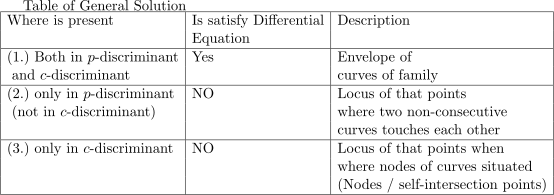
Also Read This Article:- Singular solution
3.Envelope and Cusp Locus-B.Sc. Maths Examples
\text{Illustration : } 1. \text{ Solve the differential equation } \\ (px^2 + y^2)(px + y) = (p + 1)^2 \\ \text{by reducing it to clairaut's form using } x + y = u \text{ and } xy = v \\ \text{and find its singular solution, if any.} \\ \text{Solution : } (px^2 + y^2)(px + y) = (p + 1)^2 \dots (1) \\ \text{Let us put } x + y = u \text{ and } xy = v \\ \text{so that } 1 + \frac{dy}{dx} = \frac{du}{dx} \Rightarrow 1 + p = \frac{du}{dx} \\ \text{and } x \frac{dy}{dx} + y = \frac{dv}{dx} \Rightarrow xp + y = \frac{dv}{dx} \\ \therefore P = \frac{dv}{du} = \frac{\frac{dv}{dx}}{\frac{du}{dx}} = \frac{xp + y}{1 + p} \dots (2) \\ \text{The given equation can be written as } \\ [(px + y)(x + y) - xy(p + 1)](px + y) = (p + 1)^2 \\ \text{Dividing by } (p + 1)^2, \text{ we get } \\ \left[\frac{px + y}{p + 1}(x + y) - xy\right] \frac{px + y}{p + 1} = 1 \\ \Rightarrow [Pu - v] P = 1 \quad [\text{from } (1) \text{ and } (2)] \\ \Rightarrow v = Pu - \frac{1}{P} \\ \text{Clairaut's form} \\ \text{Its primitive is } v = cu - \frac{1}{c} \\ \Rightarrow cu - \frac{1}{c} - v = 0 \\ \Rightarrow c^2(x + y) - cxy - 1 = 0 \dots (3) \\ c\text{-discriminant} \\ B^2 - 4AC = 0 \\ \Rightarrow (-xy)^2 - 4 \times (x + y) \times -1 = 0 \\ \Rightarrow x^2y^2 + 4(x + y) = 0 \dots (4) \\ \text{Again equation is} \\ p^2(x^3 - 1) + p(xy^2 + x^2y - 2) + y^3 - 1 = 0 \\ p\text{-discriminant} \\ B^2 - 4AC = 0 \\ (xy^2 + x^2y - 2)^2 - 4 \times (x^3 - 1)(y^3 - 1) = 0 \\ \Rightarrow x^2y^4 + x^4y^2 + 4 + 2x^3y^3 - 4x^2y - 4xy^2 - 4x^3y^3 + 4x^3 + 4y^3 - 4 = 0 \\ \Rightarrow x^2y^4 + x^4y^2 - 2x^3y^3 - 4x^2y + 4x^3 - 4xy^2 + 4y^3 = 0 \\ \Rightarrow x^2y^2(x^2 + y^2 - 2xy) + 4x^3(x - y) - 4y^2(x - y) = 0 \\ \Rightarrow x^2y^2(x - y)^2 + (x - y)(4x^2 - 4y^2) = 0 \\ \Rightarrow x^2y^2(x - y)^2 + 4(x - y)(x^2 - y^2) = 0 \\ \Rightarrow x^2y^2(x - y)^2 + 4(x - y)^2(x + y) = 0 \\ \Rightarrow (x - y)^2(x^2y^2 + 4(x + y)) = 0 \dots (5) \\ \text{common factors occuring once in } c\text{-discriminant and } \\ p\text{-discriminant by } (4) \text{ and } (5) \\ x^2y^2 + 4(x + y) = 0 \text{ which is singular solution} \\ \text{Again } (x - y)^2 = 0 \text{ which occurs} \\ \text{twice only in } p\text{-discriminant} \\ \text{represents Tac-locus} \\ \text{General solution : } c^2(x + y) - cxy - 1 = 0 \\ \text{S.S. } x^2y^2 + 4(x + y) = 0 \\ \text{Tac-locus } x - y = 0 \\ \text{Illustration : } 2. \text{ Reduce the equation} \\ x^2p^2 + py(2x + y) + y^2 = 0 \\ \text{to clairaut's form by putting} \\ u = y \text{ and } v = xy \text{ and find its} \\ \text{complete primitive and also} \\ \text{it singular solution.} \\ \text{Solution : We have} \\ x^2p^2 + py(2x + y) + y^2 = 0 \dots (1) \\ \text{We have } u = y \text{ and } v = xy \\ \text{so that } \frac{du}{dx} = \frac{dy}{dx} \Rightarrow \frac{du}{dx} = p \\ \frac{dv}{dx} = x \frac{dy}{dx} + y \Rightarrow \frac{dv}{dx} = xp + y \\ \text{Now } P = \frac{dv}{du} = \frac{\frac{dv}{dx}}{\frac{du}{dx}} = \frac{xp + y}{p} \\ \text{so that } P\frac{du}{dx} = xp + y \\ \Rightarrow P\left(\frac{dv}{du} - x\right) = y \\ \Rightarrow p = \frac{y}{\frac{dv}{du} - x} = \frac{y}{P - x} \\ \text{putting this value of } p \text{ in} \\ \text{equation } (1), \text{ we get} \\ \frac{x^2y^2}{(P - x)^2} + \frac{y}{P - x} y(2x + y) + y^2 = 0 \\ \Rightarrow y^2\left[x^2 + (2x + y)(P - x) + (P - x)^2\right] = 0 \\ \Rightarrow yP - xy + P^2 = 0 \\ \Rightarrow xy = yP + P^2, \text{ i.e. } v = uP + P^2 \\ \text{which is of clairaut's form} \\ \text{Hence replacing } P \text{ by } c \text{, the general} \\ \text{solution is} \\ v = uc + c^2 \Rightarrow xy = yc + c^2 \\ \text{which is general solution} \\ c\text{-discriminant} \\ B^2 - 4AC = 0 \\ y^2 + 4 \times 1 \times xy = 0 \Rightarrow y^2 + 4xy = 0 \\ \text{i.e. } y(y + 4x) = 0 \\ p\text{-discriminant} \\ \text{From equation } (1) \\ B^2 - 4AC = 0 \\ [y(2x + y)]^2 - 4 \times x^2 \times y^2 = 0 \\ \Rightarrow y^2 \left[(2x + y)^2 - 4x^2\right] = 0 \\ \Rightarrow y^2 (2x + y - 2x)(2x + y + 2x) = 0 \\ \Rightarrow y^2 (y)(y + 4x) = 0 \\ \Rightarrow y^3(y + 4x) = 0 \\ \text{Now } y(y + 4x) \text{ occurs both} \\ \text{in } c\text{-discriminant and} \\ \text{p}\text{-discriminant and both} \\ y = 0 \text{ and } y + 4x = 0 \text{ satisfy} \\ \text{the given differential equation. Therefore } y = 0 \text{ and } y + 4x = 0 \\ \text{are both singular solutions.} \\ \text{Again } y^2 = 0 \text{ which occurs twice} \\ \text{only in } p\text{-discriminant} \\ \text{represents tac-locus} \\ \text{General solution : } xy = yc + c^2 \\ \text{S.S. } y = 0 \text{ and } y + 4x = 0 \\ \text{Tac-locus } y = 0
\text{Illustration : } 3. \text{ Find the singular} \\
\text{solution of the equation } y = px + ap(1 - p) \\
\text{Solution : The given equation is} \\
y = px + ap(1 - p) \dots (1) \\
\text{This is in clairaut's form} \\
\text{viz } y = px + f(p) \text{ and so its} \\
\text{general solution is} \\
y = cx + f(c) \Rightarrow y = cx + ac(1 - c) \\
\Rightarrow ac^2 - c(x + a) + y = 0 \dots (2) \\
\text{Differentiating } (2) \text{ partially with} \\
\text{respect to } c, \text{ we get} \\
2ac - (x + a) = 0 \Rightarrow c = \frac{x + a}{2a} \dots (3) \\
\text{Eliminating } c \text{ between } (1) \text{ and} \\
(3), \text{ we get} \\
a \left[\frac{x + a}{2a}\right]^2 - \left[\frac{x + a}{2a}\right](x + a) + y = 0 \\
\Rightarrow \frac{(x + a)^2}{4a} - \frac{(x + a)^2}{2a} + y = 0 \\
\Rightarrow 4ay = (x + a)^2 \dots (4) \\
c\text{-discriminant} \\
4ay = (x + a)^2 \dots (4) \\
\text{Differentiating } (4) \text{ with respect} \\
\text{to } x, \text{ we get} \\
4a\left(\frac{dy}{dx}\right) = 2(x + a) \\
\Rightarrow p = \frac{dy}{dx} = \frac{x + a}{2a} \\
\text{substituting this value of } p \\
\text{in } (1), \text{ we get} \\
y = \frac{(x + a)x}{2a} + a \left(\frac{x + a}{2a}\right) \left[1 - \frac{x + a}{2a}\right] \\
= \frac{x + a}{2a} \left[x + a - \frac{1}{2}(x + a)\right] \\
\Rightarrow (x + a)^2 = 4ay \\
p\text{-discriminant} \\
(x + a)^2 = 4ay \dots (5) \\
\text{which is the same as } (4) \text{ and} \\
p = \frac{x + a}{2a} \text{ satisfies } (1) \\
\text{Hence the required singular} \\
\text{Solution} \\
4ay = (x + a)^2 \\
\text{Illustration : } 4. \text{ Solve and find} \\
\text{the singular solution of the} \\
\text{differential equation} \\
3y = 2px - \frac{2p^2}{x} \\
\text{Solution : Given equation is} \\
3y = 2px - \frac{2p^2}{x} \dots (1) \\
\text{Differentiating the equation} \\
\text{w.r.t. } x, \text{ we get} \\
3p = 2p + 2x \frac{dp}{dx} + \frac{2p^2}{x^2} - \frac{4p}{x} \frac{dp}{dx} \\
\text{i.e. } \left(2x \frac{dp}{dx} - p\right) \left(1 - \frac{2p}{x^2}\right) = 0 \\
\text{i.e. } 2x \frac{dp}{dx} - p = 0 \\
\Rightarrow 2 \frac{dp}{p} = \frac{dx}{x} \\
\text{Integrating, } p^2 = cx \\
\text{Putting the value of } p^2 \text{ in the} \\
\text{given equation } (1), \text{ we get} \\
3y = 2px - 2c \Rightarrow (3y + 2c)^2 = 4p^2 x^2 \\
\Rightarrow (3y + 2c)^2 = 4cx^3 \dots (1) \\
\text{which is complete primitive} \\
\text{Now the given differential} \\
\text{equation can be written as} \\
2p^2 - 2x^2p + 3xy = 0 \dots (2) \\
\text{and } (1) \text{ is } 4c^2 + 4c(3y - 2x^3) + 9y^2 = 0 \dots (3) \\
c\text{-discriminant} \\
\text{From } (3), B^2 - 4AC = 0 \\
16(x^3 - 3y)^2 - 144y^2 = 0, \text{ i.e. } x^3 - 6y^3 = 0 \\
\Rightarrow x^3(x^3 - 6y) = 0 \dots (4) \\
p\text{-discriminant} \\
\text{From } (2), B^2 - 4AC = 0 \\
x(x^3 - 6y) = 0 \\
\text{we find that factor } x^3 - 6y \\
\text{occurs only once in both } \\
p \text{ and } c\text{-discriminant.} \\
\text{Hence } x^3 - 6y = 0 \text{ is the singular} \\
\text{solution.} \text{Also x which occurs once in} \\
p\text{-discriminant and twice in} \\
c\text{-discriminant is the cus locus.} \\
\text{Illustration : } 5. \text{ Find the singular} \\
\text{solution of the equation} \\
xp^2 - 2yp + x + 2y = 0 \\
\text{Solution : The given equation is} \\
xp^2 - 2yp + x + 2y = 0 \dots (1) \\
\text{we have } x^2 = u, y - x = v \\
2x = \frac{du}{dx} \text{ and } \frac{dy}{dx} - 1 = \frac{dx}{dx} \Rightarrow p - 1 = \frac{dx}{dx} \\
\therefore P = \frac{dv}{du} = \frac{\frac{dv}{dx}}{\frac{du}{dx}} = \frac{p - 1}{2x} \\
\Rightarrow P = \frac{p - 1}{2x} \Rightarrow p = 1 + 2xP \\
\text{putting this value of } p \text{ in the} \\
\text{given equation, we get} \\
x(1 + 2p)^2 - 2y(1 + 2xp) + x + 2y = 0 \\
\text{i.e. } 4x^2p^2 + 4x^2P + 2x - 4myp = 0 \\
\Rightarrow 4x^2p^2 + 4P(x - y) + 2 = 0 \\
\Rightarrow 4uP^2 - 4vP + 2 = 0 \\
\Rightarrow v = uP + \frac{1}{2P} \\
\text{This is clairaut's form} \\
\text{Hence replacing } P \text{ by } c, \\
\text{the equation is} \\
v = uc + \frac{1}{2c} \\
\Rightarrow y - x = x^2c + \frac{1}{2c} \\
\Rightarrow 2c^2x^2 - 2c(y - x) + 1 = 0 \dots (2) \\
c\text{-discriminant} \\
\text{From } (2) \\
B^2 - 4AC = 0 \\
[-2(y - x)]^2 - 4 \times 2 \times x^2 = 0 \\
\Rightarrow 4(y - x)^2 - 8x^2 = 0 \\
\Rightarrow 4\left[y^2 - 2xy + x^2 - 2x^2\right] = 0 \\
\Rightarrow y^2 - x^2 - 2xy = 0 \\
\text{and } p\text{-discriminant} \\
\text{From } (1), B^2 - 4AC = 0 \\
(-2y)^2 - 4 \times x \times (x + 2y) = 0 \\
\Rightarrow 4y^2 - 4x^2 - 8xy = 0 \\
\Rightarrow (y^2 - x^2 - 2xy) = 0 \\
\Rightarrow y^2 - x^2 - 2xy = 0 \dots (3) \\
\text{Since } y^2 - x^2 - 2xy = 0 \text{ occurs} \\
\text{only once both in } c\text{-discriminant} \\
\text{and } p\text{-discriminant}, \text{ these represent} \\
\text{the singular solution.} \\
\text{Therefore the general solution} \\
(2) \text{ which represents a} \\
\text{system of parabolas touches} \\
\text{a pair of lines.} \\
y^2 - x^2 - 2xy = 0
With the above illustrations,Envelope and Cusp Locus-B.Sc. Maths.
4.Practice Problems of Envelope and Cusp Locus-B.Sc. Maths for Students
Obtain the complete primitive (C.P.) and singular solutions (S.S.) of the following equations:
(1.) \quad x^2p^2 - 3xyp + 2y^2 + x^3 = 0 \\
(2.) \quad dy \sqrt{x} = dx \sqrt{y} \\
\text{Ans. } (1.) \quad \text{S.S. : } x^2(y - 4x^3) = 0 \\
(2.) \quad \text{C.P. } (x + y - c)^2 = 4xy, \text{ S.S. } xy = 0
By solving the above questions,you can understand the Envelope and Cusp Locus-B.Sc. Maths well because the concept is well understood when you solve it practically.
### 📢 If you liked this math article:
* 👥 **Share with Friends:** Knowledge grows by sharing, so be sure to share it with your friends.
* 🔔 **Follow the Website:** If this is your first time here, follow our **email subscription** so that you get instant notifications for every new article.
* 💬 **Give Your Suggestions:** If you have any issues or would like to make any suggestions, do let us know by **commenting** below.
*Welcome to read the full article!*
5.Frequently Asked Questions Related to Envelope and Cusp Locus-B.Sc. Maths
Q:1.Explain about the cusp-locus
Ans:The general solution f(x,y)=0 may represent a set of curves each of which has a cusp.The cusp will lie on a curve,which is called the cuspidal locus.
Q:2.Write a comment on the envelope
Ans:p-discriminant
\cong ECT^2
and c-discriminant
\cong EN^2C^3
of these only the envelope is a solution of the differential equation and the others are not the solution of the differential equation and are therefore called Extraneous Loci.
Q:3.How do you find the equation of the singular solution?
Ans:Therefore to know the singular solution and extraneous loci one should calculate the p-discriminant and c-discriminant and take the help of the above results to decide their nature.
By answering the above questions,you can know about the primary terms of Envelope and Cusp Locus-B.Sc. Maths.
**छात्र-छात्राओं से आज का सवाल**
🎯विनर्स कॉर्नर:क्या आप इस सवाल का सही जवाब दे सकते हैं? अपने नाम के साथ नीचे कमेंट करें!सही जवाब देने वाले Top Students के नाम हमारी आगे post/is article ke update में Photo ya Special Mention के साथ publish की जाएगी। अपना जवाब अभी दर्ज करें!👇Q:*”एक महीने में सभी रविवार महीने की चौथी,ग्यारहवीं या पच्चीसवीं तारीख को पड़ते हैं।यदि महीना बृहस्पतिवार से प्रारम्भ हो,तो महीने की अन्तिम तारीख को कौनसा दिन होगा?”*
(A)शनिवार (B)मंगलवार (C)बृहस्पतिवार (D)तथ्य अधूरे हैं (E)इनमें से कोई नहीं
**Today’s Question to Students**
*”All Sundays in a month fall on the fourth, eleventh or twenty-fifth of the month. If the month starts on Thursday, what will be the day on the last date of the month?”*
(A)Saturday (B)Tuesday (C)Thursday (D)facts are incomplete (E)none of them
*पिछली प्रश्नोत्तरी का उत्तर*
स्त्री के पिता का एकमात्र पुत्र स्त्री का भाई हुआ।यह भाई उस पुरुष का पिता है।अतः वह पुरुष उस स्त्री के भाई का पुत्र अर्थात् भतीजा हुआ।
*Previous Quiz Solution*
The only son of the woman’s father became the brother of the woman. This brother is the father of that man. So the man became the son of the woman’s brother, i.e., nephew
*”This article has been prepared by **Satyam Coaching Centre** on the **Satyam Mathematics** blog.”*
About Author

Sanjay Kumawat
(1.)**Satyam Narain Kumawat** **Website Name:Satyam Mathematics** *Owner:satyamcoachingcentre.in* *Sthan:Manoharpur,Jaipur (Rajasthan)* **Teaching Mathematics aur Anya Anubhav** ***Shiksha:**B.sc.,B.Ed.,(M.sc. star Ke Mathematics Ko Padhane ka Anubhav),B.com.,M.com. Ke vishayon Ko Padhane ka Anubhav,Philosophy,Psychology,Religious,sanskriti Mein Gahri Ruchi aur Adhyayan ***Anubhav:**phichale 23 varshon se M.sc.,M.com.,Angreji aur Vigyan Vishayon Mein Shikshaka Ka Lamba Anubhav ***Visheshagyata:*Maths,Adhyatma (spiritual),Yog vishayon ka vistrit Gyan* ****In Brief:I have read about M.sc. books,psychology,philosophy,spiritual, vedic,religious,yoga,health and different many knowledgeable books.A dedicated math expert with 23+ years of teaching experience upto M.sc. ,M.com.,English and science.After guiding thousands of students through Satyam Coaching Center,now share Mathematics,Trigonometry (Upto M.sc) and Educational Strategies in simple language on this blog from December 2018.* (2.)**(Technical Expert & Co-Admin):** ***Name:Sanjay Kumawat* *Qualification:Graduate in Mechanical Engineering (B.Tec) in 2013* *Profession:Physics Lecturer* *Teaching Experience:15 Years and Teaching to NEET,JEE Students* *Technical Experience:5 Years Coding and Article Editing,Classic Photo Editing by Laptop in Satyam Coaching Centre Blog* *A school lecturer and digital content strategist.On this blog,he handles all the responsibility of coding,image editing,SEO, and technical management,so that the mathematical content reaches the readers in a very accurate and beautiful form.* Updated on 15.06.2026

