Stereographic Projection and Inverse Points of Complex Numbers
1.Stereographic Projection and Inverse Points of Complex Numbers
Do you know stereographic projection and have any problem about it.we solve it Stereographic Projection and Inverse Points of Complex Numbers in simple language step-by-step.
“Before diving into these solutions,make sure you understand the foundational concept of “Geometrical Construction of Complex Numbers on Argand Plane” and have reviewed the essential “Properties of Complex Numbers“.This will make following today’s step-by-step solutions much easier.”
Table of Topics Covered in This Article
(1.)Equation of a circle through three given
System of Circles with Two Points as Inverse Points
(2.)Stereographic Projection
(3.)A stereographic projection projects circles into circles or straight lines
(4.)Practice Problems for Students
(5.)Frequently Asked Questions Related to Stereographic Projection and Inverse Points of Complex Numbers
2.Equation of a circle through three given points
[Kota 2007]
Let A,B,C be three given points representing the complex numbers z_1, z_2, z_3 respectively.Let z be the complex number representing any point P on the circle.Then either
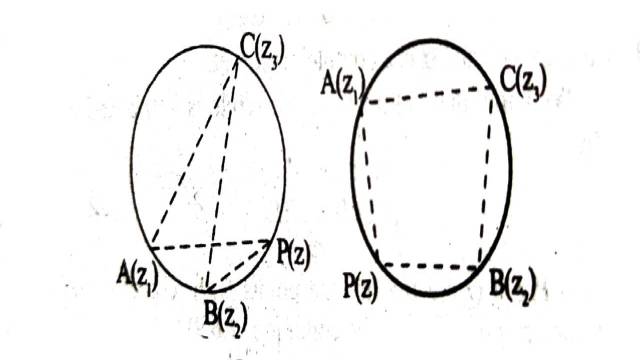
\angle ACB = \angle APB \text{ as in Figure 1 } \\
\angle ACB + \angle APB = \pi \text{ as in Figure } 2 \\
\text{Now from Figure 1 } \\
\angle ACB = \arg\left(\frac{z_3 - z_2}{z_3 - z_1}\right) \text{ and} \\
\angle APB = \arg\left(\frac{z - z_2}{z - z_1}\right) \\
\text{Hence } \arg\left(\frac{(z_3 - z_2)(z - z_1)}{(z_3 - z_1)(z - z_2)}\right) = 0 \dots (1) \\
\text{similarly from Figure } 2, \text{ we have} \\
\arg\left(\frac{(z_3 - z_2)(z - z_1)}{(z_3 - z_1)(z - z_2)}\right) = \pi \dots (2) \\
\text{From } (1) \text{ and } (2) \text{ it follows that} \\
\frac{(z_3 - z_2)(z - z_1)}{(z_3 - z_1)(z - z_2)}
is purely real and so it must conjugate. Hence
\frac{(z - z_1)(z_3 - z_2)}{(z - z_2)(z_3 - z_1)} = \frac{(\bar{z} - \bar{z}_1)(\bar{z}_3 - \bar{z}_2)}{(\bar{z} - \bar{z}_2)(\bar{z}_3 - \bar{z}_1)}
as the required equation of the circle.
Corollary:The four points and are concyclic if
z_1, z_2, z_3 \text{ and } z_4 \text{ are concyclic} \\
\text{if} \\
\frac{(z_4 - z_1)(z_3 - z_2)}{(z_4 - z_2)(z_3 - z_1)}
Definition.Two points P, Q are said to be inverse points with respect to a circle with centre C and radius r if
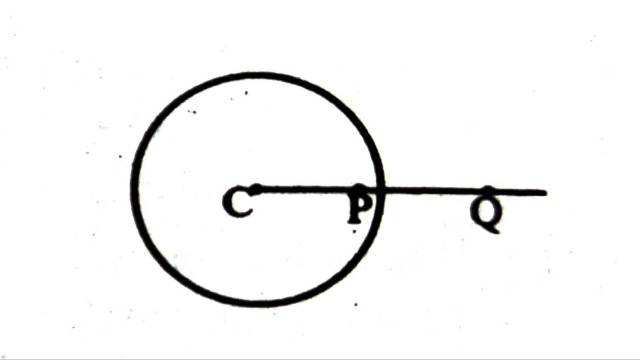
(1.) the point C,P,Q are co-Ilinear
(2.)CP \cdot CQ = r^2 \cdots (1)
We now find a relation between the inverse points with respect to the circle.
where a,c are real and \alpha is a complex constant.
az\bar{z} + \alpha z + \bar{\alpha}\bar{z} + c = 0 \cdots (2)
We know that centre C of this circle is -\frac{\bar{\alpha}}{\alpha} and the radius r is given by
r^2 = \frac{\alpha\bar{\alpha} - ac}{a^2} \cdots (3)
If P and Q are the inverse points with respect to the circle with affixes z and z’ respectively.The condition (1) in this case becomes
\left|z + \frac{\bar{\alpha}}{a}\right| \left|z'+\frac{\bar{\alpha}}{a}\right| = r^2 \cdots (4)
Also since C,P,Q are collinear,we have
\arg\left(z' + \frac{\bar{\alpha}}{a}\right) = \arg\left(z + \frac{\bar{\alpha}}{a}\right) \\
= -\arg\left(\overline{z + \frac{\bar{\alpha}}{a}}\right) \\
= -\arg\left(\bar{z} + \frac{\alpha}{a}\right) \\
\Rightarrow \arg\left(\left(z' + \frac{\bar{\alpha}}{a}\right)\left(\bar{z} + \frac{\alpha}{a}\right)\right) = 0 \cdots (5)\\
\Rightarrow \left(z' + \frac{\bar{\alpha}}{a}\right)\left(\bar{z} + \frac{\alpha}{a}\right) is a positive real number.
Again equation (4) can be written as
\left|\left(z' + \frac{\bar{\alpha}}{a}\right)\overline{\left(z + \frac{\bar{\alpha}}{a}\right)}\right| = r^2 \cdots (6)
Hence the conditions (5) and (6) are equivalent to a single condition
\left(z' + \frac{\bar{\alpha}}{a}\right)\left(\bar{z} + \frac{\alpha}{a}\right) = r^2 \\
\Rightarrow z\bar{z} + \frac{z'\alpha + \bar{z}\bar{\alpha}}{a} + \frac{\alpha\bar{\alpha}}{a^2} = \frac{\alpha\bar{\alpha} - ac}{a^2} \\
\Rightarrow az\bar{z} + z'\alpha + \bar{z}\bar{\alpha} + c = 0 \cdots (7)
The equation (7) gives a relation between z and the inverse point z’.Thus to obtain a relation between z and its inverse z’,we replace z by z’ leave \bar{z} unchanged in the equation of the circle.
Particular Case:Consider the circle |z|=r i.e. the circle with radius r and centre as origin.This equation may be written
|z|^2 = r^2 \text{ i.e. } z\bar{z} = r^2
Hence in this case,the relation between the point z and its inverse z’ is given by
z'\bar{z} = r^2 \Rightarrow z' = \frac{r^2}{\bar{z}}
Thus the inverse of the point z with respect to circle |z|=r is \frac{r^2}{\bar{z}}
If the radius of the circle is unity,then the inverse of the point z is \frac{1}{\bar{z}}
Also Read this Article:- Stereographic projection
3.System of Circles with Two Points as Inverse Points

Let |z - \alpha| = r be a circle with centre C(\alpha) and radius r. Also suppose that z_1 \text{ and } z_2 are inverse points with respect to circle.
Thus if z_1 = \alpha + \lambda e^{i\theta} \\
\text{then } z_2 = \alpha + \left(\frac{r^2}{\lambda}\right) e^{i\theta} \\
\text{If } z = \alpha + re^{i\phi} is any point on the circle,then
\left|\frac{z - z_1}{z - z_2}\right| = \left|\frac{re^{i\phi} - \lambda e^{i\theta}}{re^{i\phi} - \left(\frac{r^2}{\lambda}\right) e^{i\theta}}\right| \\
= \frac{\lambda}{r} \left|\frac{re^{i\phi} - \lambda e^{i\theta}}{\lambda e^{i\theta} - re^{i\phi}}\right| \\
\text{Now } |re^{i\phi} - \lambda e^{i\theta}| \\
= |(r\cos\phi - \lambda\cos\theta) + i(r\sin\phi - \lambda\sin\theta)| \\
= \sqrt{(r\cos\phi - \lambda\cos\theta)^2 + (r\sin\phi - \lambda\sin\theta)^2} \\
= \sqrt{r^2 + \lambda^2 - 2r\lambda\cos(\phi - \theta)} \\
\text{similarly } |\lambda e^{i\phi} - re^{i\theta}| = \sqrt{r^2 + \lambda^2 - 2\lambda r\cos(\phi - \theta)} \\
\text{Therefore } \left|\frac{z - z_1}{z - z_2}\right| = \frac{\lambda}{r}
Thus it turns out that a new form of the circle is Conversely,any equation of the form
\left|\frac{z - z_1}{z - z_2}\right| = k, (k \neq 1)
represents a circle,called the circle of Apollonius of which z_1 \text{ and } z_2 are inverse points.
Real-World Application:
(1.)GPS & Navigation (Triangulation): The Apollonius Circle model is used to track the location of ships or aircraft when the ratio of distances from two signal towers is fixed.
(2.)Acoustics (Sound Localization): To determine the location of a sound source based on the ratio of arrival times of sound at two microphones.
Conversely:Consider
\left|\frac{z - z_1}{z - z_2}\right| = k (k \neq 1) \cdots (1) \\
\Rightarrow \frac{(z - z_1)(\bar{z} - \bar{z}_1)}{(z - z_2)(\bar{z} - \bar{z}_2)} = k^2 \\
\Rightarrow (1 - k^2)z\bar{z} + (\bar{z}k^2 - \bar{z}_1)z + \\
(z_2 k^2 - z_1)\bar{z} + z_1\bar{z}_1 - k^2 z_2\bar{z}_2 = 0 \cdots (2)
Obviously (2) represents a circle as z\bar{z} coefficient of and last term are real and coefficient of z and \bar{z} are conjugate to each other.Also writing z_1 \text{ and} \bar{z}_2 in place of z and \bar{z} respectively in (2), we get
(1 - k^2)z_1\bar{z}_2 + (\bar{z}_2 k^2 - \bar{z}_1)z_1 + \\
(z_2 k^2 - z_1)\bar{z}_2 + z_1\bar{z}_1 - k^2 z_2\bar{z}_2 = 0
Therefore z_1 \text{ and} \bar{z}_2 are inverse points for the circle (2.)
Thus \left|\frac{z - z_1}{z - z_2}\right| = k (k \neq 1)
represents system of circles with z_1 \text{ and} \bar{z}_2 as inverse points.
Real-World Application:
(1.)Electromagnetism & Electrostatics: Used to model the patterns of equipotential surfaces and electric field lines generated by electric charges.
(2.)Signal Processing & Antenna Design: Used to determine signal coverage circles by calculating the phase difference between two distinct signal sources.
4.Stereographic Projection

[Ajmer (Hons.) 99; Raj. B.Sc.1995,96, 2002, 05; Kota 2007]
Often in complex analysis we will be concerned with functions that become infinite as the variables approach a given point and so we need one more complex number denoted by \infty .This symbol represents infinity,or the point at infinity. For this complex number we do not introduce the notions of the real and imaginary parts or the notion of the argument,however.every straight line will pass through the point at infinity,and no half plane shall contain it.
The connection of the point at infinity with the points of complex plane is algebraically given by setting
a \pm \infty = \infty \pm a = \infty \\
b \cdot \infty = \infty \cdot b = \infty \\
\frac{a}{\infty} = 0, \frac{\infty}{a} = \infty, \frac{b}{0} = \infty
where a and b are complex numbers (b \neq 0)
The relation of the point at infinity to the points of the Argand plane becomes very clear through the representation of complex number on the surface of a sphere,called the Reimann sphere in honour of famous mathematician Reimann who introduced this idea.The Argand plane is then called the “stereographic projection” of the surface of the Riemann sphere.
Consider a sphere \Sigma of unit radius with centre at 0 and an Argand plane \pi with origin at 0.Any complex number z=x+iy can be represented by a point (x,y) in this plane.In order to associate points on the sphere with those on the plane,we first draw the diameter NOS of the sphere which is perpendicular to the plane π.Let us now draw the line-segment joining N
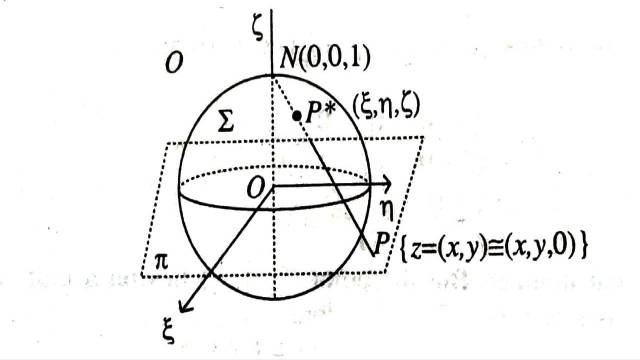
to any point P on the plane.Then the line segment NP or its extension,intersects the sphere \Sigma at a unique point different from N.Call this point P^*.Clearly this construction provides a one-to-one correspondence between the points of the sphere \Sigma (except for the point N from itself) and the points of the plane \pi.This construction is called stereographic projection.If p \in \pi represents the complex number z,then the point P^* also represents the complex number Z on the Riemann sphere \Sigma.
For the sake of visualization we introduce geographic terminology.The circle along which the sphere intersects the complex plane is called the equator,the straight line that passes through O perpendicular to the argand plane the axis of the sphere,and points N and S at which the axis intersects the sphere the North and South Poles,respectively.The great circles through N and S are called meridians and the meridian lying in the plane NOX,where OX is the positive real axis in the Argand plane is called the prime meridian.Evidently points of \pi lying inside the unit circle |z|=1 are mapped into points of southern hemisphere (containing the pole S) while the points of \pi outside the unit circle are mapped into points northern hemisphere (containing the pole N).The upper half plane Im z or y > 0 is mapped into the eastern hemisphere while the lower half plane y < 0 is mapped into the western hemisphere.
This one-one correspondence covers all points in the finite complex plane \pi and all points on the sphere \Sigma except the point N the north pole.The point at \infty in the extended complex number system is identified with the north pole.Note that a neighbourhood of in the complex plane corresponds to the interior of an arctic circle,whose centre is the north pole.
Analytically we may proceed as follows:
Let the sphere be
\xi^2 + \eta^2 + \zeta^2 = 1 \cdots (1)
and the plane of projection be
\zeta = 0 \cdots (2)
We take the vertex N of projection as (0,0,1)
Let (\xi, \eta, \zeta) be the co-ordinates of any P^* on the sphere and (x,y,0) the co-ordinates of the corresponding point P where line, \text{ NP }^* meets the plane of projection. Since the points (0,0,1),(\xi, \eta, \zeta),(x,y,0) are in a straight line,therefore we have
\frac{\xi - 0}{x - 0} = \frac{\eta - 0}{y - 0} = \frac{\zeta - 1}{0 - 1} = k \\
\Rightarrow \frac{\xi}{x} = \frac{\eta}{y} = \frac{1 - \zeta}{1} = k \cdots (3)
where k is a real number,But the point (\xi, \eta, \zeta) lies on a unit sphere,whose equation is given by (1),therefore
x^2k^2 + y^2k^2 + (1 - k)^2 = 1
Solving for k,we obtain
k = \frac{2}{x^2 + y^2 + 1}
In view of (3),the complex number (x,y,0) on the plane is then identified with the point
(\xi, \eta, \zeta) = \left(\frac{2x}{x^2 + y^2 + 1}, \frac{2y}{x^2 + y^2 + 1}, \frac{x^2 + y^2 - 1}{x^2 + y^2 + 1}\right) \cdots (4)
on the sphere.Rewriting (4) we identify the complex number z=x+ iy with the point
(\xi, \eta, \zeta) = \left(\frac{z + \bar{z}}{|z|^2 + 1}, \frac{z - \bar{z}}{i(|z|^2 + 1)}, \frac{|z|^2 - 1}{|z|^2 + 1}\right) \cdots (5)
on the sphere.Also from (3),we have
x = \frac{\xi}{1 - \zeta}, y = \frac{\eta}{1 - \zeta} \text{ and } z = x + iy = \frac{\xi + i\eta}{1 - \zeta} \cdots (6)
and z=x+iy The equation (5) and (6) establish a one-one correspondence between the complex number and the points on a spherical surface except that no point of the complex plane corresponds to vertex N(0,0,1) of the sphere.This is accomplished by defining the point at infinity of the complex plane.
It is geometrically apparent that under the stereographic projection,every straight line in the z-plane \pi is transformed into a circle on the Riemann sphere \Sigma,which passes through the pole (0,0,1) and conversely,Moreover any circle on the sphere \Sigma corresponds to a circle or a straight line in the z-plane.This is called circle preserving property of stereo-graphic projection.
Real-World Application:
(1.)Cartography (Map Making):To represent the 3D Earth (globe) on a 2D flat map without distorting angles (particularly for polar regions/North-South Poles).
(2.)Computer Graphics & VR: To render 360-degree panoramic images onto flat screens or VR headsets.
(3.)Crystallography & Geology: To plot the internal structure of crystals and the orientation of geological fault lines on a 2D plane.
5.A stereographic projection
projects circles into circles or straight lines [Raj. B.Sc.1997, 2000, 02(S), 04, 06; Ajmer B.Sc. (Hons.) 99; Udaipur (M.Sc.) 2004; Kota 2007]
Proof. Any circle on the Riemann sphere \Sigma is the intersection of the unit sphere
\xi^2 + \eta^2 + \zeta^2 = 1
with some plane
a\xi + b\eta + c\zeta + d = 0 \cdots (7)
In view of (3),the corresponding points of the plane satisfy the equation.
(c + d)(x^2 + y^2) + 2ax + 2by + d - c = 0 \cdots(8)
Equation (8) represents a circle if c + d \neq 0 and a straight line if c+d=0 But c+d=0 if the plane (7) passes through the North pole (0,0,1).Therefore,we get a circle or a straight line in the plane \pi according as the circle on the sphere does not pass through North pole or passes through North pole,In particular,if the plane (7) is parallel to the plane π i.e. a=b=0,then the corresponding circle (8) is
(c + d)(x^2 + y^2)=c-d
which has centre at origin. On the other hand if the plane (7) goes through the axis NS i.e. the circle on \Sigma is one of the great meridians then c=d=0,and in the plane \pi we obtain from (8) a straight line ax+by=0 through the origin of coordinates. With the above theory,one can understand the Stereographic Projection and Inverse Points of Complex Numbers. Real-World Application: (1.)Optics & Lens Correction:To rectify (straighten) distorted images captured by fisheye lenses (wide-angle lenses) in cameras. (2.)Conformal Mapping: Used in aerodynamics to transform shapes without altering angles, helping to understand fluid flow around aircraft wings.
6.Practice Problems for Students
(1.)What is polar form of complex number -5+5i?
(2.)If the amplitude of the complex number be,then what is amplitude of iz?
(3.)What is the multiplicative inverse of complex number (a,b)=(0,0)?
Answers: By solving the above questions,you can understand the Stereographic Projection and Inverse Points of Complex Numbers well because the concept is well understood when you solve it practically.
### 📢 If you liked this math article:
* 👥 **Share with Friends:** Knowledge grows by sharing, so be sure to share it with your friends.
* 🔔 **Follow the Website:** If this is your first time here, follow our **email subscription** so that you get instant notifications for every new article.
* 💬 **Give Your Suggestions:** If you have any issues or would like to make any suggestions, do let us know by **commenting** below.
*Welcome to read the full article!*
7.Frequently Asked Questions Related to Stereographic Projection and Inverse Points of Complex Numbers
Q:1.What is a complex number?
Ans:If a,b \in R ,then the expression of the form a+ib or a-ib is called complex number which i=\sqrt{-1} is generally represented by z,where a is real part and b is imaginary part
Q:2.What are imaginary numbers?
Ans:Every number whose square is a negative number is called an imaginary number.
Q:3.What are conjugate complex numbers?
Ans:Two complex numbers are said to be conjugate if their real parts are the same and the imaginary parts are the same but opposite symbols.
By answering the above questions,you can know about the primary terms of Stereographic Projection and Inverse Points of Complex Numbers.
**छात्र-छात्राओं से आज का प्रश्न**
🎯 Winner’s Corner: Kya aap is sawal ka sahi jawab de sakte hain? Apne naam ke saath niche comment karein! Sahi jawab dene wale top 5 students ke naam hamari agli post/is article ke update mein Photo ya Special Mention ke sath publish kiye jayenge.Apna jawab abhi darj karein! 👇
*”किसी संख्या के वर्ग का 1\frac{4}{5} गुना उसी संख्या के घन के बराबर हो,तो उस संख्या का 81% कितना होगा?”*
(A) \frac{2}{5} (B) \frac{1}{5} (c) \frac{1}{2} (D)\frac{4}{5} (E) इनमें से कोई नहीं
**Today’s Question to Students**
*”If 1\frac{4}{5} times the square of a number is equal to the cube of the same number, then what is 81% of that number?”*
(A) \frac{2}{5} (B) \frac{1}{5} (c) \frac{1}{2} (D)\frac{4}{5} (E) None of these
*पिछली प्रश्नोत्तरी का उत्तर*(D)
महीने के दिनों की संख्या अज्ञात है।अतः इसी कारण उस महीने की अंतिम तारीख के दिन के बारे में पता लगाना कठिन है।
*Previous Quiz Solution*(D)
The number of days of the month is unknown.Therefore,it is difficult to find out the day of the last date of that month.
*”This article has been prepared by **Satyam Coaching Centre** on the **Satyam Mathematics** blog.”*

About Author

Sanjay Kumawat
(1.)**Satyam Narain Kumawat** **Website Name:Satyam Mathematics** *Owner:satyamcoachingcentre.in* *Sthan:Manoharpur,Jaipur (Rajasthan)* **Teaching Mathematics aur Anya Anubhav** ***Shiksha:**B.sc.,B.Ed.,(M.sc. star Ke Mathematics Ko Padhane ka Anubhav),B.com.,M.com. Ke vishayon Ko Padhane ka Anubhav,Philosophy,Psychology,Religious,sanskriti Mein Gahri Ruchi aur Adhyayan ***Anubhav:**phichale 23 varshon se M.sc.,M.com.,Angreji aur Vigyan Vishayon Mein Shikshaka Ka Lamba Anubhav ***Visheshagyata:*Maths,Adhyatma (spiritual),Yog vishayon ka vistrit Gyan* ****In Brief:I have read about M.sc. books,psychology,philosophy,spiritual, vedic,religious,yoga,health and different many knowledgeable books.A dedicated math expert with 23+ years of teaching experience upto M.sc. ,M.com.,English and science.After guiding thousands of students through Satyam Coaching Center,now share Mathematics,Trigonometry (Upto M.sc) and Educational Strategies in simple language on this blog from December 2018.* (2.)**(Technical Expert & Co-Admin):** ***Name:Sanjay Kumawat* *Qualification:Graduate in Mechanical Engineering (B.Tec) in 2013* *Profession:Physics Lecturer* *Teaching Experience:15 Years and Teaching to NEET,JEE Students* *Technical Experience:5 Years Coding and Article Editing,Classic Photo Editing by Laptop in Satyam Coaching Centre Blog* *A school lecturer and digital content strategist.On this blog,he handles all the responsibility of coding,image editing,SEO, and technical management,so that the mathematical content reaches the readers in a very accurate and beautiful form.* Updated on 15.06.2026

