Motion Up Inclined Plane Questions with Solution
1.नत समतल पर गति के सवाल हल सहित (Motion Up Inclined Plane Questions with Solution):
नत समतल पर गति के सवाल हल सहित (Motion Up Inclined Plane Questions with Solution) में जानिए कि किसी कण का एक समतल पर परास और वेग कैसे ज्ञात करते हैं।सम्पूर्ण सूत्रों की सारणी और सवालों का कम्प्लीट सोल्यूशन स्टेप-बाइ-स्टेप।
Also Read This Article:- Projectile Questions with Solution
2.एक नत समतल पर परास तथा उड्डयन काल (Range and time of flight up an inclined plane):
समतल के एक बिन्दु से,जो क्षैतिज के साथ \beta कोण बनाता है,एक कण u वेग से क्षैतिज तल से \alpha कोण की दिशा में फेंका जाता है।नत समतल के चढ़ान पर परास एवं उड्डयन काल भी ज्ञात करना:
(From a point on a plane,which is inclined at an angle \beta to the horizon,a particle is projected with a velocity u at an angle \alpha with the horizontal. To find the range up the inclined plane and also the time of flight):
(Ajmer 2002,Raj.83,89)
उपपत्ति (Proof):मान लो O प्रक्षेप बिन्दु है तथा OA नत समतल में अधिकतम झुकाव (greatest slope) वाली रेखा है।मान लो OA क्षैतिज रेखा OX से \beta कोण बनाती है।मान लो प्रक्षेप्य u वेग से OX से \alpha कोण बनाते हुए अधिकतम झुकाव वाली रेखा से गुजरने वाले उर्ध्वाधर समतल में प्रक्षेप किया जाता है।
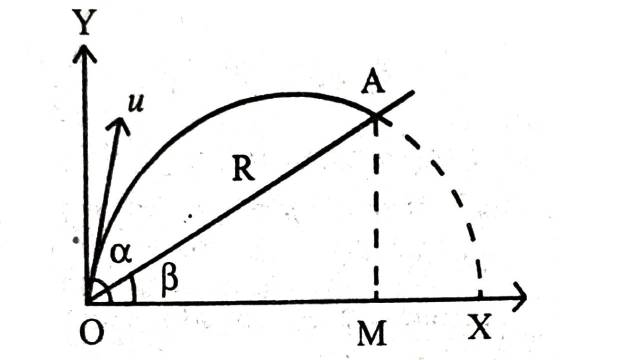
प्रक्षेप बिन्दु O से गुजरने वाली क्षैतिज रेखा OX को x-अक्ष तथा उर्ध्वाधर रेखा OY को y-अक्ष लेने पर प्रक्षेप पथ का समीकरण होगा:
y=x\tan\alpha-\frac{gx^2}{2u^2\cos^2\alpha} \cdots(1)
मान लो प्रक्षेप्य पुनः नत समतल से बिन्दु A पर टकराता है तथा इस समतल पर प्रक्षेप्य का परास (range) OA=R हो,तो बिन्दु A के निर्देशांक होंगे।
चूँकि बिन्दु A प्रक्षेप पथ (1) पर स्थित है
R\sin\beta=R\cos\beta\tan\alpha-\frac{gR^2\cos^2\beta}{2u^2\cos^2\alpha} \\ \Rightarrow \frac{gR\cos^2\beta}{2u^2\cos^2\alpha}=\frac{\cos\beta \sin \alpha}{\cos \alpha}-\sin\beta\\ \Rightarrow \frac{gR\cos^2\beta}{2u^2\cos^2\alpha} =\frac{\cos\beta\sin\alpha-\sin\beta\cos\alpha}{\cos\alpha}\\ \Rightarrow \frac{gR\cos^2\beta}{2u^2\cos^2\alpha}=\frac{\sin(\alpha-\beta)}{\cos\alpha} \\ \therefore R=\frac{2u^2\sin(\alpha-\beta)\cos\alpha}{g\cos^2\beta}
यह किसी दिए हुए झुकाव वाले नत समतल पर प्रक्षेप्य का अभीष्ट परास (range) है।
यदि O से A तक उड्डयन काल T हो तो इस समय में नत समतल के लम्बवत चली गई दूरी शून्य होगी।अतः
0=u\sin(\alpha-\beta)T-\frac{1}{2}g\cos\beta T^2\\ T=\frac{2u\sin(\alpha-\beta)}{g\cos\beta}
नोट:समतल के ऊपर और नीचे अधिकतम परास के लिए उपर्युक्त परास के सूत्र से ही व्युत्पन्न किया जाता है।
Also Read This Article:- Inclined Plane
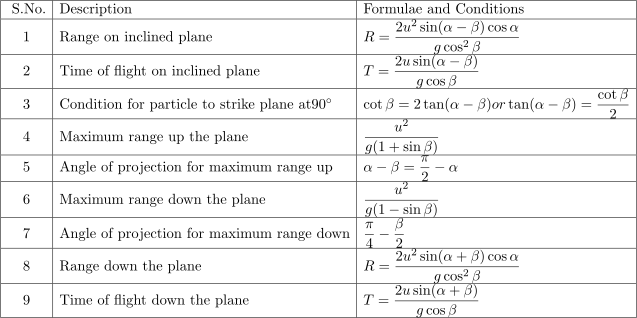
3.नत समतल पर परास व अन्य के महत्त्वपूर्ण सूत्र व प्रतिबन्ध की सारणी (Table of Important Formulas and Conditions of Range and Others on Inclined Plane):

4.नत समतल पर गति के सवाल (Motion Up Inclined Plane Questions):
Example:1.यदि एक तोप एक नत समतल पर स्थित है,तो सिद्ध करो कि अधिकतम झुकाव वाली रेखा के लम्बवत् दिशा में अधिकतम परास,नत समतल के ऊपर की ओर तथा इसके नीचे की ओर अधिकतम परास का हरात्मक माध्य होता है।
(Show that if a gun be situated on an inclined plane,the maximum range in a direction at right angles to the line of greatest slope is harmonic mean between the maximum ranges up and down the plane respectively.)
Solution:माना O प्रक्षेप बिन्दु है और u प्रक्षेप वेग है।माना क्षैतिज के साथ कोण बनाता है तब नत समतल पर ऊपर की ओर परास
\frac{u^2}{g(1+\sin\beta)}=R_1 \cdots(1)
और नत समतल पर नीचे की ओर परास
R_2=\frac{u^2}{g(1-\sin\beta)} \cdots(2)
रेखा का महत्तम झुकाव O से गुजरेगा जो कि रेखा नत समतल में स्थित है और रेखा से 90° जहाँ समतल क्षैतिज से मिलता है।यदि R_3 क्षैतिज दिशा में महत्तम परास है तो
R_3=प्रक्षेप वेग u के साथ क्षैतिज में महत्तम परास=\frac{u^2}{g} \\ \\ \frac{1}{R_1}+\frac{1}{R_2} =\frac{g(1+\sin\beta)}{u^2}+\frac{g(1-\sin\beta)}{u^2} \\ =\frac{g}{u^2} \left[(1+\sin\beta)+(1-\sin\beta)\right] \\ =\frac{2g}{u^2} \\ \therefore \frac{1}{R_1}+\frac{1}{R_2} =\frac{2}{R_3} [(1) व (2) से]
अतः अभीष्ट R_1 और R_2 का हरात्मक माध्य R_3 है।
Example:2.यदि u तथा v प्रारम्भिक वेग के उर्ध्वाधर दिशा तथा नत समतल की दिशा में तिर्यक घटक हैं,तो सिद्ध करो कि नत समतल पर परास \frac{2uv}{g} होता है।
(If u and v be the oblique components of the initial velocity along the vertical and along the inclined plane. Show that the range on the inclined plane is equal to \frac{2uv}{g}.)
Solution:स्टेप:1. \alpha समतल का क्षैतिज के साथ झुकाव,
\theta :क्षैतिज के साथ प्रक्षेप कोण
v_0 :प्रक्षेप का प्रारम्भिक वेग
प्रारम्भिक वेग के घटक निम्न प्रकार हैं:
स्टेप:2.u (उर्ध्वाधर घटक) u = v_0 \sin\theta
v (झुके हुए तल के अनुदिश घटक)
v=v_0\cos(\theta-\alpha)
किसी झुके हुए तल पर परास (R) का सूत्र इस प्रकार है:
R =\frac{2v_0^{2}\sin(\theta-\alpha)\cos\theta}{g\cos^2\alpha}
इसे सरल करने के लिए,घटकों u और v के बीच सम्बन्ध देखते हैं।
त्रिकोणमितीय सर्वसमिकाओं और प्रक्षेप ज्यामिति का उपयोग करने पर व्यंजक को सरल करके निम्न रूप में लिखा जा सकता है:
R=\frac{2(v_0\sin\theta) (v_0\cos(\theta-\alpha))}{g}
दिए हुए घटकों को प्रतिस्थापित करने परः
R=\frac{2uv}{g}
Example:3.एक कण u वेग से नत समतल के किसी बिन्दु से जो क्षैतिज के साथ \alpha कोण बनाता है,फेंका जाता है।यदि R_1 तथा R_2 नत समतल के ऊपर की ओर तथा नीचे की ओर अधिकतम परास हो,तो सिद्ध करो कि \frac{1}{R_1}+\frac{1}{R_2} समतल के झुकाव पर निर्भर नहीं करता।
(A particle is projected with velocity u from a point on a plane inclined at an angle to the horizontal. If R_1 and R_2 be the maximum ranges up and down the inclined plane,prove that \frac{1}{R_1}+\frac{1}{R_2} is independent to the inclination of the plane.)
Solution:नत समतल पर ऊपर की ओर परास
R_1=\frac{u^2}{g(1+\sin\alpha)}
नत समतल पर नीचे की ओर परास
R_2=\frac{u^2}{g(1-\sin\alpha)} \\ \frac{1}{R_1}+\frac{1}{R_2}= \frac{g(1+\sin\alpha)}{u^2} + \frac{g(1-\sin\alpha)}{u^2} \\ = \frac{g}{u^2} \left(1+\sin\alpha+1-\sin\alpha\right) \\ = \frac{2g}{u^2} \\ \Rightarrow \frac{1}{R_1}+\frac{1}{R_2} = \frac{2g}{u^2}
\dfrac{1}{R_1}+\dfrac{1}{R_2} केवल गुरुत्वीय त्वरण g और प्रारम्भिक वेग u पर निर्भर करता है,जो कि प्रक्षेप कोण पर निर्भर नहीं है।
Example:4.जब नत तल पर परास अधिकतम हो तो परवलयिक पथ का नाभि नत तल के नीचे,तल पर या तल के ऊपर होगा लिखिए।
(When the range on an inclined plane is maximum then focus of the parabolic path lies below,on or above the inclined plane. Write.)
Solution:जब नत तल (inclined plane) पर अधिकतम परास (maximum range) प्राप्त होती है,तब परवलयिक पथ का फोकस (नाभि) ठीक नत तल पर (on the inclined plane) स्थित होता है।
Example:5(a).सिद्ध करो कि एक दिये हुए प्रक्षेप वेग के लिए \alpha झुकाव वाले तल के नीचे की ओर तथा ऊपर की ओर अधिकतम परासों का अनुपात होता है।
(Show that for a given velocity of projection the maximum ranges down and up a plane of inclination \alpha are in the ratio \frac{1+\sin\alpha}{1-\sin\alpha}.)
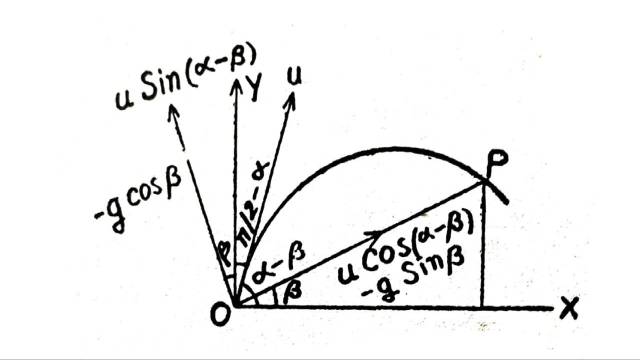
Solution: R=\frac{2u^2\cos \alpha ,\sin(\theta-\beta)}{g\cos^2\beta} \\= \frac{u^2}{g\cos^2\beta} \left[ \sin(2\alpha-\beta)-\sin\beta \right] \\ R=\frac{u^2}{g\cos^2\beta}\left[\sin(2\alpha-\beta)-\sin\beta\right]
यदि u और \beta दिए हों,तब परास पर निर्भर होगी,इस प्रकार यह अधिकतम होगी यदि
2\alpha-\beta= \frac{\pi}{2} \\ \Rightarrow \alpha-\beta = \frac{\pi}{2}-\alpha \\ \angle UOP=\angle UOY
अतः हम कह सकते हैं कि अधिकतम परास के लिए प्रक्षेप्य की दिशा उर्ध्वाधर और नत तल के बीच कोण को समद्विभाजित करेगी
2\alpha-\beta=\frac{\pi}{2} \\ R_{\text{max}}= \frac{u^2}{g(1-\sin^2\beta)}(1-\sin\beta) \\= \frac{u^2}{g(1+\sin\beta)} \cdots(1)
नत तल के नीचे अधिकतम परास
(1) में के \beta स्थान पर -\beta रखने परः
Range down the plane= \frac{u^2}{g(1-\sin\beta)} \cdots(2) \\ \frac{R_{\text{max(up)}}}{R_{\text{max(down)}}}=\frac{1-\sin\beta}{1+\sin\beta}
\beta को \alpha से प्रतिस्थापित करने परः
\frac{R_{\text{max(up)}}}{R_{\text{max(down)}}}=\frac{1-\sin\alpha}{1+\sin\alpha}
Example:5(b).एक कण झुकाव वाले किसी तल के एक बिन्दु से u वेग से फेंका जाता है।सिद्ध कीजिए कि तल के नीचे की ओर अधिकतम परास होगा:
(A particle is projected with the velocity u from a point on a plane inclined at an angle.Prove that the maximum range down the plane.)
\frac{u^2}{g}\sec\beta\left(\sec\beta+\tan\beta\right)
Solution:Question 5(a) के समीकरण (2) से
Range down the plane=\frac{u^2}{g(1-\sin\beta)} \\ R_{\text{max(down)}}=\frac{u^2}{g(1-\sin\beta)} \\=\frac{u^2(1+\sin\beta)}{g(1-\sin\beta)(1+\sin\beta)} \\=\frac{u^2(1+\sin\beta)}{g\cos^2\beta} \\=\frac{u^2}{g} \cdot \frac{1}{\cos\beta}\frac{1+\sin\beta}{\cos\beta} \\ =\frac{u^2}{g}\frac{1}{\cos\beta} \cdot\left( \frac{1}{\cos\beta}+\frac{\sin\beta}{\cos\beta}\right) \\=\frac{u^2}{g}\sec\beta \left(\sec\beta+\tan\beta\right)
Example:6.एक पूर्णरूपेण प्रत्यास्थ गेंद,एक नत समतल जिसका क्षैतिज से झुकाव \beta है,के पाद से फेंकी जाती है।यदि यह समतल को प्रक्षेप बिन्दु से l की दूरी पर टकराकर प्रतिक्षिप्त होती है तथा पहले पथ के मार्ग पर दुबारा जाती,सिद्ध करो कि प्रक्षेप वेग होगा:
(A perfectly elastic ball is thrown from the foot of plane inclined at angle \beta to the horizon. If after striking the plane at a distance l from the point of projection it rebounds and retraces its former path,show that the velocity of projection is)
u=\sqrt{ \frac{gl(1+3\sin\beta)}{2\sin\beta}}
Solution:यदि क्षैतिज के साथ कोण है।यदि यह समतल से टकराकर पहले पथ पर जाती है,यदि यह समतल से 90° कोण पर टकराती है और उसके लिए शर्त है:
v=u+ft \\ 0=u\cos(\alpha-\beta)-g\sin\beta \left(\frac{2u\sin(\alpha-\beta)}{g\cos\beta}\right) \\ \Rightarrow \frac{\cos\beta}{\sin\beta}=\frac{2\sin(\alpha-\beta)}{\cos(\alpha-\beta)} \\ \Rightarrow \cot\beta = 2\tan(\alpha-\beta) \ldots(1)
जबकि यह l दूरी पर तल पर 90° पर टकराती है तो इसका तल के सहारे वेग दूरी l पर घुमने के बाद समाप्त हो जाता है:
v^2=u^2-2fs [ along the plane]
\therefore u^2= 2gl\sin\beta \sec^2(\alpha-\beta) \\ = 2gl\sin\beta \left[ 1+\tan^2(\alpha-\beta) \right] \\ = 2gl\sin\beta \left[ 1+\frac{\cot^2\beta}{4} \right] [(1) से ]
= 2gl\sin\beta \left[ \frac{4\sin^2\beta+(1-\sin^2\beta)}{4\sin^2\beta} \right] \\ \therefore u= \sqrt{\frac{gl(1+3\sin^2\beta)}{2\sin\beta}}
उपर्युक्त उदाहरणों के द्वारा नत समतल पर गति के सवाल हल सहित (Motion Up Inclined Plane Questions with Solution) को समझ सकते हैं।
5.छात्र-छात्राओं के लिए नत समतल पर गति के सवाल (Motion Up Inclined Plane Questions with Solution for Students):

(1.)A bullet is shot with a velocity 200 m/sec.Find the angle at which it is shot,if the greatest height attained by it is 1500 meters.
(2.)A particle is projected with a velocity 80 m/sec at an angle 60° from the foot of a plane at angle 30°.Find the range on the inclined plane.
यदि आप इन सवालों को हल कर लेंगे तो नत समतल पर गति के सवाल हल सहित (Motion Up Inclined Plane Questions with Solution) ठीक से समझ में आ जाएगा।
\begin{array}{|c|} \hline \textbf{**छात्र-छात्राओं से आज का सवाल } \\ \textbf{(Today's Question to Students)**} \\ \textbf{"Q:एक विद्यार्थी हर एक घण्टे के बाद 5 बिस्किट} \\ \textbf{ खाता है तो वह 15 बिस्कुट कितने घण्टे में खाएगा?"} \\ \textbf{दिनांक 11.06.2026 के प्रश्न का उत्तर:45 } \\ \textbf{हल:19+12×3=9+36=45} \\ \hline \end{array}
*”यह आर्टिकल **Satyam Mathematics** ब्लॉग पर **Satyam Coaching Centre** के द्वारा तैयार किया गया है।”*
### 📢 यदि आपको यह गणित का आर्टिकल पसंद आया हो:
* 👥 **मित्रों के साथ शेयर करें:** ज्ञान बांटने से बढ़ता है,इसलिए इसे अपने दोस्तों के साथ ज़रूर साझा करें।
* 🔔 **वेबसाइट को फॉलो करें:** अगर आप यहाँ पहली बार आए हैं, तो हमारे **ईमेल सब्सक्रिप्शन** को फॉलो करें ताकि हर नए आर्टिकल का नोटिफिकेशन आपको तुरंत मिले।
* 💬 **अपने सुझाव दें:** यदि आपकी कोई समस्या है या कोई सुझाव देना चाहते हैं,तो नीचे **कमेंट** करके हमें ज़रूर बताएं।
*पूरा आर्टिकल पढ़ने के लिए आपका वेलकम है!*
Also Read This Article:- Projectile Motion Solved Problems
6.नत समतल पर गति के सवाल हल सहित (Frequently Asked Questions Related to Motion Up Inclined Plane Questions with Solution) से सम्बन्धित अक्सर पूछे जाने वाले प्रश्न:
प्रश्न:1.अधिकतम परास की क्या शर्त है? (Maximum Range ki kya shart hai?):
उत्तर: R=\frac{2u^2\sin(\alpha-\beta)\cos\alpha}{g\cos^2\beta}
इसमें u, \beta व g सब अचर (constant) है,केवल \alpha चर (variable) है।अतः R अधिकतम होगा यदि \alpha का मान अधिकतम अर्थात् 1 हो
\sin(2\alpha-\beta)=1 \Rightarrow 2\alpha-\beta=\frac{\pi}{2}\\ \Rightarrow \alpha=\frac{\pi}{4}+\frac{\beta}{2}
प्रश्न:2.अधिकतम परास की दिशा पर संक्षिप्त टिप्पणी लिखो। (Maximum Range ki disha par sankshipt tippani likho?):
उत्तर:अधिकतम परास के लिए प्रक्षेप कोण की दिशा उर्ध्वाधर तथा नत समतल के बीच के कोण को समद्विभाजित करती है।
प्रश्न:3.अधिकतम परास के लिए कितनी दिशाएँ सम्भव हैं? (Maximum Range ke liye kitani directions sambhav hai?)
उत्तर:दिए हुए वेग से किसी दिए हुए परास के लिए दो प्रक्षेप दिशाएँ सम्भव हैं और ये दिशाएँ नत समतल पर अधिकतम परास के लिए अभीष्ट दिशा से समान कोण बनाती है।
उपर्युक्त प्रश्नों के उत्तर द्वारा नत समतल पर गति के सवाल हल सहित (Motion Up Inclined Plane Questions with Solution) की कुछ विशिष्ट टर्म्स समझ में आ जाएगी।
“यह आर्टिकल Satyam Mathematics ब्लॉग पर Satyam Coaching Centre के द्वारा तैयार किया गया है।”





About Author

Sanjay Kumawat
(1.)**Satyam Narain Kumawat** **Website Name:Satyam Mathematics** *Owner:satyamcoachingcentre.in* *Sthan:Manoharpur,Jaipur (Rajasthan)* **Teaching Mathematics aur Anya Anubhav** ***Shiksha:**B.sc.,B.Ed.,(M.sc. star Ke Mathematics Ko Padhane ka Anubhav),B.com.,M.com. Ke vishayon Ko Padhane ka Anubhav,Philosophy,Psychology,Religious,sanskriti Mein Gahri Ruchi aur Adhyayan ***Anubhav:**phichale 23 varshon se M.sc.,M.com.,Angreji aur Vigyan Vishayon Mein Shikshaka Ka Lamba Anubhav ***Visheshagyata:*Maths,Adhyatma (spiritual),Yog vishayon ka vistrit Gyan* ****In Brief:I have read about M.sc. books,psychology,philosophy,spiritual, vedic,religious,yoga,health and different many knowledgeable books.A dedicated math expert with 23+ years of teaching experience upto M.sc. ,M.com.,English and science.After guiding thousands of students through Satyam Coaching Center,now share Mathematics,Trigonometry (Upto M.sc) and Educational Strategies in simple language on this blog from December 2018.* (2.)**(Technical Expert & Co-Admin):** ***Name:Sanjay Kumawat* *Qualification:Graduate in Mechanical Engineering (B.Tec) in 2013* *Profession:Physics Lecturer* *Teaching Experience:15 Years and Teaching to NEET,JEE Students* *Technical Experience:5 Years Coding and Article Editing,Classic Photo Editing by Laptop in Satyam Coaching Centre Blog* *A school lecturer and digital content strategist.On this blog,he handles all the responsibility of coding,image editing,SEO, and technical management,so that the mathematical content reaches the readers in a very accurate and beautiful form.* Updated on 15.06.2026

