Projectiles
1.प्रक्षेप जो दिए गए बिन्दुओं से गुजरते हों (Projectiles Who Pass Through Given Points),प्रक्षेप्य (Projectiles):
प्रक्षेप जो दिए गए बिन्दुओं से गुजरते हों (Projectiles Who Pass Through Given Points) के इस आर्टिकल में प्रक्षेप की सम्भव दिशाएँ,न्यूनतम वेग,किसी बिन्दु पर पहुँचने में लगा समय आदि ज्ञात करने के लिए कुछ सवालों को हल करके समझने का प्रयास करेंगे।
आपको यह जानकारी रोचक व ज्ञानवर्धक लगे तो अपने मित्रों के साथ इस गणित के आर्टिकल को शेयर करें।यदि आप इस वेबसाइट पर पहली बार आए हैं तो वेबसाइट को फॉलो करें और ईमेल सब्सक्रिप्शन को भी फॉलो करें।जिससे नए आर्टिकल का नोटिफिकेशन आपको मिल सके।यदि आर्टिकल पसन्द आए तो अपने मित्रों के साथ शेयर और लाईक करें जिससे वे भी लाभ उठाए।आपकी कोई समस्या हो या कोई सुझाव देना चाहते हैं तो कमेंट करके बताएं।इस आर्टिकल को पूरा पढ़ें।
Also Read This Article:- Projectile in Dynamics
2.प्रक्षेप जो दिए गए बिन्दुओं से गुजरते हों के उदाहरण (Projectiles Who Pass Through Given Points Illustrations):
Illustration:1.एक उर्ध्वाधर दीवार के पाद से x दूरी पर पृथ्वी के किसी बिन्दु से 45° के प्रक्षेप कोण पर एक गेंद इस तरह फेंकी जाती है कि वह दीवार को ठीक पार करती हुई उसके दूसरी ओर y दूरी पर पृथ्वी पर गिरती है।सिद्ध करो कि दीवार की ऊँचाई होगी।
\frac{x y}{x+y}
(From a point on the ground at a distance x from the foot of a vertical wall a ball is thrown at an angle of 45°,which just clears the top of the wall and afterwards strikes the ground at a distance y on the other side.Show that height of the wall is)
\frac{x y}{x+y}
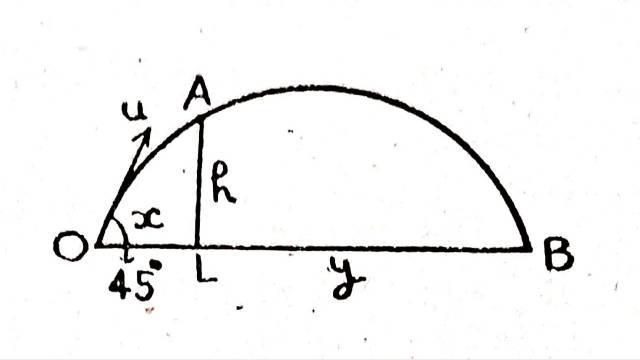
Solution:चित्र के अनुसार परास x+y तथा प्रक्षेप कोण 45° है,अतः यह परास अधिकतम होगीः
=\frac{u^2}{g}=x+y \\ \therefore u^2=g(x+y)
बिन्दु A(x,h) प्रक्षेप पथ पर हैः
h=x \tan \alpha-\frac{1}{2} g \cdot \frac{x^2}{u^2 \cos ^2 \alpha}
Put \alpha=45^{\circ} and u^2=g(x+y) \\ \therefore h=x \tan 45^{\circ}-\frac{1}{2} g \cdot \frac{x^2}{g(x+y) \cos^2 45^{\circ}} \\ =x \cdot 1-\frac{x^2}{2(x+y) \cdot\left(\frac{1}{2}\right) g} \\ =x-\frac{2 x^2}{2(x+y) g} \\ =x-\frac{x^2}{g(x+y)} \\ \Rightarrow h=x-\frac{x^2}{x+y}=\frac{x y}{x+y}
Illustration:2.एक कण क्षैतिज से कोण बनाते हुए फेंका जाता है।यदि वह बिन्दु \left( x_1 ,y_1 \right) में से गुजरता है तथा यदि R परास हो तो सिद्ध करो कि
\tan \alpha = \frac{y_1}{x_1} \cdot \frac{R}{R-x_1}
(A particle is projected in a direction making an angle with the horizon.If the horizontal range is R and it passes through the point \left( x_1 ,y_1 \right) ,show that)
\tan \alpha = \frac{y_1}{x_1} \cdot \frac{R}{R-x_1}
तथा यदि कण बिन्दु \left( x_2 ,y_2 \right) से भी गुजरता हो,तो सिद्ध करो
(and if the projectile also passes through the point \left( x_2 ,y_2 \right) then prove that)
\tan \alpha=\frac{x_2^2 y_1-x_1^2 y_2}{x_1 x_2\left(x_2-x_1\right)}
Solution:माना प्रारम्भिक वेग u तथा प्रक्षेप वेग \alpha है,तब OA क्षैतिज परास R के बराबर है
R=\frac{u^2 \sin 2 x}{g} \cdots(1)
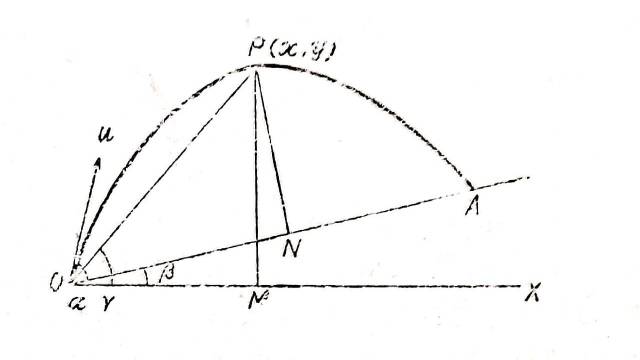
यदि P शीर्ष है तब A M=R-x_1 तथा M P=y_1 तथा
\tan \alpha +\tan \beta=\frac{y_1}{x_1}+\frac{y_1}{R-x_1}=\frac{y_1}{R_1} \cdot \frac{R}{R-x_1}
पुनः \left( x_1 ,y_1 \right) पथ पर कोई बिन्दु है
\therefore y_1=x_1 \tan \alpha-\frac{1}{2} g \cdot \frac{x_2}{u^2 \cos ^2 \alpha} \\ \therefore \frac{y_1}{x_1}=\tan \alpha-\frac{1}{2} g \frac{x_1}{u^2 \cos ^2 \alpha} \\ \Rightarrow \frac{y_1}{x_1}=\tan \alpha\left[1-\frac{1}{2 u^2} \cdot \frac{g x_1}{\sin \alpha \cos \alpha}\right] \\ =\tan \alpha\left[1-\frac{g x_1}{u^2 \sin 2 \alpha}\right] \\=\tan \alpha\left[1-\frac{g x_1}{g R}\right] [(1) से]
=\tan \alpha\left(1-\frac{x_1}{R}\right) \\ \Rightarrow \frac{y_1}{x_1}=\tan \alpha\left(\frac{R-x_1}{R}\right) \\ \Rightarrow \tan \alpha=\frac{y_1}{x_1} \cdot \frac{R}{R-x_1}
अब \left( x_1 ,y_1 \right) तथा \left( x_2 ,y_2 \right) दोनों परवलय पर स्थित है तथा ये बिन्दुपथ के समीकरण को सन्तुष्ट करेंगे:
\therefore y_1=x_1 \tan \alpha-\frac{1}{2} g \frac{x_1}{u^2 \cos ^2 \alpha} \cdots(2) \\ y_2=x_2 \tan \alpha-\frac{1}{2} g \frac{x_1^2}{u^2 \cos ^2 \alpha} \cdots(3)
(1) को x_{2}^2 तथा (2) को x_{1}^2 से गुणा करने तथा घटाने पर
y_1 x_2^2-y_2 x_1^2=\tan \alpha\left(x_1 x_2^2-x_2^2 x_1^2\right) \\ \therefore \tan \alpha=\frac{x_2^2 y_1-x_1^2 y_2}{x_1 x_2\left(x_2-x_1\right)}
Illustration:3.यदि एक कण बिन्दु O से \alpha उनन्तांश पर फेंका जाता है,तब सिद्ध करो कि
(Prove that if a particle be projected from O at an elevation \alpha and after time t the particle is at P,then prove that)
\tan \beta=\frac{1}{2}(\tan \alpha+\tan \theta)
जहाँ \beta व \theta ,OP तथा P पर कण की गति दिशा का क्षैतिज के साथ कोण है।
(Where \beta and \theta are the inclinations with the horizontal of OP and of the direction of motion of the particle,when at P.)
Solution:हम जानते हैं कि तल पर उड्डयन काल होता है:
\frac{2 u \sin (\alpha-\theta)}{g \cos \theta}
जबकि OA से लिया गया समय से आधा समय O से P तक होगाः
\therefore t=\frac{u \sin (\alpha-\theta)}{g \cos \theta} \cdots(1) \\ \tan \beta=\frac{PM}{OM} =\frac{u \sin \alpha \times t-\frac{1}{2} g t^2}{u \cos \alpha} \\ =\frac{\sin \alpha}{\cos \alpha}-\frac{1}{2} \frac{g}{u \cos \alpha} \cdot \frac{u \sin (\alpha-\theta)}{g \cos \alpha} [(1) से ]
=\frac{2 \sin \alpha \cos \theta-\sin (\alpha-\theta)}{2 \cos \alpha \cos \theta} \\ =\frac{2 \sin \alpha \cos \theta-(\sin \alpha \cos \theta-\cos \alpha \sin \theta)}{2 \cos \alpha \cos \theta} \\ =\frac{2 \sin \alpha \cos \theta-\sin \alpha \cos \theta+\cos \alpha \sin \theta}{2 \cos \alpha \cos \theta}\\ =\frac{\sin \alpha \cos \theta+\cos \alpha \sin \theta}{2 \cos \alpha \cos \theta} \\ =\frac{1}{2} \left(\frac{\sin \alpha \cos \theta}{\cos \alpha \cos \theta}+\frac{\cos \alpha \sin \theta}{\cos \alpha \cos \theta}\right) \\ =\frac{1}{2}(\tan \alpha+\tan \theta) \\ \Rightarrow \tan \beta=\frac{1}{2}(\tan \alpha+\tan \theta)
Illustration:4.सिद्ध करो कि h ऊँचाई से फेंकने पर किसी कण का प्रक्षेप बिन्दु से d दूरी पर गिरने के लिए न्यूनतम वेग \sqrt{[g(d-h)]} होगा।
(Prove that the minimum velocity required to project a particle from a height h to fall at distance d from the point of projection is \sqrt{[g(d-h)]} )
Solution:गति का समीकरण (मूलबिन्दु से शुरू प्रक्षेप पथ में)
y=x \tan \alpha-\frac{2 x^2}{2 u^2 \cos ^2 \alpha}
जब कण (0,h) पर पहुँचता है और (d,0) पर पहुँचना चाहिए,हम मूलबिन्दु को या निर्देशांकों को प्रतिस्थापित करते हैं।माना लक्ष्य x=d दूरी और y=-h ऊँचाई पर है:
-h=d \tan \alpha-\frac{g d^2}{2 u^2} \sec ^2 \alpha \\ \Rightarrow-h=d \tan \alpha-\frac{g d^2}{2 u^2}\left(1+\tan ^2 \alpha\right) \\ \frac{g d^2}{2 u^2}\left(1+\tan ^2 \alpha\right)=d \tan \alpha+h \\ \Rightarrow u^2=\frac{g d^2\left(1+\tan ^2 \alpha\right)}{2(d \tan \alpha+h)} \cdots(1)
न्यूनतम वेग के लिए
f^{\prime}(\alpha)=0 \\ f^{\prime}(\alpha)=u^2=\frac{g d^2\left(1+\tan ^2 \alpha\right)}{2(d \tan \alpha+h)} \\ f^{\prime}(\alpha)=\frac{g d^2}{2} \cdot \frac{(d\tan \alpha+h) \cdot 2 \tan \alpha \sec ^2 \alpha-\left(1+\tan ^2 \alpha\right) \cdot d \sec ^2 \alpha}{(d \tan \alpha+h)^2} \\ =\frac{g d^2}{2} \cdot \frac{\left[(d \tan \alpha+h)\left(1+\tan ^2 \alpha\right) 2 \tan \alpha-(1+\tan^2 \alpha) d \sec ^2 \alpha \right]}{(d \tan \alpha+h)^2} \\ =(1+\tan^2 \alpha) \frac{g d^2}{1} \cdot \left[\frac{2(d \tan \alpha+ h) \tan \alpha-d \sec ^2 \alpha}{(d \tan \alpha+h)^2}\right] \\ f^{\prime}(\alpha)=0 से
2\left(d \tan \alpha+h\right) \tan \alpha-d \sec ^2 \alpha=0 \\ \Rightarrow 2 d \tan ^2 \alpha+2 h \tan \alpha-d\left(1+\tan ^2 \alpha\right)=0 \\ \Rightarrow d \tan ^2 \alpha+2 h \tan \alpha-d=0 \\ \tan \alpha=\frac{-2 h+\sqrt{4 h^2-4 \times d(-d)}}{2 d} \\ \Rightarrow \tan \alpha=\frac{-h+\sqrt{h^2+d^2}}{d} \\ \tan \alpha का मान समीकरण (1) में रखने पर:
u^2=\frac{g d^2\left(1+\frac{-h+\sqrt{h^2+d^2}}{d}\right)^2}{2\left(d \frac{\left(-h+\sqrt{h^2+ d^2} \right)}{d}+h\right)} \\ =\frac{g d^2}{2d^2}\left[\frac{\left(d-h+\sqrt{h^2+d^2}\right)^2}{\sqrt{h^2+ d^2}}\right] \\ \Rightarrow u=\sqrt{\frac{g}{2}}\left[\frac{d-h+\sqrt{h^2+d^2}}{\sqrt{h^2+d^2}}\right] \\ \Rightarrow u \approx \sqrt{g(d-h)}
Illustration:5.यदि t_1, t_2 बिन्दु A से B तक उड्डयन काल है तथा \alpha ,AB का क्षैतिज के साथ कोण है,तो सिद्ध करो कि t_1^2+2 t_1 t_2 \sin \alpha+t_2^2, \alpha से स्वतन्त्र होगा।
(Prove that if t_1, t_2 be the times of flight from a point A to a point B and \alpha be the inclination of AB to the horizontal,then prove that t_1^2+2 t_1 t_2 \sin \alpha+t_2^2 is independent of d.)
Solution:हम जानते हैं कि किसी कण को प्रक्षेपित करने पर दो भिन्न दिशाएँ (h,k) पर टक्कर मारने पर होती है अतः दो उड्डयन काल होंगे
t_1^2+t_2^2=-\frac{4}{g^2}\left(g k^2-u^2\right)
तथा t_1^2 t_2^2=\frac{4 d^2}{g^2}=\frac{4\left(h^2+k^2\right)}{g^2}
\alpha , OA का क्षैतिज के साथ कोण है जहाँ O मूलबिन्दु तथा A(h,k) है:
\tan \alpha=\frac{k}{h} \Rightarrow \sin \alpha=\frac{k}{\sqrt{h^2+k^2}} \\ 2 t_1 t_2 \sin \alpha =2 \cdot \frac{2}{g} \cdot \sqrt{\left(h^2+k^2\right)} \cdot \frac{k}{\sqrt{\left(h^2+k^2\right)}} \\ =\frac{4k}{g} \\ \therefore t_1^2+t_2^2+2 t_1 t_2 \sin \alpha=-\frac{u}{g^2}\left(g k-u^2\right)+\frac{4 k}{g} \\ =\frac{4 u^2}{g} \\ \Rightarrow t_1^2+t_2^2+2 t_1 t_2 \sin \alpha=\frac{4 u^2}{g}
जो कि \alpha से स्वतन्त्र हैं।
Illustration:6.दो कण एक ही बिन्दु से एक ही उर्ध्वाधर तल में समान वेग से फेंके जाते हैं।यदि उनको उनके पथ के दूसरे उभयनिष्ठ बिन्दु तक पहुँचने t,t’ समय लगता है तथा उच्चतम बिन्दु तक पहुँचने में T,T’ समय लगता है,तो सिद्ध करो कि t T+t’T’ उनके प्रक्षेप की दिशाओं से स्वतन्त्र होगा।
(Two particle are projected from the same point in the same vertical plane with equal velocities.If t,t’ be the times taken to reach the other common point of their paths and T,T’ the times so the highest point,Show that tT+t’T’ is independent of the direction of projection.)
Solution:माना u उभयनिष्ठ वेग तथा \alpha, \beta प्रक्षेप कोण हैं,तब
\frac{u \sin \alpha}{g}=T तथा \frac{u \sin \beta}{g}=T^{ \prime} \cdots(1)
माना उभयनिष्ठ बिन्दु के निर्देशांक (x,y) हैं,तब
x=(u \cos \alpha) t=(u \cos \beta) t \cdots(2) \\ \therefore t^{\prime} T^{\prime}+t T=\frac{x}{u \cos \alpha} \cdot \frac{u \sin \alpha}{g}+\frac{x}{u \cos \beta} \cdot \frac{u \sin \beta}{g} \\ =\frac{x}{g}(\tan \alpha+\tan \beta) \cdots(3)
अब (x,y) दोनों प्रक्षेप्य पथ पर स्थित हैं
\therefore \quad y=x \tan \alpha-\frac{1}{2} g \cdot \frac{x^2}{u^2 \cos ^2 \alpha} \\ y=x \tan \beta-\frac{1}{2} g \cdot \frac{x^2}{u^2 \cos^2 \beta}
घटाने पर:
x(\tan \alpha-\tan \beta)=\frac{1}{2} \frac{g x^2}{u^2}\left(\sec ^2 \alpha-\sec ^2 \beta\right) \\ \Rightarrow(\tan \alpha-\tan \beta)=\frac{g x}{2 u^2}\left(\tan ^2 \alpha-\tan ^2 \beta\right) \\ \therefore \frac{x}{g}(\tan \alpha+\tan \beta)=\frac{2 u^2}{g^2} \cdots(4)
(3) और (4) से:
tT+t^{\prime} T^{\prime}=\frac{2 u^2}{g^2}
जो कि प्रक्षेप की दिशाओं से स्वतन्त्र हैं।
Illustration:7.एक जहाज पर समुद्र की सतह से h ऊँचाई पर किले से तोप,गोले बरसा रही है।यह मानते हुए कि किले तथा जहाज से दो तोपें \sqrt{(2ag)} वेग से गोले बरसा रही हैं,सिद्ध करो कि,
(A ship is under fire from the guns of a foot h feet above sea level.Assuming that two guns of the ship and the fort fire with a velocity \sqrt{(2ag)} ,prove that)
\frac{R_1}{R_2}=\sqrt{\left(\frac{a+h}{a-h}\right)}
जहाँ R_1 तथा R_2 तोपों के वे अधिकतम परास हैं,जहाँ तक किले और जहाज से गोले की मार की जा सकती है।
(Where R_1 and R_2 are the greatest horizontal ranges at which the foot and the ship can engage.)
Solution:माना A किला है तथा L जहाज की स्थिति है जहाँ LA=R
तल की अधिकतम परास=\frac{u^2}{g(1+\sin \beta)} \\ \therefore R=\frac{u^2}{g(1+\sin \beta)} \\ \Rightarrow R=\frac{2 a g}{g\left(1+\frac{h}{R}\right)} \quad[\because u=\sqrt{(2 a g)}] \cdots(1) \\ \therefore R+h=2 a \Rightarrow R=2 a-h \cdots(2)
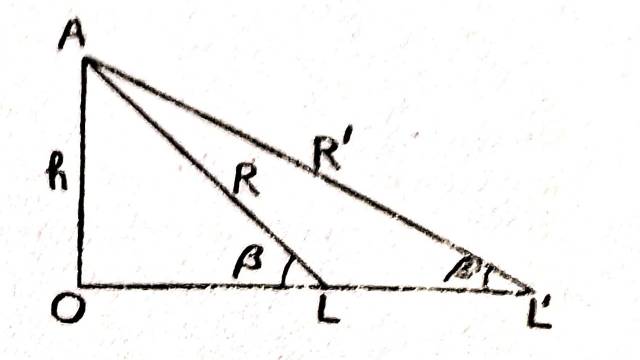
पुनः AL’ अधिकतम परास है अतः L’ जहाज की चरम स्थिति है जहाँ से किले पर गोले दागे जाते हैं:
\therefore R^{\prime}=\frac{u^2}{g\left(1-\sin \beta^{\prime}\right)}=\frac{2 a g}{g\left(1-\frac{h}{R}\right)} \cdots(3)\\ \therefore R^{\prime}-h=2 a \Rightarrow R^{\prime}=2 a+h \cdots(4) \\ OL^{\prime}=R_1 तथा OL=R_2 \\ OL^2=AL^2-AO^2 \\ R_2^2=(a-h)^2-h^2=4 a^2-4 a h+h^2-h^2 \\ \Rightarrow R_2^2=4 a^2-4 a h=4 a(a-h) \\ \Rightarrow R_2=\sqrt{4 a(a-h)} \cdots(5) \\ O{L^{\prime}}^2=A L^2-AO^2 \\ \Rightarrow R_1^2=(2 a+h)^2-h^2=4 a^2+4 a h+h^2-h^2 \\ \Rightarrow R_1^2=4 a(a+h) \Rightarrow R_1=\sqrt{4 a(a+h)} \cdots(6)
(5) व (6) से:
\frac{R_1}{R_2}=\frac{\sqrt{h a(a+h)}}{\sqrt{h a(a-h)}} \\ \Rightarrow \frac{R_1}{R_2}= \sqrt{\left(\frac{a+h}{a-h}\right)}
Illustration:8.एक समलम्बक जिसकी समान्तर भुजाओं की लम्बाई 2a एवं 4a है तथा असमान्तर भुजाओं की लम्बाई 2a है को पृथ्वी पर उर्ध्वाधर इस प्रकार रखकर खड़ा किया गया है कि सबसे बड़ी भुजा पृथ्वी के सम्पर्क वाली भुजा के सिरे से इस प्रकार प्रक्षेपित किया जाता है कि यह समलम्बक के अन्य सिरों को छुए।प्रदर्शित कीजिए कि गेंद द्वारा तय की गई अधिकतम ऊँचाई \frac{4a}{\sqrt{3}} है।
(A trapezium with parallel sides of length 2a and 4a and non-parallel sides each of length 2a is placed on the ground with its plane vertical and with the ground. A ball is projected from the corner lying on the ground so as just to graze the other three corners of the trapezium.Show that the greatest height reached by the ball in \frac{4a}{\sqrt{3}} .)
Solution:समलम्बक चतुर्भुज की भुजाएँ 2a (ऊपर वाली) और 4a (नीचे वाली) समान्तर है तथा असमान्तर भुजाएँ 2a हैं।अतः यह सममित समलम्बक (Iscosceles) चतुर्भुज है।माना कि आधार (bottom) भुजा x-अक्ष पर है जिसके कोने (0,0) से (4a,0) है।तल पर कोना P_1=(0,0), P_4=(4 a,0) ऊपर वाला कोना जिसकी लम्बाई में केन्द्र पर है।इसके x-निर्देशांक a तथा 3a हैं।
समलम्बक की ऊँचाई h समकोण त्रिभुज से
h=\sqrt{(2 a)^2-a^2} [a आधार है]
=\sqrt{3 a^2}=\sqrt{3} a
प्रक्षेप्य (0,0) , (a, a \sqrt{3}) तथा (3a, a \sqrt{3}) से गुजरता है।
प्रक्षेप्य की समीकरण प्रक्षेप्य का पथ परवलय है।अतः यह (0,0) से प्रारम्भ होता है और यह समलम्बक के केन्द्र से सममित है (शीर्ष x=2a)
इसकी परास 4a होनी चाहिए
पथ का समीकरण
y=kx(4a-x)
बिन्दु (a, a \sqrt{3}) रखने परः
a \sqrt{3}=k(a)(h a-a) \Rightarrow 3k a^2=a \sqrt{3} \\ \Rightarrow k=\frac{a \sqrt{3}}{3 a^2}=\frac{1}{a \sqrt{3}}
महत्तम ऊँचाई परास के मध्य बिन्दु पर है:x=2a
H=k(2 a) \cdot(4 a-2 a)=k(2 a)(2 a) \\ \Rightarrow H=4 k a^2 \\ \Rightarrow H=4 a^2 \cdot \frac{1}{a \sqrt{3}}\left(\because k=\frac{1}{a \sqrt{3}}\right) \\ \Rightarrow H=\frac{4 a}{\sqrt{3}}
Illustration:9.एक मीनार से भूमि पर एक वस्तु का अवनमन कोण क्षैतिज के नीचे \phi है।एक गोली उन्नतांश कोण \alpha पर दागी गई है जो उस वस्तु को नहीं लगी तथा भूमि पर एक अन्य बिन्दु को लगी जिसका अवनमन कोण \psi है।सिद्ध कीजिए कि सही उन्नतांश कोण \theta निम्न से प्राप्त होता है।
(From a tower an object on the ground was observed at an elevation \alpha below the horizon.A gun was fired at an elevation but the shot missing the object struck the ground at a point whose depression was \psi .Prove that the correct elevation \theta of the gun is gives by)
\frac{\cos \theta \sin (\theta+\phi)}{\cos \alpha \sin (\alpha+\psi)}=\frac{\cos ^2 \phi \cdot \sin \psi}{\cos ^2 \psi \cdot \sin \phi}
Solution:उन्नतांश कोण \alpha है,तब गोली वस्तु को नहीं लगी परन्तु B पर गिरती है जिसके निर्देशांक है।पथ का समीकरण है:
y=x \tan \alpha-\frac{1}{2} g \frac{x^2}{u^2 \cos ^2 \alpha}
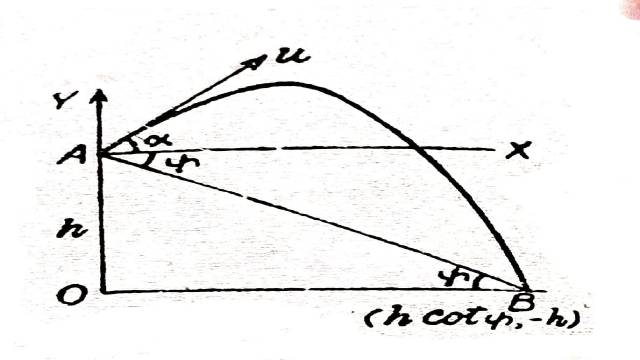
बिन्दु B इस पर स्थित है:
-h=h \cot \phi \tan \alpha-\frac{1}{2} g h^2 \frac{\cot ^2 \phi}{u^2 \cos ^2 \alpha} \\ \Rightarrow \cot \psi \tan \alpha+1=\frac{1}{2} g \frac{h \cot ^2 \psi}{u^2 \cos ^2 \alpha} \cdots(1) \\ \Rightarrow \frac{\cos \psi \sin \alpha+\sin \psi \cos \alpha}{\sin \psi \cos \alpha}=\frac{1}{2} \frac{g h}{u^2} \frac{\cos ^2 \psi}{\sin^2 \psi \cos ^2 \alpha} \cdots(2)\\ \Rightarrow \cos \alpha \sin (\phi+\alpha)=\frac{1}{2} \frac{g h \cos ^2 \psi}{u^2 \sin \psi} \cdots(3)
इसी प्रकार अवनमन कोण (वस्तु का) \phi है तब सही अवनमन कोण \theta
\alpha को \theta से तथा \psi को \phi से (2) में बदलने परः
\cos \theta \sin (\phi+\theta)=\frac{1}{2} \frac{g h \cos^2 \phi}{u^2 \sin \phi} \cdots(4)
(4) को (3) से विभाजित करने परः
\frac{\cos \theta \sin (\phi+\theta)}{\cos \alpha \sin (\psi+\alpha)}=\frac{\frac{\frac{1}{2} g h \cos ^2 \phi}{u^2 \sin \phi}}{\frac{1}{2} \frac{gh \cos ^2 \psi}{\sin \psi}} \\ \Rightarrow \frac{\cos \theta \sin (\phi+ \theta)}{\cos \alpha \sin (\alpha+\psi)}=\frac{\cos ^2 \phi \sin \psi}{\cos ^2 \psi \sin \phi}
उपर्युक्त प्रश्नों के उत्तर द्वारा प्रक्षेप जो दिए गए बिन्दुओं से गुजरते हों (Projectiles Who Pass Through Given Points),प्रक्षेप्य (Projectiles) के बारे में और अधिक जानकारी प्राप्त कर सकते हैं।

Also Read This Article:- Projectiles in Dynamics
3.प्रक्षेप जो दिए गए बिन्दुओं से गुजरते हों (Frequently Asked Questions Related to Projectiles Who Pass Through Given Points),प्रक्षेप्य (Projectiles) से सम्बन्धित अक्सर पूछे जाने वाले प्रश्न:
प्रश्न:1.दिए हुए वेग से किसी प्रक्षेप्य के फेंके जाने पर एक निश्चित बिन्दु में से गुजरने के लिए सम्भव दिशाएँ ज्ञात करने का सूत्र (A Formula to Find the Possible Directions of Projection of a Projectile Passing Through a Fixed Point Projected with a Given Velocity of Projection):
उत्तर: y=x \tan \alpha-\frac{g x^2}{2 u^2 \cos^2 \alpha} P(a,b) से गुजरने परः
रखने
\tan ^2 \alpha-\frac{2 u^2}{a g} \tan \alpha+\left(1+\frac{2 u^2 b}{g a^2}\right)=0
प्रश्न:2.प्रक्षेप्य का दिए हुए बिन्दु में से गुजरने के लिए न्यूनतम वेग ज्ञात करने का सूत्र (The Formula to Find the Least Velocity of Projection Through a Given Point):
उत्तर: u \geq [g(b+d)]^\frac{1}{2}
उदाहरण 4 के अनुसार b=-h रखने परः
u \geq [g(b-h)]^\frac{1}{2}
प्रश्न:3.दिए हुए बिन्दु तक पहुँचने में लगा समय ज्ञात करने का सूत्र (A Formula to Find the Time of Flight to a Given Point):
उत्तर: t_1^2+t_2^2=\frac{4\left(u^2-b g\right)}{g^2} तथा t_1^2 t_2^2=\frac{4 d^2}{g^2}
उपर्युक्त प्रश्नों के उत्तर द्वारा प्रक्षेप जो दिए गए बिन्दुओं से गुजरते हों (Projectiles Who Pass Through Given Points),प्रक्षेप्य (Projectiles) के बारे में और अधिक जानकारी प्राप्त कर सकते हैं।
| No. | Social Media | Url |
|---|---|---|
| 1. | click here | |
| 2. | you tube | click here |
| 3. | click here | |
| 4. | click here | |
| 5. | Facebook Page | click here |
| 6. | click here | |
| 7. | click here |
Projectiles Who Pass Through Given Points
प्रक्षेप जो दिए गए बिन्दुओं से गुजरते हों
(Projectiles Who Pass Through Given Points)
Projectiles Who Pass Through Given Points
प्रक्षेप जो दिए गए बिन्दुओं से गुजरते हों (Projectiles Who Pass Through Given Points)
के इस आर्टिकल में प्रक्षेप की सम्भव दिशाएँ,न्यूनतम वेग,किसी बिन्दु पर पहुँचने में लगा
समय आदि ज्ञात करने के लिए कुछ सवालों को हल करके समझने का प्रयास करेंगे।


About Author

Satyam
Lekhak Ke Baare Mein (About the Author) **Satyam Narain Kumawat** **Website Name:Satyam Mathematics** *Owner:satyamcoachingcentre.in* *Sthan:Manoharpur,Jaipur (Rajasthan)* **Teaching Mathematics aur Anya Anubhav** ***Shiksha:**B.sc.,B.Ed.,(M.sc. star Ke Mathematics Ko Padhane ka Anubhav),B.com.,M.com. Ke vishayon Ko Padhane ka Anubhav,Philosophy,Psychology,Religious,sanskriti Mein Gahri Ruchi aur Adhyayan ***Anubhav:**phichale 23 varshon se M.sc.,M.com.,Angreji aur Vigyan Vishayon Mein Shikshaka Ka Lamba Anubhav ***Visheshagyata:*Maths,Adhyatma (spiritual),Yog vishayon ka vistrit Gyan* ****In Brief:I have read about M.sc. books,psychology,philosophy,spiritual, vedic,religious,yoga,health and different many knowledgeable books.I have about 23 years teaching experience upto M.sc. ,M.com.,English and science. Updated on 18.06.2026

