Projectile in Dynamics
1.गतिविज्ञान में प्रक्षेप्य (Projectile in Dynamics),प्रक्षेप्य (Projectiles):
गतिविज्ञान में प्रक्षेप्य (Projectile in Dynamics) के इस आर्टिकल में किसी कण द्वारा प्रक्षेप्य गति करने पर परास,उड्डयन काल आदि ज्ञात करने के लिए कुछ सवालों को हल करके समझने का प्रयास करेंगे।
आपको यह जानकारी रोचक व ज्ञानवर्धक लगे तो अपने मित्रों के साथ इस गणित के आर्टिकल को शेयर करें।यदि आप इस वेबसाइट पर पहली बार आए हैं तो वेबसाइट को फॉलो करें और ईमेल सब्सक्रिप्शन को भी फॉलो करें।जिससे नए आर्टिकल का नोटिफिकेशन आपको मिल सके।यदि आर्टिकल पसन्द आए तो अपने मित्रों के साथ शेयर और लाईक करें जिससे वे भी लाभ उठाए।आपकी कोई समस्या हो या कोई सुझाव देना चाहते हैं तो कमेंट करके बताएं।इस आर्टिकल को पूरा पढ़ें।
Also Read This Article:- Projectiles in Dynamics
2.गतिविज्ञान में प्रक्षेप्य के साधित उदाहरण (Projectile in Dynamics Solved Illustrations):
Illustration:10.एक तोप एक गतिशील प्लेटफॉर्म से चलाई जाती है।जब प्लेटफॉर्म v वेग से आगे की तरफ चलता है तो गोली का परास R और पीछे की तरफ इसी वेग से चलता है तो परास S प्राप्त होता है।सिद्ध करो कि तोप का उन्नतांश कोण होगा:
(A gun is fired from a moving platform and the range of the shoot is observed to be R when the platform is moving forward and S when moving backward with the same velocity v.Prove that the elevation of the gun is \tan ^{-1}\left[\frac{g(R-S)^2}{4 v^2(R+S)}\right] )
Solution:माना प्रारम्भिक वेग u तथा प्रक्षेप वेग \alpha है।प्लेटफॉर्म की गति का क्षैतिज घटक u \cos \alpha +v या u \cos \alpha-v है प्लेटफॉर्म के आगे या पीछे की गति करने पर।गति का प्रारम्भिक उर्ध्वाधर घटक u \sin \alpha है जबकि मन्दन g है।
उड्डयन काल=\frac{2 u \sin \alpha}{g} \\ \therefore R=\frac{2 u \sin \alpha}{g}(u \cos \alpha+v), \\ S=\frac{2 u \sin \alpha}{g}(u \cos \alpha-v \\ \therefore(R-S)^2=\frac{16 u^2 \sin ^2 \alpha \cdot v^2}{g^2} तथा R+S=\frac{4 u^2 \sin \alpha \cos \alpha}{g} \\ \therefore \frac{g}{4 v^2} \cdot \frac{(R-S)^2}{R+S}=\frac{g}{4 v^2} \cdot \frac{16 u^2 \sin ^2 \alpha \cdot v^2}{g^2} \times \frac{g}{4 u^2 \sin \alpha \cos \alpha}=\tan \alpha \\ \therefore \alpha=\tan ^{-1}\left[\frac{g(R-S)^2}{4 v^2(R+S)}\right]
Illustration:11.यदि किसी प्रक्षेप-पथ की नाभि प्रक्षेप बिन्दु में से जाने वाले क्षैतिज तल से उतना ही नीचे है जितना कि उसका शीर्ष उसके ऊपर है,तो सिद्ध कीजिए कि प्रक्षेप कोण \sin ^{-1}\left(\frac{1}{\sqrt{3}}\right) होगा।
(If the focus of a trajectory lies as much below the horizontal plane through the point of projection as the vertex is above,prove that the angle of projection is \sin ^{-1}\left(\frac{1}{\sqrt{3}}\right) .)
Solution:माना एक कण का प्रारम्भिक वेग u और क्षैतिज से \alpha कोण पर प्रक्षेपित किया जाता है।प्रक्षेपण बिन्दु को मूलबिन्दु (0,0) मानने पर प्रक्षेपण वक्र (trajectory) का समीकरण हैः
y=x \tan \alpha-\frac{2 x^2}{2 u^2 \cos ^2 \alpha}
प्रक्षेप वक्र के शीर्ष (vertex) की ऊँचाई H होगीः
H=\frac{u^2 \sin ^2 \alpha}{2 g}
परवलयिक प्रक्षेप वक्र के लिए,शीर्ष से फोकस (focus) की उर्ध्वाधर दूरी a (नाभ्यान्तर) निम्न हैः
a=\frac{u^2 \cos ^2 \alpha}{2 g}
चूँकि प्रक्षेप वक्र नीचे की ओर खुलता है,इसलिए फोकस शीर्ष से a दूरी नीचे स्थित है।प्रक्षेपण के बिन्दु (क्षैतिज तल) के सापेक्ष फोकस की ऊँचाई y_F होगी:
Y_F=H-a=\frac{u^2 \sin ^2 \alpha}{2 g}-\frac{u^2 \cos ^2 \alpha}{2 g}
प्रश्न के अनुसार फोकस क्षैतिज तल से उतना ही नीचे है जितना शीर्ष ऊपर है।अर्थात् Y_F=-H \\ -\frac{u^2 \sin ^2 \alpha}{2 g}=\frac{u^2 \sin ^2 \alpha}{2 g}-\frac{u^2 \cos ^2 \alpha}{2 g} \\ \Rightarrow 2\left(\frac{u^2 \sin ^2 \alpha}{2 g}\right)=\frac{u^2 \cos ^2 \alpha}{2 g} \\ \Rightarrow-2 \sin ^2 \alpha=\cos ^2 \alpha \\ \Rightarrow 2 \sin ^2 \alpha=1-\sin ^2 \alpha \\ \Rightarrow 3 \sin ^2 \alpha=1 \\ \Rightarrow \sin ^2 \alpha=\frac{1}{3} \\ \Rightarrow \sin \alpha=\frac{1}{\sqrt{3}} \\ \Rightarrow \alpha=\sin ^{-1}\left(\frac{1}{\sqrt{3}}\right)
Illustration:12.कुछ कण एक उर्ध्वाधर तल में \alpha प्रक्षेप कोण पर एक ही बिन्दु से \frac{1}{\sqrt{(\sin \theta)}} के समानुपाती वेग से फेंके जाते हैं।उनके पथों के शीर्षों का बिन्दुपथ ज्ञात करिए।
(Some particles are projected from the same point in a vertical plane with velocities which varies as \frac{1}{\sqrt{(\sin \theta)}} , \alpha being the angle of projection.Find the locus of the vertices of the paths.)
Solution:यहाँ u=\frac{k}{\sqrt{(\sin \theta)}}
यदि शीर्ष के निर्देशांक (x,y) हों,तो
x=\frac{u^2 \sin \alpha \cos \alpha}{g} \\ =\frac{k^2}{\sin \theta} \cdot \frac{\sin \theta \cos \theta}{g} \quad[\therefore \alpha=\theta] \\ \Rightarrow x=\frac{k^2}{g} \cos \theta \cdots(1)\\ y=\frac{u^2 \sin ^2 \alpha}{2 g} \\ =\frac{k^2}{\sin \theta} \cdot \frac{\sin ^2 \theta}{2 g} \\ \Rightarrow y=\frac{k^2 \sin \theta}{2 g} \\ \Rightarrow 2 y=\frac{k^2}{g} \sin \theta \cdots(2)
समीकरण (1) तथा (2) का वर्ग करके जोड़ने परः
x^2+4 y^2=\left(\frac{k^2}{g}\right)^2 \cos ^2 \theta+\left(\frac{k^2}{g}\right)^2 \sin ^2 \theta \\ =\left(\frac{k^2}{g}\right)^2\left(\cos ^2 \theta+\sin ^2 \theta\right) \\ \Rightarrow x^2+4 y^2 =\left(\frac{k^2}{g}\right)^2 ,जहाँ k अचर है।
Illustration:13.एक कण समतल से h ऊँचाई पर स्थित किसी बिन्दु से वेग \sqrt{2 a g} से फेंका जाता है।सिद्ध कीजिए कि महत्तम परास=2 \sqrt{a(a+h)} एवं महत्तम परास के लिए प्रक्षेप कोण है जहाँ \tan ^2 \alpha=\frac{a}{a+h}
(A particle is projected under gravity with velocity \sqrt{2 a g} from a point at a height h above a level.Show that Maximum Range=2 \sqrt{a(a+h)} and angle of projection is for maximum range where \tan ^2 \alpha=\frac{a}{a+h} .)
Solution:गति का समीकरण हैः
y=x \tan \alpha-\frac{1}{2} g \cdot \frac{x^2}{u^2 \cos ^2 \alpha} \\ \therefore-h=R \tan \alpha-\frac{1}{2} g \frac{R^2}{u^2}\left(1+\tan ^2 \alpha\right) \\ \therefore R^2 \tan ^2 \alpha-2 \frac{u^2}{g} R \tan \alpha+R^2-\frac{2 h u^2}{g}=0 \cdots(1)
प्रक्षेप कोण ज्ञात करने के लिए उपर्युक्त समीकरण का \alpha के सापेक्ष अवकलन करने पर क्योंकि अधिकतम परास देगी:
\frac{d R}{d \alpha}=0 जब R अधिकतम है
\therefore 2 R^2 \cdot \tan \alpha \cdot \sec ^2 \alpha-\frac{2 u^2}{g} R \sec \alpha=0 \\ \therefore \frac{2 R \sec ^2 \alpha}{g}\left(y R \tan \alpha-u^2\right)=0 \\ \therefore \tan \alpha= \frac{u^2}{g R} \cdots(2) \\ u^2=2ag रखने पर (given)
\tan \alpha=\frac{2 a g}{g R}=\frac{2 a}{R}
समीकरण में यह मान रखने परः
R^2 \cdot \frac{4 a^2}{R^2}-2 \cdot \frac{2 a g}{g} R \cdot \frac{2 a}{R}+R^2-\frac{2 h}{g} 2 a g=0 \\ \Rightarrow 4 a^2-8 a^2+R^2-4 a h=0 \\ \Rightarrow R^2=4 a h+4 a^2 \\ \Rightarrow R=4 a(a+h) \\ \Rightarrow R=2 \sqrt{a(a+h)}
पुनः समीकरण (3) सेः
\tan \alpha=\frac{2 a}{2 \sqrt{a(a+h)}}=\sqrt{\left(\frac{a}{a+h}\right)} \\ \Rightarrow \tan ^2 \alpha=\frac{a}{a+h}
Illustration:14.कुछ कण एक उर्ध्वाधर वृत्त के व्यासों पर नीचे की ओर फिसलते हैं।सिद्ध करो कि उनके उत्तरगामी परवलीय पथों की नाभियों का बिन्दुपथ एक वृत्त है।
(Some particles fall down the diameters of a vertical circle. Prove that the locus of the foci of their subsequent paths is a circle.)
Solution:किसी व्यास AP पर विचार करो।P बिन्दु पर वेग= \sqrt{2g \text{PM}} जहाँ PM,A के नीचे उर्ध्वाधर गहराई है।चूँकि P परवलय पर है और इसका वेग \sqrt{2gh} जहाँ h,P के ऊपर नियता की ऊँचाई है।
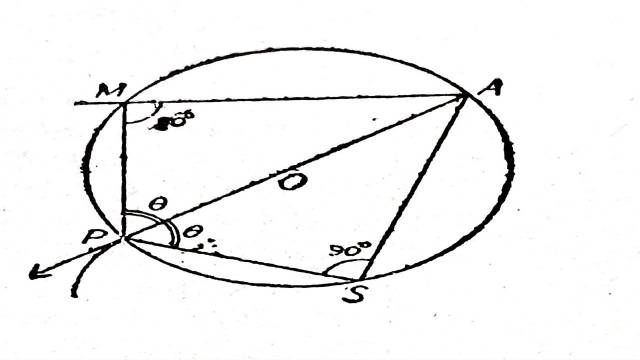
\therefore h=PM अर्थात् AM नियता है।अब PS=PM खींचे,वे P पर स्पर्शरेखा पर बराबर झुके हुए हैं अर्थात् AP.तब S नाभि है।अब \triangle APM \cong \triangle APS \\ \therefore \angle ASP=\angle AMP परन्तु \angle A M P=\frac{\pi}{2} \\ \therefore \angle A S P=\frac{\pi}{2}
S वृत्त पर है क्योंकि अर्धवृत्त का कोण समकोण है।अतः S का बिन्दुपथ दिया हुआ वृत्त है।
Illustration:15.बहुत से पिण्ड एक उर्ध्वाधर वृत्त के उच्चतम बिन्दु से विरामावस्था से रवाना होकर उसकी विभिन्न जीवाओं पर नीचे की ओर फिसलते हैं और फिर स्वतन्त्र रूप से चलते हैं।सिद्ध करो कि उनके उत्तरगामी पथों की नाभियों का पथ एक वृत्त होता है जिसकी त्रिज्या दिए हुए वृत्त की त्रिज्या की आधी है।
(A number of bodies slide from rest down the chords of a vertical circle starting from its highest point and afterwards move freely.Prove that the locus of the foci of their subsequent paths is a circle whose radius is half that of the given circle.)
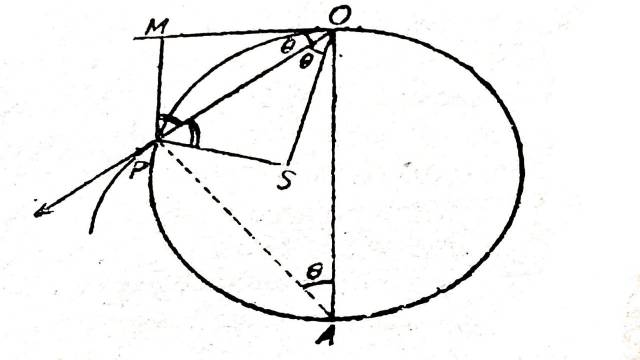
Solution:यहाँ कण उच्चतम बिन्दु O से नीचे जीवा OP पर फिसलते हैं।हम सिद्ध कर सकते हैं कि OM नियता है जहाँ कण P से OP पर गमन करता है।यदि PM,PS के बराबर खींचा जाए ताकि OP,PM व PS से बराबर झुकी हुई हो तो S नाभि है।अब
\triangle OPM \cong \triangle ORS \\ \angle OMP=\angle OSP=90^{\circ} और \angle POM = \angle POS=\theta
माना (R, \phi) ,S के निर्देशांक है जिसका बिन्दुपथ ज्ञात करना है।
तब R=OS तथा \phi=2 \theta \\ R=OS=OP \cos \theta=(2 a \sin \theta) \cos \theta \\ \because \angle OPA=\frac{\pi}{2} (अर्धवृत्त में)
\therefore O P=O A \sin \theta=2 a \sin \theta \\ \therefore R=a \sin 2 \theta \Rightarrow R=a \sin \phi, \because \phi=2\theta
\therefore S का बिन्दुपथ r=a \sin \theta है जो कि वृत्त है जिसका व्यास a है;अर्थात् त्रिज्या \frac{1}{2} a अर्थात् दिए हुए वृत्त की त्रिज्या की आधी है।
Illustration:16.यदि कुछ कण एक उर्ध्वाधर वृत्त की जीवाओं पर वृत्त के निम्नतम बिन्दु तक फिसलें और फिर स्वतन्त्रता से चलने दिए जाएं,तो सिद्ध करो कि उनके उत्तरगामी पथों के नाभि का बिन्दुपथ एक हृदयाभ होता है।
(If particles slide down the chords of a vertical circle to its lowest point and are then allowed to move freely,prove that the locus of the foci of their subsequent paths is cardioide.)
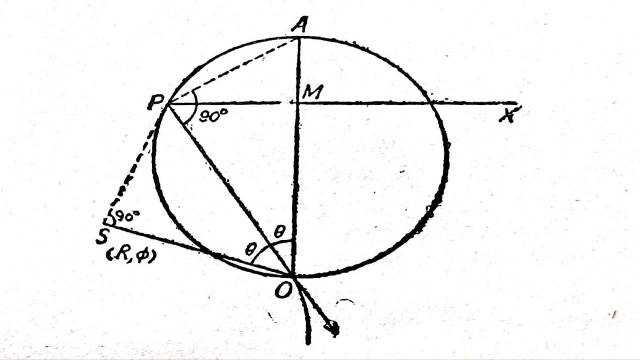
Solution:माना OA=2a उर्ध्वाधर व्यास और O निम्नतम बिन्दु लिया गया है जो ध्रुव है।OP जीवा है जो \theta कोण के साथ व्यास के साथ झुकी है।इसका त्वरण g \cdot \cos \theta होगा,अतः O पर वेग होगाः
\sqrt{(2 f S)}=\sqrt{(2 g \cos \theta \cdot O P)}
परन्तु OM=O P \cdot \cos \theta \Rightarrow v=\sqrt{(2 g \cdot O M)} \cdots(1)
O पर कण के पहुँचने के बाद यह परवलय में गमन करेगा और O इस परवलय का प्रारम्भिक बिन्दु होगा।हम जानते हैं कि किसी बिन्दु पर प्रक्षेप्य का वेग,नियता से उस बिन्दु तक स्वतन्त्रतापूर्वक कण के गिरने पर प्राप्त वेग के समान है।
\therefore u=\sqrt{(2gh)} \cdots(2) जहाँ h,O से ऊपर नियता की ऊँचाई है।(1) व (2) की तुलना करने परः
h=OM क्षैतिज रेखा PM,P से गुजरने वाली,परवलय की नियता है जिस पर कण O से गमन करता है और PO परवलय के बिन्दु O पर स्पर्शरेखा है।
पुनः हम जानते हैं कि परवलय में नाभि से किसी बिन्दु की दूरी,नियता से दूरी के समान है।हम यह भी जानते हैं कि किसी बिन्दु पर स्पर्शरेखा उस बिन्दु पर नाभीय दूरी और इससे नियता पर अभिलम्ब के बीच के कोण को समद्विभाजित करती है।
उपर्युक्त गुणधर्मों को ध्यान में रखते हुए एक रेखा खींचते है OS=OM और OP स्पर्शरेखा से समान कोण \theta बनाती है जैसे कि OM,OP से जुड़ी है।तब S बिन्दु परवलय की नाभि है और माना इसके निर्देशांक (R , \phi) है जिसका बिन्दुपथ ज्ञात करना है।चित्र से स्पष्ट है कि \phi=2 \theta और R=OS=OM=OP \cos \theta=(2 a \cos \theta) \cos \theta \\ \triangle APM से
OP=OA \cos \theta=2 a \cos \theta \\ \therefore R=a(1+\cos 2 \theta) \\ \Rightarrow R=a(1+\cos \phi)
अतः नाभि (R , \phi) का बिन्दुपथ r=a(1+\cos \phi) है जिसे हम जानते हैं कि यह हृदयाभ की समीकरण है।
उपर्युक्त उदाहरणों के द्वारा गतिविज्ञान में प्रक्षेप्य (Projectile in Dynamics),प्रक्षेप्य (Projectiles) को समझ सकते हैं।

Also Read This Article:- Horizontal Motion in Resisting Medium
3.गतिविज्ञान में प्रक्षेप्य (Frequently Asked Questions Related to Projectile in Dynamics),प्रक्षेप्य (Projectiles) से सम्बन्धित अक्सर पूछे जाने वाले प्रश्न:
प्रश्न:1.प्रक्षेप्य पथ के शीर्ष के निर्देशांक (Coordinates of the Vertex of the Projectile Path):
उत्तर:परवलय के शीर्ष के निर्देशांक \left(\frac{u^2 \sin \alpha \cos \alpha}{g}, \frac{u^2 \sin ^2 \alpha}{2 g}\right)
प्रश्न:2.प्रक्षेप्य पथ के नाभि के निर्देशांक (Coordinates of the Focus of the Projectile Path):
उत्तर: \left(\frac{u^2 \sin 2 \alpha}{2 g},-\frac{u^2 \cos 2 \alpha}{2 g}\right)
प्रश्न:3.प्रक्षेप्य पथ की नियता का समीकरण (Equation of Directrix of Projectile Path):
उत्तर:नियता का समीकरण: y=\frac{u^2 \cos ^2 \alpha}{2 g}
प्रश्न:4.प्रक्षेप्य पथ की अधिकतम ऊँचाई (Greatest Height of Projectile Path):
उत्तर:अधिकतम ऊँचाई H=\frac{u^2 \sin ^2 \alpha}{2 g}
उपर्युक्त प्रश्नों के उत्तर द्वारा गतिविज्ञान में प्रक्षेप्य (Projectile in Dynamics),प्रक्षेप्य (Projectiles) के बारे में और अधिक जानकारी प्राप्त कर सकते हैं।
| No. | Social Media | Url |
|---|---|---|
| 1. | click here | |
| 2. | you tube | click here |
| 3. | click here | |
| 4. | click here | |
| 5. | Facebook Page | click here |
| 6. | click here | |
| 7. | click here |
Projectile in Dynamics
गतिविज्ञान में प्रक्षेप्य
(Projectile in Dynamics)
Projectile in Dynamics
गतिविज्ञान में प्रक्षेप्य (Projectile in Dynamics) के इस आर्टिकल में किसी कण द्वारा प्रक्षेप्य
गति करने पर परास,उड्डयन काल आदि ज्ञात करने के लिए कुछ सवालों को हल करके
समझने का प्रयास करेंगे।





About Author

Satyam
Lekhak Ke Baare Mein (About the Author) **Satyam Narain Kumawat** **Website Name:Satyam Mathematics** *Owner:satyamcoachingcentre.in* *Sthan:Manoharpur,Jaipur (Rajasthan)* **Teaching Mathematics aur Anya Anubhav** ***Shiksha:**B.sc.,B.Ed.,(M.sc. star Ke Mathematics Ko Padhane ka Anubhav),B.com.,M.com. Ke vishayon Ko Padhane ka Anubhav,Philosophy,Psychology,Religious,sanskriti Mein Gahri Ruchi aur Adhyayan ***Anubhav:**phichale 23 varshon se M.sc.,M.com.,Angreji aur Vigyan Vishayon Mein Shikshaka Ka Lamba Anubhav ***Visheshagyata:*Maths,Adhyatma (spiritual),Yog vishayon ka vistrit Gyan* ****In Brief:I have read about M.sc. books,psychology,philosophy,spiritual, vedic,religious,yoga,health and different many knowledgeable books.I have about 23 years teaching experience upto M.sc. ,M.com.,English and science. Updated on 18.06.2026

