NCERT Class 10 Maths Chapter 2 Exercise 2.1 Solutions:How to Find Zeroes from Graphs (Key Points)
1.NCERT Class 10 Maths Chapter 2 Exercise 2.1 Solutions:How to Find Zeroes from Graphs (Key Points):
In this article “NCERT Class 10 Maths Chapter 2 Exercise 2.1 Solutions”,we will find zeroes of Polynomials (Representation in Graphs).
Also Read This Article:- Coordinate Plane in Class 9
2.NCERT Class 10 Maths Chapter 2 Exercise 2.1 Key Points
Key Concepts & Summary:Chapter 2.1 Polynomials
1.Basic Definitions & Degree of a Polynomial
(1.)Polynomial:An algebraic expression of the form P(x) = a_n x^n + a_{n-1} x^{n-1} + \dots + a_1 x + a_0 ,where powers of x are non-negative integers.
(2.)Degree of a Polynomial:The highest power of the variable x in a polynomial p(x).
(3.)Non-Polynomial Expressions:Expressions with negative or fractional exponents (e.g. \frac{1}{x-1}, \sqrt{x} + 2,) are not polynomials.
(4.)Types of Polynomials (Based on Degree)
(5.)Value and Zeroes of a Polynomial
Value of p(x) at x=k:Obtained by substituting x=k into p(x),denoted as p(k).
(i)Zero of a Polynomial:A real number k is called a zero of the polynomial p(x) if p(k)=0.
(ii) Zero of a Linear Polynomial:For p(x)=ax+b,setting P(k) = 0 \Rightarrow k = -\frac{b}{a} = -\frac{\text{constant term}}{\text{coefficient of x}} .
(6.)Geometrical Meaning of the Zeroes of a Polynomial
(ii)The zeroes of a polynomial p(x) are precisely the x-coordinates of the points where the graph of y=p(x) intersects the x-axis.
(ii)Linear Polynomial (y=ax+b):
(iii)Graph shape:Straight Line Intersects the x-axis at exactly 1 point: \left(-\frac{b}{a}, 0\right)
(iv) Has exactly 1 zero.
(v)Quadratic Polynomial (y = ax^2 + bx + c):
(vi)Graph shape:Parabola
(a)Opens upwards (\cup) if a > 0
(b)Opens downwards (\cap) if a < 0 Possible Cases for Zeroes:
Case 1:Intersects x-axis at 2 distinct points \Rightarrow 2 distinct zeroes.
Case 2:Touches x-axis at 1 point (coincident points) \Rightarrow 1 zero or 2 equal zeroes.
Case 3:Does not touch or intersect the x-axis \Rightarrow No real zeroes.
(vii)Cubic Polynomial (y = ax^3 + bx^2 + cx + d):
(a)Can intersect the x-axis at a maximum of 3 points.
(b)Has at most 3 zeroes.
(7.)Important Rule to Remember A polynomial p(x) of degree n can intersect the x-axis at most n points,and therefore has at most n zeroes (8.)Value of zeroes of a Quadratic polynomial
P(x) = ax^2 + bx + c \ (a \neq 0) \\ \text{Sum of zeroes} = -\left(\frac{\text{coefficient of } x}{\text{coefficient of } x^2}\right) = -\frac{b}{a} \\ \text{Product of zeroes} = \frac{\text{constant term}}{\text{coefficient of } x^2} = \frac{c}{a}
If \alpha \text{ and } \beta are zeroes of polynomial then quadratic polynomial
K\left[x^2 - (\text{sum of zeroes})x + \text{product of polynomial}\right] \\
\Rightarrow K \left[x^2 - (\alpha + \beta)x + \alpha\beta\right] \\
\text{Hence } \alpha + \beta = -\frac{b}{a} \text{ and } \alpha\beta = \frac{b}{a}
3.How to Find Zeroes from Graphs
Example:1.The graphs of y=p(x) are given in Figure below for some polynomials p(x).Find the number of zeroes of p(x),in each case.
Example:1(i).
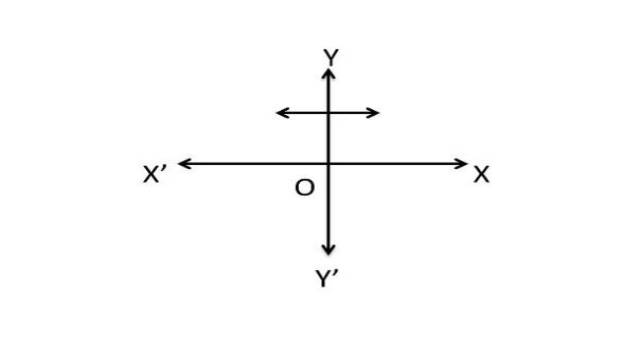
Solution:Polynomial not touches the x-axis. So,number of zeroes=0
Example:1(ii)
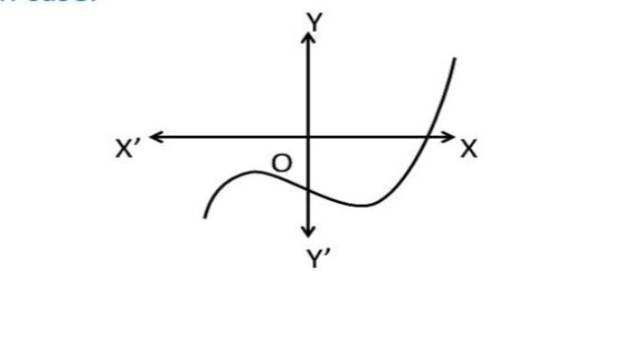
Solution:Polynomial intersects the x-axis at one point. So,number of zeroes=1
Example:1(iii)
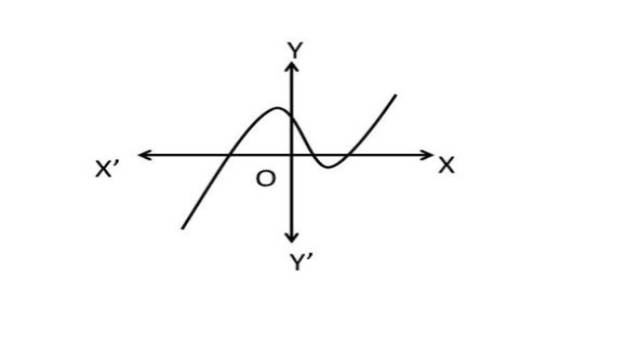
Solution:Polynomial intersects the x-axis at three point. So,number of zeroes=3
Example:1(iv)
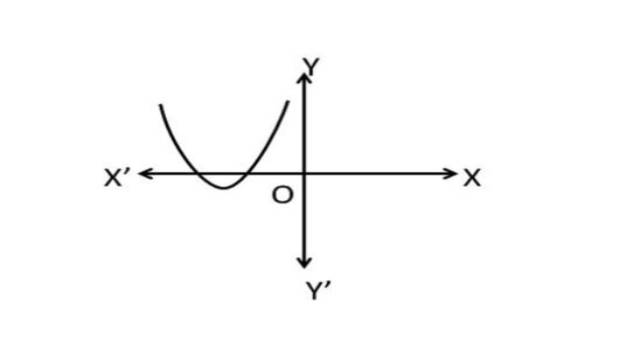
Solution:Polynomial intersects the x-axis at two point. So,number of zeroes=2
Example:1(v)
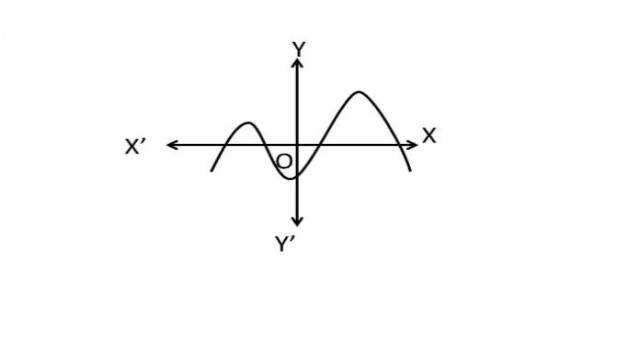
Solution:Polynomial intersects the x-axis at four point. So,number of zeroes=4
Example:1(vi)
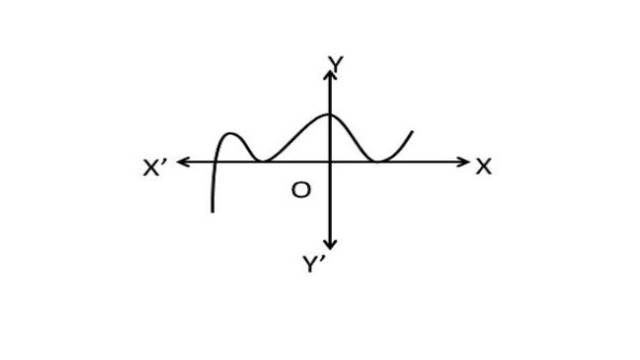
Solution:Polynomial intersects the x-axis at three point. So,number of zeroes=3
By solving the above examples,one can understand the NCERT Class 10 Maths Chapter 2 Exercise 2.1 Solutions.
Also Read This Article:- Distance Between Two Points Class 9
4.Practice Question for Students
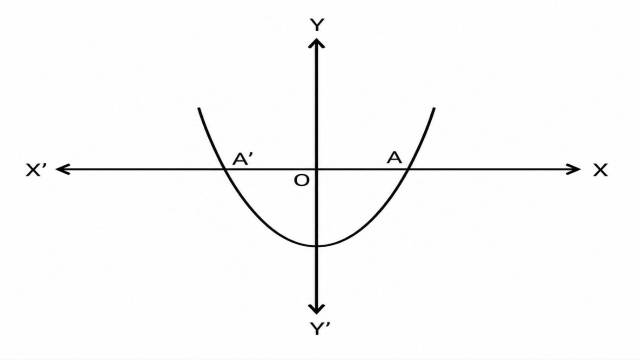
The graphs of y=p(x) are given in Figure below for some polynomials p(x).Find the number of zeroes of p(x),in each case.
graph (1.)
(2.)
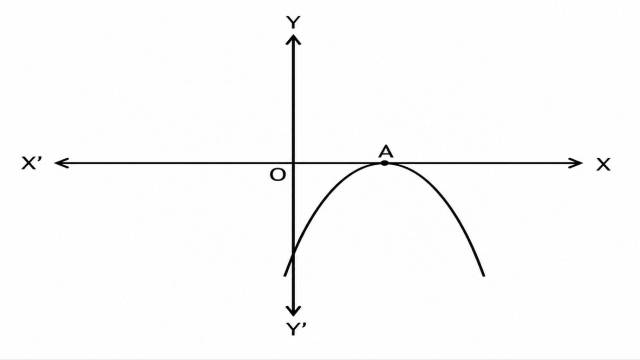
Answer:(1.)2 (2.)1
By solving the above questions, one can understand the NCERT Class 10 Maths Chapter 2 Exercise 2.1 Solutions well because the concept is well understood when you solve the questions practically.
### 📢 If you liked this math article:
* 👥 **Share with Friends:** Knowledge grows by sharing, so be sure to share it with your friends.
* 🔔 **Follow the Website:** If this is your first time here, follow our **email subscription** so that you get instant notifications for every new article.
* 💬 **Give Your Suggestions:** If you have any issues or would like to make any suggestions, do let us know by **commenting** below.
*Welcome to read the full article!*
Also Read This Article:- Zero of a function
5.Frequently Asked Questions Related to NCERT Class 10 Maths Chapter 2 Exercise 2.1
Q:1.What is a linear polynomial?
Ans:A polynomial of degree 1 is called a linear polynomial.
For example 2x-3
Q:2.Define a Quadratic Polynomial
Ans:A polynomial of degree 2 is called a quadratic polynomial.
Example: 2x^2 + 3x - \frac{3}{5}
Q:3.What is meant by a three dimensional polynomial?
Ans:A polynomial of degree 3 is called a cubic polynomial.
Example: -x^2 + x^3
By answering the above questions,you can know about the primary terms of NCERT Class 10 Maths Chapter 2 Exercise 2.1 Solutions.
6.छात्र-छात्राओं से आज का प्रश्न (Today’s Questions to Students):
🎯 विनर्स कॉर्नर:क्या आप इस सवाल का सही जवाब दे सकते हैं?अपने नाम के साथ नीचे कमेंट करें!सही जवाब देने वाले Top Students के नाम हमारी आगे post/is article ke update में Photo ya Special Mention के साथ publish की जाएगी।अपना जवाब अभी दर्ज करें!👇
निम्नलिखित भिन्न को आरोही क्रम में लिखो। (Write the following fractions in ascending order.)
\frac{5}{9}, \frac{3}{5}, \frac{9}{12}
*पिछली प्रश्नोत्तरी का उत्तर*
पुल की लम्बाई=समय×चाल
=15 मिनट×5 किमी प्रति घंटा
=15 मिनट× \frac{5 \times 1000}{60} मीटर/मिनट
=1250 मीटर
*Previous Quiz Solution*
Bridge length=time×speed
=15 min×5 kmph
=15 minutes× \frac{5 \times 1000}{60} m/min
=1250 m
*”This article has been prepared by **Satyam Coaching Centre** on the **Satyam Mathematics** blog.”*
About Author

Sanjay Kumawat
(1.)**Satyam Narain Kumawat** **Website Name:Satyam Mathematics** *Owner:satyamcoachingcentre.in* *Sthan:Manoharpur,Jaipur (Rajasthan)* **Teaching Mathematics aur Anya Anubhav** ***Shiksha:**B.sc.,B.Ed.,(M.sc. star Ke Mathematics Ko Padhane ka Anubhav),B.com.,M.com. Ke vishayon Ko Padhane ka Anubhav,Philosophy,Psychology,Religious,sanskriti Mein Gahri Ruchi aur Adhyayan ***Anubhav:**phichale 23 varshon se M.sc.,M.com.,Angreji aur Vigyan Vishayon Mein Shikshaka Ka Lamba Anubhav ***Visheshagyata:*Maths,Adhyatma (spiritual),Yog vishayon ka vistrit Gyan* ****In Brief:I have read about M.sc. books,psychology,philosophy,spiritual, vedic,religious,yoga,health and different many knowledgeable books.A dedicated math expert with 23+ years of teaching experience upto M.sc. ,M.com.,English and science.After guiding thousands of students through Satyam Coaching Center,now share Mathematics,Trigonometry (Upto M.sc) and Educational Strategies in simple language on this blog from December 2018.* (2.)**(Technical Expert & Co-Admin):** ***Name:Sanjay Kumawat* *Qualification:Graduate in Mechanical Engineering (B.Tec) in 2013* *Profession:Physics Lecturer* *Teaching Experience:15 Years and Teaching to NEET,JEE Students* *Technical Experience:5 Years Coding and Article Editing,Classic Photo Editing by Laptop in Satyam Coaching Centre Blog* *A school lecturer and digital content strategist.On this blog,he handles all the responsibility of coding,image editing,SEO, and technical management,so that the mathematical content reaches the readers in a very accurate and beautiful form.* Updated on 15.06.2026

)