Euclid Division Algorithm Class 10 and Important Questions with Solution
1.Euclid Division Algorithm Class 10 and Important Questions with Solution:
We continue our discussion on Euclid Division Algorithm Class 10 and Important Questions with Solution in this article.We begin with two very important properties of positive integers namely the Euclid’s division algorithm and the fundamental theorem of arithmetic.
Also Read This Article:- Surface Area and Volume Board Question:Important Board Question with Solutions Class 10
2.Theorem:1.Euclid’s Division Lemma
Given positive integers a and b,there exist unique integers q and r satisfying a=bq+r,\quad 0 \leq r< b
This result was perhaps known for a long time,but was recorded in Book VII of Euclid’s Elements.Euclid’s division algorithm is based on this lemma.
Euclid’s division algorithm is a technique to compute the Highest Common Factor (HCF) of two given positive integers.Recall that the HCF of two positive integers a and b is the largest positive integer d that divides both a and b.Following are some properties of divisibility
(1.) \pm 1 divides every non-zero integer.
(2.)0 is divisible by every non-zero integer.
(3.)0 does not divided any integer.
(4.)If a and b are non-zero integers,then division operation can be apply on these integers.
(5.)If a and b are non-zero integers,and q and r are other two integers such that:
a=bq+r
a and b are called dividend and divisor respectively,q and r are called quotient and remainder respectively.
Theorem:1.1.Euclid’s Division Algorithm
To obtain the HCF of two positive integers,say c and d,with c > d , follow the steps below:
Step:1.Apply Euclid’s division lemma,to c and d.So,we find whole numbers,q and r such that c=dq+r, \quad 0 \leq r< d
Step:2.If r=0,d is the HCF of c and d.If r \neq 0 ,apply the division lemma to d and r.
Step:3.continue the process till the remainder is zero.The divisor at this stage will be the required HCF.
This algorithm works because HCF(c,d)=HCF(d,r) where the symbol HCF(c,d) denotes the HCF of c and d,etc.
Also Read This Article:- Euclidean division
3.Euclid Division Algorithm Class 10 and Important Questions
Example:1.Use Euclid’s division algorithm to find the HCF of:
Example:1(i).135 and 225
Solution:Step:1.Given integers are 225 and 135 such that 225 > 135. Applying Euclid’s division lemma to 225 and 135,we get
225=135×1+90
Step:2.since the remainder.So,applying the Euclid’s division lemma to divisor 135 and remainder 90 to get:
135=90×1=45
Step:3.As the remainder 45 \neq 0 , we apply Euclid’s division lemma to divisor 90 and new remainder 45 to get
90=45×2+0
The remainder at this stage is zero.So,the last divisor 45 is the HCF of 225 and 135.
Example:1(ii).196 and 38220
Solution:Step:1.Given integers are 196 and 38220 such that 38220 > 196.Applying Euclid’s division lemma to 38220 and 196,we get
38220=196×195+0
The remainder at this stage is zero.So,the last divisor 196 is the HCF of 196 and 38220.
Example:1(iii).867 and 255
Solution:Step:1.Given integers are 867 and 255 such that 867 >255 .Applying Euclid’s division lemma to 867 and 255,we get
867=255×3+102
Step:2.since the remainder 102 \neq 0 .So,applying the Euclid’s division lemma to divisor 255 and remainder 102 to get:
255=102×2+51
Step:3.As the remainder 51 \neq 0, we apply Euclid’s division lemma to divisor 102 and new remainder 102,to get
102=51×2+0
The remainder at this stage is zero.So,the last divisor 51 is the HCF of 867 and 255.
Example:2.Show that any positive odd integer is of the form 6q+1 or 6q+3 or 6q+5,where q is some integer
Solution:Let a be any odd integer and b=6. By applying Euclid’s Division Lemma, there exists integers q and r such that:
a=6q+r, \quad \text{where } 0 \leq r<6\\ \Rightarrow a=6q, \text{ or } a=6q+1, \text{ or } a= 6q+2, \text{ or } a=6q+3, \text{ or } a=6q+4, \text{ or } a=6q+5\\ \left( \because 0 \leq r < 6 \Rightarrow r=0,1,2,3,4,5 \right) \\ \Rightarrow a=6q+1, 6q+3, 6q+5
a=6q+1,6q+3,6q+5 ( \because a is odd integer)
\therefore a \neq 6q+2 , a \neq 6q+4
Hence,any odd integer is of the form 4q+1,4q+3,4q+5
Example:3.An army contingent of 616 members is to much behind an army band of 32 members in a parade.The two groups are to march in the same number of columns.What is the maximum number.
Solution:The two groups,consisting of an army contingent of 616 members and army band of 32 members have to march in the same number of columns.
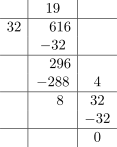
The maximum number of columns is the HCF of 616 and 32.Applying Euclid’s division lemma to 616 and 32 we get
616=32×19+8
since the remainder 8 \neq 0 ,therefore we consider the divisor 32 and the remainder 8 and apply Euclid’s division Lemma to get:
32=8×4+0
The remainder is zero at this stage.So,the last divisor 8 is the HCF of 616 and 32.
The maximum number of columns in which they can march is 8.
In brief,this division process can be understand as:
Example:4.Use Euclid’s division lemma to show that the square of any integer is either of the form 3m or 3m+1 for some integer m.
Solution:Let a be any positive integer.Then,it is of the form 3q or 3q+1 or 3q+2
So,we have the following cases:
(i)when a=3q, we have a^2=(3q)^2=9q^2=3q(3q)=3m , where m=q(3q)
(ii)when a=3q+1, we have a^2=(3q+1)^2=9q^2+6q+1\\ =3(3q^2+2q)+1\\ =3m+1 , where m=q(3q+2)
(iii)when a=(3q+2),we have a^2=(3q+2)^2=9q^2+12q+4\\ =9q^2+12q+3+1\\ =3(3q^2+4q+1)+1\\ =3m+1 where m=3 q^2+4q+1
Hence, a is of the form 3m or 3m+1
Example:5.Use Euclid’s division lemma to show that the cube of any positive integers of the form 9m,9m+1,9m+8.
Solution:Let a be any positive integer. Then,it is of the form 3q or 3q+1 or 3q+2.
So,we have the following cases:
(i).when a=3q,we have
a^3=(3q)^3=27q^3=9(3q^3)=9m where m=3 q^3
(ii)when a=3q+1,we have
a^3=(3q+1)^3=27q^3+27q^2+9q+1 \\ =(27q^3+27q^2+9q)+1 \\ =9(3q^3+3q^2+q)+1\\ =9m+1 where m=3q^3+3q^2+q
(iii)when a=3q+2,we have
a^3=(3q+2)^3=27q^3+54q^2+36q+8\\ =9(3q^3+6q^2+4q)+8 \\ =9m+8 where m=3q^3+6q^2+4q
Hence,a is the form 9m or 9m+1 or 9m+8
With the above illustrations,one can understand the Euclid Division Algorithm Class 10 and Important Questions with Solution.
4.Euclid Division Algorithm Class 10 Practice Problems for Students
(1.)Find the largest number which divides 245 and 2053 leaving remainder 5 in each case.
(2.)Show that any positive odd integer is of the form 4q+1 or 4q+3,where q is some integer.
Answer:(1.)16
By solving the above questions,you can understand the Euclid Division Algorithm Class 10 and Important Questions with Solution well because the concept is well understood when you solve it practically.
Also Read This Article:- Important Board Questions Class 10:Area Related to Circles
5.Frequently Asked Questions Related to Euclid Division Algorithm Class 10 and Important Questions with Solution
Q:1.What is the difference between Euclid’s, division lemma and algorithm?
Ans:Euclid’s division lemma and algorithm are so closely interlinked that people often call former as the division algorithm also.
Q:2.Does Euclid’s Division Algorithm Apply for Positive Integers?
Ans:Although Euclid’s Division Algoithm is stated for only positive integers, it can be extended for all integers except zero, i.e., However, we shall not discuss this aspect here.
Q:3.Who invented Euclid’s Lemma?
Ans:Euclid was a Greek mathematician,who initiated a new way of thinking the study of Geometry.He is famous for his Elements of Geometry and important contributions to the number system.Among these one is the Euclid’s Lemma.
By answering the above questions,you can know about the primary terms of Euclid Division Algorithm Class 10 and Important Questions with Solution.
\begin{array}{|c|} \hline \text{Today's Question to Students} \\ \text{"एक वर्गाकार प्लाट की भुजा पर आठ-आठ} \\ \text{स्तम्भ गढ़े हुए हैं।उसके चारों ओर कुल कितने स्तम्भ हैं?} \\ \text{"On the side of a square plot are} \\ \text{eight pillar each.How many pillar are there around him?" } \\ \text{दिनांक 21.06.2026 के प्रश्न का उत्तर:1kg } \\ \text{Let the Weight of Book=x kg.} \\ \text{Answer to Question Dated 21.06.2026:} \\ \text{Weight of Book=1 kg.} \\ x=\frac{1}{2} \text{kg}+\frac{1}{2}x \\ \frac{1}{2}x=\frac{1}{2} \text{kg} \Rightarrow x=1 \text{ kg} \\ \hline \end{array}
*”This article has been prepared by **Satyam Coaching Centre** on the **Satyam Mathematics** blog.”*


About Author

Sanjay Kumawat
(1.)**Satyam Narain Kumawat** **Website Name:Satyam Mathematics** *Owner:satyamcoachingcentre.in* *Sthan:Manoharpur,Jaipur (Rajasthan)* **Teaching Mathematics aur Anya Anubhav** ***Shiksha:**B.sc.,B.Ed.,(M.sc. star Ke Mathematics Ko Padhane ka Anubhav),B.com.,M.com. Ke vishayon Ko Padhane ka Anubhav,Philosophy,Psychology,Religious,sanskriti Mein Gahri Ruchi aur Adhyayan ***Anubhav:**phichale 23 varshon se M.sc.,M.com.,Angreji aur Vigyan Vishayon Mein Shikshaka Ka Lamba Anubhav ***Visheshagyata:*Maths,Adhyatma (spiritual),Yog vishayon ka vistrit Gyan* ****In Brief:I have read about M.sc. books,psychology,philosophy,spiritual, vedic,religious,yoga,health and different many knowledgeable books.A dedicated math expert with 23+ years of teaching experience upto M.sc. ,M.com.,English and science.After guiding thousands of students through Satyam Coaching Center,now share Mathematics,Trigonometry (Upto M.sc) and Educational Strategies in simple language on this blog from December 2018.* (2.)**(Technical Expert & Co-Admin):** ***Name:Sanjay Kumawat* *Qualification:Graduate in Mechanical Engineering (B.Tec) in 2013* *Profession:Physics Lecturer* *Teaching Experience:15 Years and Teaching to NEET,JEE Students* *Technical Experience:5 Years Coding and Article Editing,Classic Photo Editing by Laptop in Satyam Coaching Centre Blog* *A school lecturer and digital content strategist.On this blog,he handles all the responsibility of coding,image editing,SEO, and technical management,so that the mathematical content reaches the readers in a very accurate and beautiful form.* Updated on 15.06.2026

