How to Find Index Number by Chain Base Method?
1.श्रृंखला आधार रीति से सूचकांक कैसे ज्ञात करें? (How to Find Index Number by Chain Base Method?):
क्या आप श्रृंखला आधार से सूचकांक ज्ञात करने में कठिनाई महसूस करते हैं।जानिए श्रृंखला आधार रीति से सूचकांक कैसे ज्ञात करें? (How to Find Index Number by Chain Base Method?) सम्पूर्ण डिटेल सरल तरीके से।
Also Read This Article:- Simple Average of Price Relative Method
2.श्रृंखला आधार रीति से सूचकांक कैसे ज्ञात करें पर आधारित उदाहरण (Examples Based on How to Find Index Number by Chain Base Method?):
Example:1.एक वस्तु का विभिन्न वर्षों में मूल्य निम्नलिखित है।विभिन्न वर्षों के सूचकांक श्रृंखला आधार रीति पर तैयार कीजिए और फिर उनको 1966 से सम्बन्धित कीजिए:
(The price of an article for different years is as follows.Prepare index numbers by chain base method chained to 1966):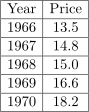
[B. Com.,Gorakhpur, 1972]
Solution:Calculation Table of Chain Base Method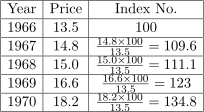
Example:2.निम्न सारणी तीन वस्तु-वगों के थोक मूल्यों को प्रदर्शित करती है।1969 से श्रृंखलाबद्ध करके श्रृंखला सूचकांक बनाइए:
(The following table gives the wholesale prices of three commodity-groups. Construct chain base index numbers chained to 1969):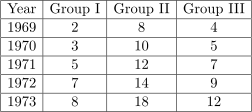
[B. Com.,Agra, 1974; M. Com.,Agra,1973]
Solution:Construction of Chain Base Indices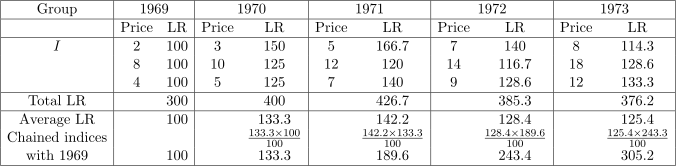
[श्रृंखला मूल्यानुपात:100,133.3,142.1,128.2,125.4; 1969 से श्रृंखलित सूचकांक 100,133.3,189.6, 243.4,305.2]
Example:3.निम्नलिखित सारणी में 1962 से 1965 तक की पाँच वस्तुओं की औसत थोक कीमतें दी हुई है। श्रृंखला-आधार रीति से सूचकांक निकालिए:
(Average wholesale prices of five commodities for the years 1962 to 1965 are given in the following table.Find index numbers by chain base method):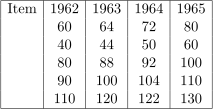
[B. Com.,Vikram,1972)
Solution:Construction of Chain Base Indices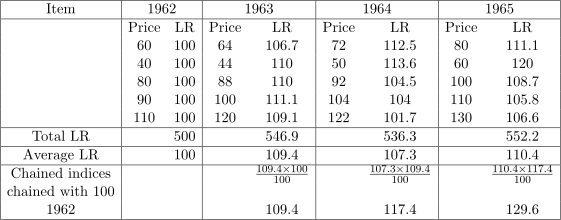 `
`
[श्रृंखला मूल्यानुपात:100,109.4,107.3,110.4, 1962 से श्रृंबलित:100,109.4,117.4,129.6]
Example:4.निम्नलिखित समंकों से 1950 वर्ष को आधार मानकर,समान्तर माध्य और मध्यका का प्रयोग करते हुए श्रृंखला-आधार विधि द्वारा कानपुर के कीमत-सूचकांक निमित कीजिए:
(Construct by the chain base method, index numbers of prices in Kanpur on base 1950, taking arithmetic mean and median as the types of average for the following data):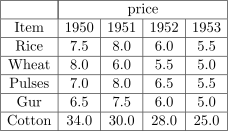
[1.A.S.,1967]
Solution:Construction of Chain Base Indices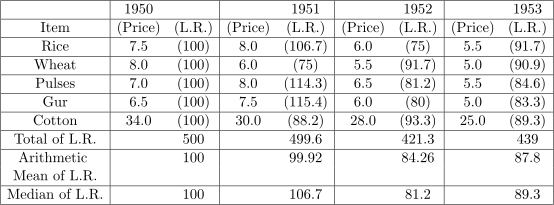
[समान्तर माध्य:100,99.9,84:2,74:1;मध्यका: 100,106-7,86-7,77-5]

Example:5.नीचे दिए हुए स्थिर-आधार सूचकांकों से श्रृंखलाधार सूचकांक बनाइए:
(From the following fixed base index numbers,construct chain base index numbers):
(B. Com.,Agra,1972
Solution:Construction from Fixed Base Index Nos. to Chain Base Index NOs.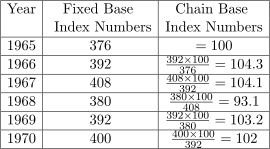
[100,104.3,104.1,93.1,103.2,102]
Example:6.नीचे दिए हुए श्रृंखला-आधार सूचकांकों से स्थिर-आधार सूचकांक निकालिए:
(From the chain base index numbers given below, prepare fixed base index numbers):
Solution:Fixed Based Index Number from C. B. Index NO. (Chained with 1960)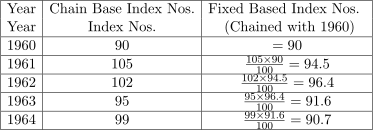
[90,94.5,96.4,91.6,90.7]
Example:7.निम्नांकित श्रृंखला-आधार सूचकांकों में स्थिर-आधार वाले सूचकांक बनाइए:
(From the chain base index numbers given below, prepare fixed base index number):
[B. Com., Meerut,1975, U. P.C. S, 1972]
Solution:Fixed Base I Numbers from C.B. Index NOs. (Chained with 1945)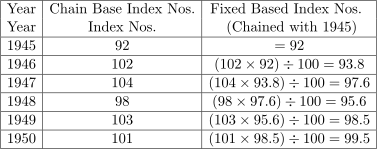
[92, 93-8, 97-6, 95-6, 98-5, 99-51
Example:8.नीचे दिए शृंखला-आधार सूचकांक से स्थिर-आधार सूचकांक तैयार कीजिए:
(From the chain base index numbers given below,prepare fixed base index numbers)
[B. Com. Hons.,Delhi, 1976)
Solution:Fixed Base Numbers from C.B. Index NOs. from C.B. Index NOs. (Chained with 1971)
(110,176,246,493,739]
Example:9.निम्न सामग्री से आधार-वर्ष को 1969 से 1971 में परिवर्तित करके नई सूचकांक श्रेणी बनाइए:
(Shift the base year from 1969 to 1971 in the following series of index numbers):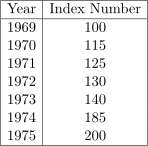
[M. A., Meerut,1976]
Solution:Calculation Table of Base Year Conversion 1969 to 1971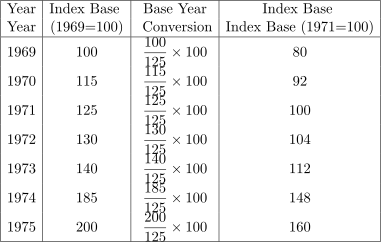
[80,92,100,104,112,148,160]
Example:10.सूचकांकों की निम्न श्रेणी को (a) 1955 के आधार पर और (b) 1957 आधार-वर्ष पर पुनर्निमित कीजिए:
(Reconstruct the following series of indices on the base of (a) 1955, and (b) 1957):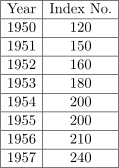
[B. Com.,Bombay,Oct.,1968]
Solution:(a)Calculation Table of Base year Conversion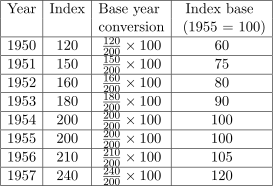
(b)Base year Conversion into 1957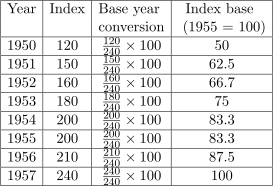
[(a) 60,75,80,90,100,100,105,120;(b) 50, 62.5, 66.7, 75, 83.3,83.3,87.5]
उपर्युक्त उदाहरणों के हल द्वारा श्रृंखला आधार रीति से सूचकांक कैसे ज्ञात करें? (How to Find Index Number by Chain Base Method?) को समझ सकते हैं।
3.छात्र-छात्राओं के लिए श्रृंखला आधार रीति से सूचकांक कैसे ज्ञात करें के प्रैक्टिस क्वेश्चंस (Practice Questions of How to Find Index Number by Chain Base Method? for Students) से सम्बन्धित अक्सर पूछे जाने वाले प्रश्न:

(1.)निम्न स्थिर आधार सूचकांकों से श्रृंखला आधार सूचकांक ज्ञात कीजिए:
(Calculate Chain Base Index No. from the following Fixed Base Index Nos.)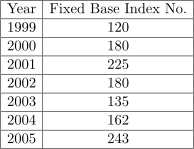
(2.)निम्न श्रृंखला आधार सूचकांकों से स्थिर आधार सूचकांकों का निर्माण कीजिए।
(From the following chain base Indices,calculate fixed base index numbers):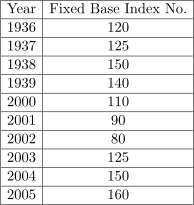
उत्तर (Answers):(1.)100,150,125,80,75,120,150 (2.)120,150,225,315,346.50,311.85,249.48,311.85,467.78,748.44
उपर्युक्त सवालों को हल करने पर श्रृंखला आधार रीति से सूचकांक कैसे ज्ञात करें? (How to Find Index Number by Chain Base Method?) को अच्छी तरह से समझ सकते हैं क्योंकि स्वयं प्रैक्टिकल रूप से हल करने पर कांसेप्ट अच्छी तरह समझ में आती है।
### 📢 यदि आपको यह गणित का आर्टिकल पसंद आया हो:
* 👥 **मित्रों के साथ शेयर करें:** ज्ञान बांटने से बढ़ता है,इसलिए इसे अपने दोस्तों के साथ ज़रूर साझा करें।
* 🔔 **वेबसाइट को फॉलो करें:** अगर आप यहाँ पहली बार आए हैं, तो हमारे **ईमेल सब्सक्रिप्शन** को फॉलो करें ताकि हर नए आर्टिकल का नोटिफिकेशन आपको तुरंत मिले।
* 💬 **अपने सुझाव दें:** यदि आपकी कोई समस्या है या कोई सुझाव देना चाहते हैं,तो नीचे **कमेंट** करके हमें ज़रूर बताएं।
*पूरा आर्टिकल पढ़ने के लिए आपका वेलकम है!*
Also Read This Article:- Correlation Examples with Solution in Statistics
4.श्रृंखला सूचकांक का वास्तविक संसार में महत्त्व (Chain Index Number ka Real World Importance):
सांख्यिकी में श्रृंखला सूचकांक का उपयोग:महंगाई/सीपीआई (उपभोक्ता मूल्य सूचकांक) (Consumer Price Index):महंगाई नापने के लिए,जहां हर साल लोगों की हालत बदलती रहती है।
डायनेमिक मार्केट्सःजहां आधार वर्ष को फिक्स्ड रखने से पुराना डेटा अप्रासंगिक हो जाता है,वहां साल-दर-साल तुलना के लिए इसे इस्तेमाल किया जाता है।
Also Read This Article:- Index (statistics)
5.श्रृंखला आधार रीति से सूचकांक कैसे ज्ञात करें? (Frequently Asked Questions Related to How to Find Index Number by Chain Base Method?) से सम्बन्धित अक्सर पूछे जाने वाले प्रश्न:
Q:1.श्रृखंला मूल्यानुपात ज्ञात करने का सूत्र लिखो। (Write a Formula to Find Link Relatives)
उत्तर:प्रत्येक वस्तु के प्रत्येक वर्ष के श्रृंखला मूल्यानुपात (Link Relatives) निम्न सूत्र द्वारा निकाले जाते हैं:
श्रृंखला मूल्यानुपात=\frac{\text{प्रचलित वर्ष का मूल्य×100}}{\text{पिछले वर्ष का मूल्य}}
प्रश्न:2.स्थिर आधार से श्रृंखलित श्रृंखला कैसे ज्ञात करते हैं? (How do you find the Chain Indices from a Fixed Base Index Number):
उत्तर:श्रृंखला मूल्यानुपातों का माध्य केवल प्रत्येक वर्ष की पिछले वर्ष से तुलना करता है।इस प्रकार दो निकटवर्ती वर्षों में कड़ियाँ (Links) स्थापित हो जाती है।इन कड़ियों की सहायता से एक श्रृंखला (chain) का निर्माण होता है जिससे सभी वर्षों के परिवर्तन एक निश्चित वर्ष से श्रृंखलाबद्ध हो जाएं।इस प्रकार से श्रृंखलित मूल्यानुपातों को श्रृंखला अनुपात (Chain Relatives) कहते हैं।
सूत्र:चालू वर्ष का श्रृंखलित सूचकांक=\frac{\text{गत वर्ष का श्रृंखलित सूचकांक×चालू वर्ष का औसत श्रृंखला मूल्यानुपात}}{100}
प्रश्न:3.स्थिर आधार से श्रृंखला आधार तथा श्रृंखला आधार से स्थिर आधार में परिवर्तन का सूत्र (Formula for Conversion from Fixed Base to Chain Base and from Chain Base to Fixed Basis):
उत्तर:स्थिर आधार वाले सूचकांकों को श्रृंखला आधार पर तथा श्रृंखला आधार वाले सूचकांकों का स्थिर आधार पर बदला जा सकता है।
(1.)स्थिर आधार से श्रृंखला प्राधार में (From Fixed Base to Chain Base):
प्रचलित वर्ष का श्रृंखला सूचकांक=\frac{\text{चालू वर्ष का स्थिर आधार सूचकांक × 100}}{\text{गत वर्ष का स्थिर आधार सूचकांक}}
(2.)श्रृंखला आधार से स्थिर आधार में (From Chain Base to Fixed Base):
चालू वर्ष का स्थिर सूचकांक=चालू वर्ष का श्रृंखला सूचकांक × गत वर्ष का स्थिर सूचकांक/100
उपर्युक्त प्रश्नों के उत्तर द्वारा श्रृंखला आधार रीति से सूचकांक कैसे ज्ञात करें? (How to Find Index Number by Chain Base Method?) की प्राइमरी टर्म्स के बारे में जान सकते हैं।
6.छात्र-छात्राओं से आज का प्रश्न (Today’s Question to Students):
🎯 विनर्स कॉर्नर:क्या आप इस सवाल का सही जवाब दे सकते हैं?अपने नाम के साथ नीचे कमेंट करें!सही जवाब देने वाले Top Students के नाम हमारी आगे post/is article ke update में Photo ya Special Mention के साथ publish की जाएगी।अपना जवाब अभी दर्ज करें!👇
0.12,0.21,8 का चतुर्थानुपाती क्या है?
(What is the fourth proportional ratio of 0.12,0.21,8?)
*पिछली प्रश्नोत्तरी का उत्तर* \frac{2}{n} \\ \left(1 - \frac{1}{3}\right)\left(1 - \frac{1}{4}\right)\left(1 - \frac{1}{5}\right) \dots \left(1 - \frac{1}{n}\right) \\= \frac{2}{3} \times \frac{3}{4} \times \frac{4}{5} \times \dots \times \frac{n - 1}{n} = \frac{2}{n}
*Previous Quiz Solution* \frac{2}{n} \\ \left(1 - \frac{1}{3}\right)\left(1 - \frac{1}{4}\right)\left(1 - \frac{1}{5}\right) \dots \left(1 - \frac{1}{n}\right) \\
= \frac{2}{3} \times \frac{3}{4} \times \frac{4}{5} \times \dots \times \frac{n - 1}{n} = \frac{2}{n}
*”यह आर्टिकल **Satyam Mathematics** ब्लॉग पर **Satyam Coaching Centre** के द्वारा तैयार किया गया है।”*





About Author

Sanjay Kumawat
(1.)**Satyam Narain Kumawat** **Website Name:Satyam Mathematics** *Owner:satyamcoachingcentre.in* *Sthan:Manoharpur,Jaipur (Rajasthan)* **Teaching Mathematics aur Anya Anubhav** ***Shiksha:**B.sc.,B.Ed.,(M.sc. star Ke Mathematics Ko Padhane ka Anubhav),B.com.,M.com. Ke vishayon Ko Padhane ka Anubhav,Philosophy,Psychology,Religious,sanskriti Mein Gahri Ruchi aur Adhyayan ***Anubhav:**phichale 23 varshon se M.sc.,M.com.,Angreji aur Vigyan Vishayon Mein Shikshaka Ka Lamba Anubhav ***Visheshagyata:*Maths,Adhyatma (spiritual),Yog vishayon ka vistrit Gyan* ****In Brief:I have read about M.sc. books,psychology,philosophy,spiritual, vedic,religious,yoga,health and different many knowledgeable books.A dedicated math expert with 23+ years of teaching experience upto M.sc. ,M.com.,English and science.After guiding thousands of students through Satyam Coaching Center,now share Mathematics,Trigonometry (Upto M.sc) and Educational Strategies in simple language on this blog from December 2018.* (2.)**(Technical Expert & Co-Admin):** ***Name:Sanjay Kumawat* *Qualification:Graduate in Mechanical Engineering (B.Tec) in 2013* *Profession:Physics Lecturer* *Teaching Experience:15 Years and Teaching to NEET,JEE Students* *Technical Experience:5 Years Coding and Article Editing,Classic Photo Editing by Laptop in Satyam Coaching Centre Blog* *A school lecturer and digital content strategist.On this blog,he handles all the responsibility of coding,image editing,SEO, and technical management,so that the mathematical content reaches the readers in a very accurate and beautiful form.* Updated on 15.06.2026

