Motion Up an Inclined Plane Examples with Solution: B.sc. Maths
1.नत समतल पर गति के उदाहरण हल सहित (Motion Up an Inclined Plane Examples with Solution: B.sc. Maths):
क्या आप एक समतल पर परास तथा उड्डयन काल ज्ञात करने में कठिनाई महसूस करते हैं।जानिए नत समतल पर गति के उदाहरण हल सहित (Motion Up an Inclined Plane Examples with Solution) कम्लीट डिटेल।
Also Read This Article:- Projectile Questions with Solution
2.नत समतल पर गति के उदाहरण हल सहित (Motion Up an Inclined Plane Examples):
Example:7.एक कण दिये हुए वेग से नत समतल पर फेंका जाता है।सिद्ध करो कि अधिकतम परास,नत समतल के ऊपर अधिकतम ऊंचाई का चार गुणा होगा।
(Prove that the greatest range of a particle,projected with a given velocity on an inclined plane,is four times the greatest vertical altitude above the inclined plane.)
[Udaipur 2004; Ajmer 98]
Solution:यदि प्रक्षेप्य पथ पर P कोई बिन्दु है जहाँ नत समतल से उच्चतम दूरी है तब चित्र से स्पष्ट है कि P पर स्पर्श रेखा (tangent) नत समतल के समान्तर है और तल के लम्बवत कण का वेग शून्य है।अतः उच्चतम लम्ब PL है।अधिकतम परास के लिए
2\alpha - \beta = \frac{\pi}{2} \quad \cdots (1)
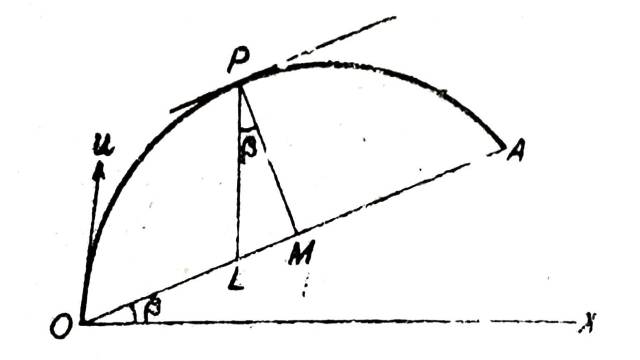
तल के लम्बवत P तक कण द्वारा पहुँची दूरी PM=h और तल के लम्बवत वेग शून्य है
0 = u^2 \sin^2(\alpha - \beta) - 2g \cos\beta \cdot h \\
\therefore h = \frac{u^2 \sin^2(\alpha - \beta)}{2g \cos\beta} \\
= \frac{u^2 [1 - \cos(2\alpha - 2\beta)]}{4g \cos\beta} \\
= \frac{u^2}{4g\cos\beta} [1 - \cos\left(\frac{\pi}{2} - \beta\right)] \\
\Rightarrow h = \frac{u^2}{4g\cos\beta} (1 - \sin\beta) \ [(1) \text{ से}] \quad \cdots (2) [(1) से]
रेखाओं के बीच कोण लम्बों के बीच के कोण के समान है अर्थात्
\angle LPM = \beta \\
\therefore PM = PL \cos\beta \\
\Rightarrow h = PL \cos\beta \\
\Rightarrow PL = \frac{h}{\cos\beta} \\
h \text{ का मान } (2) \text{ से रखने पर} \\
\Rightarrow PL = \frac{u^2}{4g\cos^2\beta} (1 - \sin\beta) \\
= \frac{u^2}{4g(1 - \sin^2\beta)} (1 - \sin\beta) \\
= \frac{1}{4g} \cdot \frac{u^2}{(1 + \sin\beta)} \\
\therefore \text{अधिकतम परास} = \frac{u^2}{g(1 + \sin\beta)} = 4PL
= four times the greatest vertical altitude
Example:8.यदि एक पहाड़ी के किनारे पर एक बिन्दु से दो पिण्ड अधिकतम झुकाव से गुजरने वाले ऊर्ध्वाधर तल में समान वेग से लेकिन एक-दूसरे के समकोण पर फेंके जाते हैं।सिद्ध करो कि उनके परासों का अन्तर उनके प्रक्षेप कोणों पर निर्भर नहीं करता।
(If from a point on the side of a hill two bodies are projected in the same vertical plane through the line of greatest slope with the same velocity but in directions at right angles to each other.Show that the difference of their ranges is independent of their angles of projection.)
Solution:माना कि कण के प्रक्षेप की दिशाएँ क्षैतिज से \alpha_1 और \alpha_2 कोण बनाती है।एक कण तल के ऊपर जाएगा और दूसरा तल के नीचे आएगा।माना उनका उभयनिष्ठ वेग (Common velocity) u है:
\text{तल के ऊपर परास } = R_1 = \frac{2u^2 \sin(\alpha_1 - \beta) \cos\alpha_1}{g \cos^2\beta}, \text{ then } \\
\text{तल के नीचे परास } = R_2 = \frac{2u^2 \sin(\alpha_2 + \beta) \cos\alpha_2}{g \cos^2\beta} \\
R_1 - R_2 = \frac{2u^2}{g \cos^2\beta} \left[\cos\alpha_1 \cdot \sin(\alpha_1 - \beta) - \cos\alpha_2 \cdot \sin(\alpha_2 + \beta)\right] \\ 90^\circ \text{ के कोण पर दिशाएँ} \\
180^\circ = \alpha_1 + 90^\circ + \alpha_2 \text{ or } \alpha_2 = 90^\circ - \alpha_1 \\
R_1 - R_2 = \frac{2u^2}{g \cos^2\beta} \left[\cos\alpha_1 \sin(\alpha_1 - \beta) - \sin\alpha_1 \cos(\alpha_1 - \beta)\right] \\
= \frac{2u^2}{g \cos^2\beta} \sin(\alpha_1 - \beta - \alpha_1) \\
= \frac{2u^2}{g \cos^2\beta} \sin(-\beta) \\
= -\frac{2u^2 \sin\beta}{g \cos^2\beta}
जो कि प्रक्षेप की दिशा पर निर्भर नहीं है।
Example:9.एक कण O से \alpha उन्नतांश पर फेंका जाता है।सिद्ध करो कि इसके पथ पर P की दो स्थितियां होंगी,जहां पर वेग की दिशा OP के लम्बवत् होगी। सिद्ध करो कि वास्तविक स्थिति के अस्तित्व के लिए \alpha , \cos^{-1} \left( \frac{1}{3} \right) से छोटा होना नहीं चाहिए।यह भी सिद्ध करो कि यदि OP क्षैतिज के साथ दो स्थितियों में \theta_{1} व \theta_{2} कोण बनाती है, सिद्ध करो कि \theta_{1}+\theta_{2}=\alpha
(A particle is projected from O at an elevation \alpha .Prove that there are two positions of P on its path at which the direction of the velocity is perpendicular to OP.Prove that for real position to exist, \alpha is not less than \cos^{-1} \left( \frac{1}{3} \right) .Also if in two positions,OP makes angles \theta_{1} and \theta_{2} with the horizontal, prove that \theta_{1}+\theta_{2}=\alpha
Solution:मान लीजिए कि कण को मूलबिन्दु O (0,0) से वेग u से कोण \alpha पर प्रक्षेपित किया जाता है।किसी भी समय t पर स्थिति और वेग के घटक इस प्रकार हैं:
स्थिति: \text{स्थिति : } x = (u\cos\alpha)t \text{ और } y = (u\sin\alpha)t- \frac{1}{2}gt^2 \\
\text{वेग } v_x = u\cos\alpha \text{ और } v_y = u\sin\alpha - gt
किसी वेग के लम्बवत होने की शर्त OP अदिश गुणनफल (Dot product) द्वारा दी जाती है:
\vec{r} \cdot \vec{v} = 0 \Rightarrow x v_x + y v_y = 0
अदिश गुणनफल में स्थिति और वेग घटकों को प्रतिस्थापन करने परः
(u \cos \alpha )t (u \cos \alpha) +\left[ (u \sin \alpha )t-\frac{1}{2}gt^2 \right]\left( u \sin \alpha-gt \right)=0
समीकरण को सरल बनाने पर (t से भाग देने पर,यह मानते हुए कि t \neq 0)
\Rightarrow u^2 \cos^2\alpha + u^2 \sin^2\alpha - (u\sin\alpha)gt \\
- \frac{1}{2}gt(u\sin\alpha) + \frac{1}{2}g^2t^2 = 0 \\
\Rightarrow u^2(\cos^2\alpha + \sin^2\alpha) - (u\sin\alpha)gt \\
- \frac{1}{2}gt(u\sin\alpha) + \frac{1}{2}g^2t^2 = 0 \\
\Rightarrow u^2 - \frac{3}{2}(ug\sin\alpha)t + \frac{1}{2}g^2t^2 = 0 \\
\Rightarrow g^2t^2 - 3(ug\sin\alpha)t + 2u^2 = 0 \\
\text{स्थितियों का अस्तित्व (existence} \text{of positions)} \\
\text{इसके लिए विविक्तकर (discriminant)} \\
D \text{ धनात्मक (गैर-ऋणात्मक) } D \geq 0 \text{होना चाहिए।} \\
\Rightarrow B^2 - 4AC \ge 0 \\
\Rightarrow (3ug\sin\alpha)^2 - 4g^2 (2u^2) \ge 0 \\
\Rightarrow 9u^2g^2 \sin^2\alpha - 8g^2u^2 \ge 0 \\
\Rightarrow 9\sin^2\alpha \ge 8 \\
\Rightarrow \sin^2\alpha \ge \frac{8}{9} \Rightarrow \cos^2\alpha \le 1 - \frac{8}{9} \le \frac{1}{9} \\
\Rightarrow \cos\alpha \le \frac{1}{3} \Rightarrow \alpha \ge \cos^{-1}\left(\frac{1}{3}\right)
मान लीजिए कि क्षैतिज के साथ OP कोण \tan\theta = \frac{y}{x} बनाता है,इसलिए
= \frac{(u\sin\alpha)t - \frac{1}{2}gt^2}{(u\cos\alpha)t} \\
\Rightarrow \tan\theta = \tan\alpha - \frac{gt}{2u\cos\alpha} \quad \cdots (1)
माना द्विघात समीकरण के मूल t_1 t_2 हैं तो
\text{मूलों का योग } t_1 + t_2 = \frac{3u\sin\alpha}{g} \quad \cdots (2) \\
\text{मूलों का गुणनफल } t_1 t_2 = \frac{2u^2}{g^2} \quad \cdots (3) \\
\tan(\theta_1 + \theta_2) = \frac{\tan\theta_1 + \tan\theta_2}{1 - \tan\theta_1 \tan\theta_2} \quad \cdots (4) \\
\text{समीकरण } (1) \text{ से} \\
\tan\theta_1 = \tan\alpha - \frac{gt_1}{2u\cos\alpha} \\
\tan\theta_2 = \tan\alpha - \frac{gt_2}{2u\cos\alpha} \\
\text{उक्त मानों को समीकरण } (4) \text{ में रखने} \text{पर} \\
\tan(\theta_1 + \theta_2) = \frac{\tan\alpha - \frac{gt_1}{2u\cos\alpha} + \tan\alpha - \frac{gt_2}{2u\cos\alpha}}{1 - \left(\tan\alpha - \frac{gt_1}{2u\cos\alpha}\right)\left(\tan\alpha - \frac{gt_2}{2u\cos\alpha}\right)} \\
= \frac{2\tan\alpha - \frac{g}{2u\cos\alpha}(t_1 + t_2)}{1 - \tan^2\alpha + \frac{g\tan\alpha}{2u\cos\alpha}(t_1 + t_2) - \frac{g^2}{4u^2\cos^2\alpha} t_1 t_2} \\
t_1 + t_2 \text{ व } t_1 t_2 \text{ का मान रखने पर} \\= \frac{2\tan\alpha - \frac{g}{2u\cos\alpha}\left(\frac{3u\sin\alpha}{g}\right)}{1 - \tan^2\alpha + \frac{g\tan\alpha}{2u\cos\alpha} \times \frac{3u\sin\alpha}{g} - \frac{g^2}{4u^2\cos^2\alpha} \times \frac{2u^2}{g^2}} \\
= \frac{2\tan\alpha - \frac{3}{2}\tan\alpha}{1 - \tan^2\alpha + \frac{3}{2}\tan^2\alpha - \frac{1}{2}\sec^2\alpha} \\
= \frac{\frac{1}{2}\tan\alpha}{1 + \frac{1}{2}\tan^2\alpha - \frac{1}{2}\sec^2\alpha} \\
= \frac{\frac{1}{2}\tan\alpha}{1 - \frac{1}{2}(\sec^2\alpha - \tan^2\alpha)} \\
= \frac{\frac{1}{2}\tan\alpha}{1 - \frac{1}{2} \times 1} \ [\because \sec^2\alpha - \tan^2\alpha = 1] \\
= \frac{\frac{1}{2}\tan\alpha}{\frac{1}{2}} \\
\Rightarrow \tan(\theta_1 + \theta_2) = \tan\alpha \\
\Rightarrow \theta_1 + \theta_2 = \alpha
Example:10.सिद्ध करो कि नतसमतल पर प्रक्षेप बिन्दु से ऊपर की ओर अधिकतम परास इसके संगत उड्डयन काल में स्वतन्त्र रूप से बराबर होता है।
(Show that the greatest range up an inclined plane through the point of projection is equal to the distance through which a paiticle could fall freely during the time of flight.)
Solution:
\text{ अधिकतम परास के लिए } \\ 2\alpha - \beta = \frac{\pi}{2} \\
\text{तथा अधिकतम परास} = \frac{u^2}{g(1 + \sin\beta)} \\
\text{तथा } T = \frac{2u\sin(\alpha - \beta)}{g\cos\beta} \\
\text{समय } T \text{ में गिरी हुई दूरी} = \frac{1}{2}gT^2 \\
= \frac{1}{2}g \cdot \frac{4u^2\sin^2(\alpha - \beta)}{g^2\cos^2\beta} \\
= \frac{u^2}{g} \frac{[1 - \cos(2\alpha - 2\beta)]}{(1 - \sin^2\beta)} \\
= \frac{u^2}{g} \frac{1 - \cos\left(\frac{\pi}{2} - \beta\right)}{1 - \sin^2\beta} \\
= \frac{u^2(1 - \sin\beta)}{g(1 - \sin^2\beta)} = \frac{u^2}{g(1 + \sin\beta)} \\
[\because 2\alpha - \beta = \frac{\pi}{2}] \\
= \frac{u^2}{g(1 + \sin\beta)} = \text{तल के ऊपर उच्चतम} \text{परास}
उपर्युक्त उदाहरणों के हल द्वारा नत समतल पर गति के उदाहरण हल सहित (Motion Up an Inclined Plane Examples with Solution: B.sc. Maths) को समझ सकते हैं।
Also Read This Article:- Motion Up Inclined Plane Questions with Solution
3.छात्र-छात्राओं के लिए नत समतल पर गति के उदाहरण के प्रैक्टिस क्वेश्चंस (Practice Questions of Motion Up an Inclined Plane Examples with Solution for Students):
(1.)एक कण को वेग u के साथ एक बिंदु से क्षैतिज कोण पर झुके हुए तल पर प्रक्षेपित किया जाता है।यदि r और r’ तल के ऊपर और नीचे इसकी अधिकतम परास है,तो साबित करें कि \frac{1}{r}+\frac{1}{r'} यह तल के झुकाव से स्वतंत्र है।
(A particle is projected with velocity u from a point on a plane inclined at an angle to the horizontal.If r and r’ are its maximum range up and down the plane,prove that \frac{1}{r}+\frac{1}{r'} is independent of the inclination of the plane.)
(2.)एक बिंदु को 25 meter/sec वेग से प्रक्षेपित किया जाता है ताकि क्षैतिज से 45° पर झुके प्रक्षेपण के बिंदु के माध्यम से एक समकोण पर एक समतल पर प्रहार किया जा सके।साबित कीजिए कि दिए गए तल की सीमा 25 \sqrt{2} मीटर में है।
(A point is projected with a velocity 25 meter/sec so as to strike at right angle a plane through the point of projection inclined at 45° to the horizontal.Prove that the range on the given plane in 25 \sqrt{2} meters.)
उपर्युक्त सवालों को हल करने पर नत समतल पर गति के उदाहरण हल सहित (Motion Up an Inclined Plane Examples with Solution: B.sc. Maths) को अच्छी तरह से समझ सकते हैं क्योंकि स्वयं प्रैक्टिकल रूप से हल करने पर कांसेप्ट अच्छी तरह समझ में आती है।
### 📢 यदि आपको यह गणित का आर्टिकल पसंद आया हो:
* 👥 **मित्रों के साथ शेयर करें:** ज्ञान बांटने से बढ़ता है,इसलिए इसे अपने दोस्तों के साथ ज़रूर साझा करें।
* 🔔 **वेबसाइट को फॉलो करें:** अगर आप यहाँ पहली बार आए हैं, तो हमारे **ईमेल सब्सक्रिप्शन** को फॉलो करें ताकि हर नए आर्टिकल का नोटिफिकेशन आपको तुरंत मिले।
* 💬 **अपने सुझाव दें:** यदि आपकी कोई समस्या है या कोई सुझाव देना चाहते हैं,तो नीचे **कमेंट** करके हमें ज़रूर बताएं।
*पूरा आर्टिकल पढ़ने के लिए आपका वेलकम है!*
Also Read This Article:- Inclined plane
4.नत समतल पर गति के उदाहरण हल सहित (Frequently Asked Questions Related to Motion Up an Inclined Plane Examples with Solution) से सम्बन्धित अक्सर पूछे जाने वाले प्रश्न:
Q:1.नत समतल पर प्रक्षेप्य परास का सूत्र लिखो। (Write the formula of the projectile range on the inclined plane):
उत्तर:नत समतल पर नीचे की ओर परास=\frac{2 u^2 \sin(\alpha+\beta) \cos \alpha}{g \cos ^2 \beta}
Q:2.नत समतल पर नीचे की ओर परास तथा उड्डयन काल के सूत्र लिखो। (Write the formulas for downward range and time of time down on the inclined plane):
उत्तर:(1.)नत समतल पर नीचे की ओर उड्डयन काल=\frac{2 u \sin (\alpha+\beta)}{g \cos \beta}
(2.)नत समतल पर नीचे की ओर अधिकतम परास=\frac{u^2}{g(1-\sin \beta)}
Q:3.अधिकतम परास के लिए प्रक्षेप कोण का मान क्या होगा? (What is the value of the projection angle for the maximum range?):
उत्तर:अधिकतम परास के लिए प्रक्षेप कोण=\frac{\pi}{4}-\frac{\beta}{2}
उपर्युक्त प्रश्नों के उत्तर द्वारा नत समतल पर गति के उदाहरण हल सहित (Motion Up an Inclined Plane Examples with Solution: B.sc. Maths) की प्राइमरी टर्म्स के बारे में जान सकते हैं।
5.छात्र-छात्राओं से आज का सवाल (Today’s Queention to students):
🎯 विनर्स कॉर्नर:क्या आप इस सवाल का सही जवाब दे सकते हैं?अपने नाम के साथ नीचे कमेंट करें!सही जवाब देने वाले Top Students के नाम हमारी आगे post/is article ke update में Photo ya Special Mention के साथ publish की जाएगी।अपना जवाब अभी दर्ज करें!👇
*”एक प्रतिशत के आधे को अगर दशमलव में लिखा जाए तो क्या होगा?”*
(What happens if half of one percent is written in decimal?)
*पिछली प्रश्नोत्तरी का उत्तर*6
हम जानते हैं कि \frac{(2n - 4)90^\circ}{360^\circ} = \frac{2}{1} \\
\Rightarrow \frac{(2n - 4) \times 90^\circ}{360^\circ} = \frac{2}{1} \\
\Rightarrow \frac{2n - 4}{4} = 2 \Rightarrow 2n - 4 = 8 \\
\Rightarrow 2n = 12 \Rightarrow n = \frac{12}{2} = 6
*Previous Quiz Solution*6
We know that \frac{(2n - 4)90^\circ}{\text{Sum of External Angles of Polygon}}= \frac{2}{1} \\
\Rightarrow \frac{(2n - 4) \times 90^\circ}{360^\circ} = \frac{2}{1} \\
= \frac{2n - 4}{4} = \frac{2}{1} \Rightarrow 2n - 4 = 8 \\
\Rightarrow 2n = 12 \Rightarrow n = \frac{12}{2} = 6
*”यह आर्टिकल **Satyam Mathematics** ब्लॉग पर **Satyam Coaching Centre** के द्वारा तैयार किया गया है।”*



About Author

Sanjay Kumawat
(1.)**Satyam Narain Kumawat** **Website Name:Satyam Mathematics** *Owner:satyamcoachingcentre.in* *Sthan:Manoharpur,Jaipur (Rajasthan)* **Teaching Mathematics aur Anya Anubhav** ***Shiksha:**B.sc.,B.Ed.,(M.sc. star Ke Mathematics Ko Padhane ka Anubhav),B.com.,M.com. Ke vishayon Ko Padhane ka Anubhav,Philosophy,Psychology,Religious,sanskriti Mein Gahri Ruchi aur Adhyayan ***Anubhav:**phichale 23 varshon se M.sc.,M.com.,Angreji aur Vigyan Vishayon Mein Shikshaka Ka Lamba Anubhav ***Visheshagyata:*Maths,Adhyatma (spiritual),Yog vishayon ka vistrit Gyan* ****In Brief:I have read about M.sc. books,psychology,philosophy,spiritual, vedic,religious,yoga,health and different many knowledgeable books.A dedicated math expert with 23+ years of teaching experience upto M.sc. ,M.com.,English and science.After guiding thousands of students through Satyam Coaching Center,now share Mathematics,Trigonometry (Upto M.sc) and Educational Strategies in simple language on this blog from December 2018.* (2.)**(Technical Expert & Co-Admin):** ***Name:Sanjay Kumawat* *Qualification:Graduate in Mechanical Engineering (B.Tec) in 2013* *Profession:Physics Lecturer* *Teaching Experience:15 Years and Teaching to NEET,JEE Students* *Technical Experience:5 Years Coding and Article Editing,Classic Photo Editing by Laptop in Satyam Coaching Centre Blog* *A school lecturer and digital content strategist.On this blog,he handles all the responsibility of coding,image editing,SEO, and technical management,so that the mathematical content reaches the readers in a very accurate and beautiful form.* Updated on 15.06.2026

