Relations in Class 12 Examples with Solutions
1.Relations in Class 12 Examples with Solutions
In this article we will reading “Relations in Class 12 Examples with Solutions”.we have already read Types of relations.Some of extra examples are following:
Also Read This Article:- Relations Class 12 Examples with Solution
2.Relations in Class 12 Examples
Example 9. Show that each of the relation R in the set A = \{x \in Z : 0 \le x \le 12\}; given by
Example 9 (i). R = \{(a, b) : |a - b| \text{ is multiple of } 4\}
Solution: A = \{x \in Z : 0 \le x \le 12\}
or A = \{0, 1, 2, 3, 4, 5, 6, 7, 8, 9, 10, 11, 12\}
R = \{(a, b) : |a - b| \text{ is multiple of } 4\}
R = \{(0, 0), (0, 4), (0, 8), (0, 12), (1, 1), (2, 2), (3, 3), (4, 4), (5, 5), (6, 6), (7, 7), (8, 8), (9, 9), \\(10, 10), (11, 11), (12, 12), (1, 5), (1, 9), (2, 6), (2, 10), (3, 7), \\ (3, 11), (4, 8), (4, 12), (5, 9), (6, 10), (7, 11), (8, 12)\}
(a) For a \in A, |a - a| = 0, which is multiple of 4 because 0 \times 4 = 0
\implies (a, a) \in R \text{ and } aRa \text{ is true}
\therefore R \text{ is reflexive.}
(b) For (a, b) \in A, (a, b) \in R \\ \implies |a - b| \text{ is multiple of } 4 \\ \implies |a - b| = 4k, \text{where } k \text{ is natural number} \\ \implies |a - b| = |-(b - a)| = |b - a| \\ \implies |b - a| = 4k, \text{where } k \text{ is natural number} \\ \implies (b, a) \in R \\ \therefore (a, b) \in R \implies (b, a) \in R \\ \implies aRb \implies bRa \\ \therefore R \text{ is symmetric.}
(c) \text{ For } a, b, c \in A, if (a, b) \in R \text{ and } (b, c) \in R \\ \implies |a - b| \text{ is multiple of } 4 \text{ and } |b - c| \text{ is multiple of } 4 \\ \implies |a - b| = 4m \text{ and } |b - c| = 4n, \text{where } m \text{ and } n \text{ natural numbers.} \\ a - b = \pm 4m \text{ and } b - c = \pm 4 n \\ \implies (a - b) + (b - c) = \pm 4m \pm 4 n \\ \implies a - c = \pm 4(m + n) \\ \implies |a - c| = \pm 4(m + n) \text{ is multiple of } 4 \\ \text{ Where } k = m + n \text{ and } k \text{ is a natural number.} \\ \implies (a, c) \in R \\ \therefore (a, b) \in R \text{ and } (b, c) \in R \implies (a, c) \in R \\ \text{ or }aRb \text{ and } bRc \implies aRc \\ \therefore R \text{ is transitive.} \\ R \text{ is reflexive, symmetric and transitive or } R \text{ is equivalence relation.}
Example 10. Give an example of a relation, which is
Example 10 (i). symmetric but neither reflexive nor transitive.
Solution: A =Set of straight lines in plane
and relation R, defined like this at set A
R = \{(a, b) : \text{ line a perpendicular on } b\}
Solution:
(a) Relation R is not reflexive because any line is not perpendicular on itself.
(b) a \perp b \implies b \perp a \\
aRb \implies bRa \\
(a, b) \in R \implies (b, a) \in R \\
\therefore R \text{ is symmetric.}
(c) a \perp b \text{ and } b \perp c \nRightarrow a \perp c \\
(a, b) \in R, (b, c) \in R \nRightarrow (a, c) \in R \\
\text{ or }aRb \text{ and } bRc \nRightarrow aRc \\
\therefore \text{Relation } R \text{ is not transitive.}
Illustration 10 (ii). Transitive but neither reflexive nor symmetric.
Solution:
(a) Relation R is not reflexive because any line is not perpendicular on itself.
(b) a \perp b \implies b \perp a \\ aRb \implies bRa \\ (a, b) \in R \implies (b, a) \in R \\ \therefore R \text{ is symmetric.}
(c) a \perp b \text{ and } b \perp c \nRightarrow a \perp c\\ (a, b) \in R, (b, c) \in R \nRightarrow (a, c) \in R \\ or aRb \text{ and } bRc \nRightarrow aRc \\ \therefore \text{Relation } R \text{ is not transitive.}
Illustration 10 (iii).Transitive but neither reflexive nor symmetric.
Solution: Let set A =Set of Real Numbers
and R is defined on A such that
R = \{(a, b) : a > b; \text{where } a \text{ and } b \text{ are real numbers}\}
(a) a \not> a \\ a \ngtr a \text{ and } (a, a) \notin R \\ \therefore R \text{ is not reflexive because any number is not greater than self.}
(b) a > b \nRightarrow b > a \\
(a, b) \in R \nRightarrow (b, a) \in R \\
or aRb \nRightarrow bRa
Hence R is not symmetric. If a is greater b then b cannot greater than a.
(c) a > b \text{ and } b > c \implies a > c \\
(a, b) \in R \text{ and } (b, c) \in R \implies (a, c) \in R \\
\text{ or } aRb \text{ and } bRc \implies aRc
Hence R is transitive.
Illustration 10 (iii). Reflexive and symmetric but not transitive.
Solution: Let A =\{4, 5, 6, 7\}
and Relation R is defined on it such that
R = \{(a, b) : a + b \leq 8, \text{where } a, b \in A\} \\
\text{ or } R = \{(1, 1), (1, 4), (1, 5), (1, 6), (1, 7), (4, 1), (4, 4), (5, 1), (6, 1), (7, 1)\}
(a) (1, 1), (4, 4) \in R \\
\text{ i.e., } 1R1; 4R4 \text{ are true } \\
(1, 1), (4, 4) \in R
Hence R is reflexive.
(b) (1, 4), (1, 5), (1, 6), (1, 7) \in R \\
\text{ and } (4, 1), (5, 1), (6, 1), (7, 1) \in R\\
\text{ i.e. }, 1R4 \implies 4R1, 1R5 \implies 5R1, \\
1R6 \implies 6R1, 1R7 \implies 7R1
Hence R is symmetric.
(c) (4, 1) \in R \text{ and } (1, 5) \in R \\ \text{ but } (4, 5) \notin R \\ \text{ i.e. }, 4R1 \text{ and } 1R5 \nRightarrow 4R5 \\ \therefore R is not transitive.
Illustration 10 (iv). Reflexive and transitive but not symmetric.
Solution: Let A = {4, 5, 6, 7, 8}
and Relation R, defined on A like this:
R =\{(a, b) : a \le b\} \\
R = \{(4, 4), (4, 5), (4, 6), (4, 7), (4, 8), (5, 5), (5, 6), (5, 7), \\ (5, 8), (6, 6), (6, 7), (6, 8), (7, 7), (7, 8), (8, 8)\}
(a) (4, 4), (5, 5), (6, 6), (7, 7), (8, 8) \in R \\ \text{ i.e. }, 4R4, 5R5, 6R6, 7R7, 8R8 \text{ are true. } \\ \therefore R is reflexive.
(b) 4 < 5 \implies 5 \not< 4 \\ i.e., 4R5 \nRightarrow 5R4 \text{ or } (4, 5) \in R \nRightarrow (5, 4) \in R \\ \therefore R is not symmetric.
(c) (4, 5), (5, 6) \in R \implies (4, 6) \in R \\ (5, 6), (6, 7) \in R \implies (5, 7) \in R \\ \text{ i.e. }, 4R5 \text{ and } 5R6 \implies 4R6 \\ \text{ and } 5R6 \text{ and } 6R7 \implies 5R7 \\ \therefore R is transitive.
Illustration 10 (v). Symmetric and transitive but not reflexive.
Solution: Let A = {1, 4, 5, 6} and Relation R is defined on A like this:
R = \{(a, b) : 0 < |a - b| \le 5\} \\
\text{ or } R = \{(1, 4), (1, 5), (4, 1), (5, 1), (4, 5), (4, 6), (6, 4), (5, 4), (5, 6), (6, 5), (1, 6), (6, 1)\}
(a) (1, 1), (4, 4), (5, 5), (6, 6) \notin R \\ \therefore R is not reflexive.
(b) (1, 4) \in R \implies (4, 1) \in R \\ (1, 5) \in R \implies (5, 1) \in R \\ (4, 5) \in R \implies (5, 4) \in R \\ (4, 6) \in R \implies (6, 4) \in R \\ (6, 5) \in R \implies (5, 6) \in R \\ (1, 6) \in R \implies (6, 1) \in R \\ \therefore R is symmetric.
(c) (1, 4) \in R \text{ and } (4, 5) \in R \\ \implies (1, 5) \in R \\ \text{ Similarly } (4, 6) \in R \text{ and } (6, 5) \in R \\ \implies (4, 5) \in R \\ \text{ i.e. }, 1R4 \text{ and } 4R5 \implies 1R5 \\ 4R6 \text{ and } 6R5 \implies 4R5 \\ \therefore R \text{ is transitive.}
Illustration 11. Show that the relation R in the set A of points in a plane given by R = {(P, Q) :distance of the point P from the origin is same as the distance of the point Q from the origin is an equivalence relation. Further, show that the set of all points related to a point P \neq (0, 0) is the circle passing through P with origin as centre.
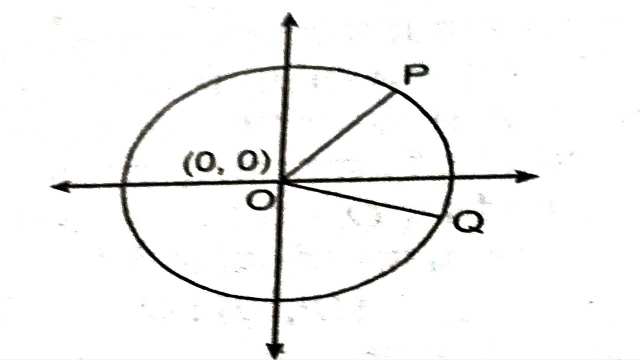
Solution: Let point O is origin in plane, then relation R is defined like this
R ={(P, Q) : OP = OQ}
(a) OP = x i.e., x = x
\implies xRx \text{ or } (x, x) \in R \\
\therefore R \text{ is reflexive.}
(b) If x and y is the distance from origin of the points P and Q respectively then
(P, Q) \in R \implies OP = OQ \\
\implies x = y \implies y = x \\
\implies OQ = OP \implies (Q, P) \in R \\
\implies (y, x) \in R \\
\therefore (x, y) \in R \implies (y, x) \in R \\
\therefore R \text{ is symmetric.}
(c) If three point P, Q and S like this
(P, Q) \in R \text{ and } (Q, S) \in R \\
\implies OP = OQ \text{ and } OQ = OS \\
\implies OP = OS \\
\implies (P, S) \in R \\
\therefore (P, Q) \in R, (Q, S) \in R \\
\therefore R \text{ is transitive.}
Hence R is reflexive, symmetric and transitive i.e., R is equivalence relation.
Again let any point fixed point P and another any point Q is in the plane like this
(P, Q) \in R \text{ then } \\
(P, Q) \in R \implies OP = OQ \\
\implies point Q moving in plane like that its distance from origin O(0, 0) is same as the fixed point P from origin.
\implies locus of Q is a circle whose centre is origin
[fixed distance OP = radius of circle]
Example 12. Show that the relation R defined in the set A of all triangles as R = \{(T_1, T_2) : T_1 \text{ is similar to } T_2\}, is equivalence relation. Consider three right angle triangles T_1 with sides 3, 4, 5, T_2 with sides 5, 12, 13 and T_3 with sides 6, 8, 10. Which triangles among T_1, T_2 \text{ and } T_3 are related?
Solution: A = \text{set of all triangles in plane} \\
or A = \{x : x \text{ is a triangle in plane}\}
and Relation R is defined like this
R = \{(T_1, T_2) : T_1, T_2 \text{ are similar}\}
(a) T_1 R T_1 is true
or (T_1, T_1) \in R \\ \therefore R \text{ is reflexive.}
(b) T_1 R T_2 \implies T_2 R T_1
or (T_1, T_2) \in R \implies (T_2, T_1) \in R
If T_1 is similar to T_2 then T_2 is also similar to T_1\\
\therefore R \text{ is symmetric.}
(c) T_1 R T_2 \text{ and } T_2 R T_3 \implies T_1 R T_3 \\
\text{ or } (T_1, T_2) \in R \text{ and } (T_2, T_3) \in R \implies (T_1, T_3) \in R
Hence T_1, T_2 are similar and T_2, T_3 are similar then T_1, T_3 also similar.
\therefore R is transitive.
R is reflexive, symmetric and transitive.
Hence R is equivalence relation.
Again T_1 with sides 3, 4, 5
Triangle T_2 with sides 5, 12, 13
and Triangle T_3 with sides 6, 8, 10
then consider sides of triangles T_1 \text{ and } T_3\\
\frac{3}{6} = \frac{4}{8} = \frac{5}{10} = \frac{1}{2}
i.e. sides of triangles T_1 \text{ and } T_3 are proportional
so T_1 and T_3 triangles are similar.
i.e. T_1 R T_3 is true
or (T_1, T_3) \in R \\
\implies T_1 \text{ and } T_3 are related.
Example 13. Show that the relation R defined in the set A of all polygons as R = \{(P_1, P_2) : P_1 \text{ and } P_2 \text{ have same number of sides}\}, is an equivalence relation. What is the set of all elements in A related to the right angle triangle T with 3, 4 and 5?
Solution: A =set of all polygons in plane
or A ={x : x is polygon in plane}
and Relation R is defined on A
R = \{(P_1, P_2) : \text{Number of sides of } P_1, P_2 \text{ are equal}\}
(a) If P_1 is any polygon then P_1 R P_1 or (P_1, P_1) \in R is true.
because in any polygon sides are equal itself.
\therefore R is reflexive.
(b) P_1 R P_2 \implies P_2 R P_1 \\
\text{ or } (P_1, P_2) \in R \implies (P_2, P_1) \in R
because P_1 \text{ and } P_2 has n sides then P_2 \text{ and } P_1 has same n sides i.e. both P_1 \text{ and } P_2 has equal n sides.
\therefore R is symmetric.
(c) P_1 R P_2 \text{ and } P_2 R P_3 \implies P_1 R P_3 \\
\text{ or } (P_1, P_2) \in R, (P_2, P_3) \in R \implies (P_1, P_3) \in R
because if polygon P_1 \text{ and } P_2 each has n sides and Polygon P_2 \text{ and } P_3 each has n sides, then Polygon P_1 \text{ and } P_3 each has n sides.
We say that Relation R is reflexive, symmetric and transitive on set A.
Hence R is equivalence Relation on A.
A has all polygons in plane A.
i.e. triangle, quadrilateral, pentagon, hexagon etc. in set A. We should find all elements of related A which has 3, 4 and 5 length right angled triangle, then T is triangle (three sides) with sides 3, 4, 5 then all triangles of set A will related to T.
Example 14. Let L be the set of all lines in xy plane and R be the relation in L defined as R = \{(L_1, L_2) : L_1 \text{ is parallel to } L_2\}. Show that R is an equivalence relation. Find the set of all lines related to the line y = 2x + 4.
Solution: Let L =set of all lines in xy-plane
or L ={x : x is a line in xy-plane}
and Relation R is defined on L such that
R = \{(L_1, L_2) : L_1 \parallel L_2\} \text{ where } L_1, L_2 \in L
(a) R is reflexive because each line is parallel to itself.
i.e. L_1 \parallel L_1 \text{ is true } \\
\text{ or } L_1 \parallel L_1 \text{ or } (L_1, L_1) \in R
(b) R is symmetric, because if the line L_1 is parallel to the line L_2, then the line L_2 will be parallel to line L_1.
i.e. L_1 \parallel L_2 \implies L_2 \parallel L_1 \\
\text{ or } (L_1, L_2) \in R \implies (L_2, L_1) \in R
(c) R is transitive, because if line L_1 is parallel to line L_2 and line L_2 is parallel to L_3, then the line L_1 will be parallel to the L_3.
i.e. L_1 \parallel L_2, L_2 \parallel L_3 \implies L_1 \parallel L_3; L_1, L_2, L_3 \in L \\
\text{ or } (L_1, L_2) \in R, (L_2, L_3) \in R \implies (L_1, L_3) \in R \\
\text{ or } L_1 R L_2, L_2 R L_3 \implies L_1 R L_3
We see that the Relation R is reflexive, symmetric and transitive on set L. Hence R is equivalence relation.
Again, the slope of the line y = 2x + 4 is 2. Hence, the set of all lines belonging to the line y = 2x + 4 will be the lines whose slope 2.
Set of lines related to y = 2x + 4 is y = 2x + k, where k is arbitrary constant.
Example 15. Let R be the relation in the set {1, 2, 3, 4} given by R = {(1, 2), (2, 2), (1, 1), (4, 4), (1, 3), (3, 3), (3, 2)}. Choose the correct answer.
(A) R is reflexive and symmetric but not transitive. (B) R is reflexive and transitive but not symmetric. (C) R is symmetric and transitive but not reflexive. (D) R is an equivalence relation.
Solution: Let A = {1, 2, 3, 4}
then R is defined on A
R ={(1, 2), (2, 2), (1, 1), (4, 4), (1, 3), (3, 3), (3, 2)}
We see that \forall a \in A, aRa \text{ is true }, i.e., (a, a) \in R, because (1, 1), (2, 2), (3, 3), (4, 4) \in R \\
\therefore R is reflexive.
Again a, b \in A \\
(a, b) \in A \nRightarrow (b, a) \in R \\
\text{ because } (1, 2) \in R \nRightarrow (2, 1) \in R \\
(1, 3) \in R \nRightarrow (3, 1) \in R \\
\text{ i.e. }, 1R2 \nRightarrow 2R1, 1R3 \nRightarrow 3R1 \\
\therefore R is not symmetric.
Now a, b, c \in A \\
(a, b) \in R, (b, c) \in R \implies (a, c) \in R\\
(1, 1) \in R, (1, 2) \in R \implies (1, 1) \in R \\
(1, 3) \in R, (3, 3) \in R \implies (1, 3) \in R \\
(1, 3) \in R, (3, 2) \in R \implies (1, 3) \in R
R is transitive.
We see that the relation on Set A is reflexive, transitive but not symmetric.
Hence option (B) is correct answer.
Example 16. Let R be the relation in the set N given by R = \{(a, b) : a = b - 2, b > 6\}. Choose the correct answer.
(A)(2, 4) \in R (B)(3, 8) \in R (C)(6, 8) \in R (D) (8, 7) \in R
Solution: N =Set of Natural Numbers
or N = \{1, 2, 3, 4, 5, 6, 7, 8, 9, 10, \dots\}
and the relation on the set is as follows R = \{(a, b) : a = b - 2, b > 6\} \\
\text{ where } a, b \in N
a = b – 2, b > 6
substituting b = 8, a = 8 – 2 = 6
then (6, 8) \in R which is given in option (C)
Hence, option (C) is correct.
With the above illustrations,one can understand the Relations in Class 12 Examples with Solutions.
### 📢 If you liked this math article:
* 👥 **Share with Friends:** Knowledge grows by sharing, so be sure to share it with your friends.
* 🔔 **Follow the Website:** If this is your first time here, follow our **email subscription** so that you get instant notifications for every new article.
* 💬 **Give Your Suggestions:** If you have any issues or would like to make any suggestions, do let us know by **commenting** below.
*Welcome to read the full article!*

Also Read This Article:- Relation (mathematics)
3.Frequently Asked Questions Related to Relations in Class 12 Examples with Solutions
Q:1.What is meant by trivial relation?
Ans:Both the empty relation and the universal relation are some times called trivial relations.
By answering the above questions,you can know about the primary terms of Relations in Class 12 Examples with Solutions.
Q:2.How did G.H. Hardy define ugly and beautiful mathematics?
Ans:There is no permanent place in the world for ugly mathematics… .It may be very hard to define mathematical beauty but that is just as true of beauty of any kind,we may not know quite what we mean by a beautiful poem,but that does not prevent us from recognising one when we read it.
By answering the above questions,you can know about the primary terms of Relations in Class 12 Examples with Solutions.
Q:3.Exaplain trivial relation with examples
Ans:(1.)A relation R is a set A is called empty relation,if no element of A is related to any element of A,i.e. R =\phi \subset A \times A
(2.)A relation R in a set A is called universal relation,if each element of A is related to every element of A,i.e. R = A \times A
By answering the above questions,you can know about the primary terms of Relations in Class 12 Examples with Solutions.
**छात्र-छात्राओं से आज का प्रश्न**
*”किसी क्लब में प्रत्येक व्यक्ति एक-दूसरे से हाथ मिलाता है।यदि कुल 190 हाथ मिलाने की गतिविधियाँ हुई हों,तो क्लब में कितने उपस्थित व्यक्ति थे?”*
**Today’s Question to Students**
*”In a club,each person shakes hands with each other.If there were a total of 190 handshake activities,how many attendees were there in the club?”*
*” पिछली प्रश्नोत्तरी का उत्तर”*
घड़ियों द्वारा प्रदर्शित औसत समय= \frac{12:25 + 12:10 + 12:30 + 12:10 + 12:15}{5} \\ = \frac{61:20}{5} = 12:16
सही समय 12:20 है।अतः घड़ियों द्वारा प्रदर्शित औसत समय 4 मिनट सुस्त (slow) है।
*Previous Quiz Solution*
Average time displayed by watches = \frac{12:25 + 12:10 + 12:30 + 12:10 + 12:15}{5} \\ = \frac{61:20}{5} = 12:16
The correct time is 12:20.Thus, the average time displayed by the clocks is 4 minutes slow.
This article has been prepared by **Satyam Coaching Centre** on the **Satyam Mathematics** blog.”*

About Author

Sanjay Kumawat
(1.)**Satyam Narain Kumawat** **Website Name:Satyam Mathematics** *Owner:satyamcoachingcentre.in* *Sthan:Manoharpur,Jaipur (Rajasthan)* **Teaching Mathematics aur Anya Anubhav** ***Shiksha:**B.sc.,B.Ed.,(M.sc. star Ke Mathematics Ko Padhane ka Anubhav),B.com.,M.com. Ke vishayon Ko Padhane ka Anubhav,Philosophy,Psychology,Religious,sanskriti Mein Gahri Ruchi aur Adhyayan ***Anubhav:**phichale 23 varshon se M.sc.,M.com.,Angreji aur Vigyan Vishayon Mein Shikshaka Ka Lamba Anubhav ***Visheshagyata:*Maths,Adhyatma (spiritual),Yog vishayon ka vistrit Gyan* ****In Brief:I have read about M.sc. books,psychology,philosophy,spiritual, vedic,religious,yoga,health and different many knowledgeable books.A dedicated math expert with 23+ years of teaching experience upto M.sc. ,M.com.,English and science.After guiding thousands of students through Satyam Coaching Center,now share Mathematics,Trigonometry (Upto M.sc) and Educational Strategies in simple language on this blog from December 2018.* (2.)**(Technical Expert & Co-Admin):** ***Name:Sanjay Kumawat* *Qualification:Graduate in Mechanical Engineering (B.Tec) in 2013* *Profession:Physics Lecturer* *Teaching Experience:15 Years and Teaching to NEET,JEE Students* *Technical Experience:5 Years Coding and Article Editing,Classic Photo Editing by Laptop in Satyam Coaching Centre Blog* *A school lecturer and digital content strategist.On this blog,he handles all the responsibility of coding,image editing,SEO, and technical management,so that the mathematical content reaches the readers in a very accurate and beautiful form.* Updated on 15.06.2026

