Distance Between Two Points Class 9
1.Distance Between Two Points Class 9
Maths:Formula,Examples & Solutions
Do you face to solve “end of chapter exercises”?Learn our article Distance Between Two Points Class 9 Maths with Formula,examples and solutions.Step-by-step solution of Questions.
“Before diving into these solutions, make sure you understand the foundational concept of “The use of Coordinates Class 9” and have reviewed the essential “Essential Coordinate Plane in Class 9“. This will make following today’s step-by-step solutions much easier.”
2.Key Points to Cover in Distance Between Two Points Class 9
(1.) 2D Coordinate Plane:Introduction to the Cartesian plane,x-axis (abscissa) and y-axis (ordinate).
(2.)Coordinates of Points:Representing points as P(x_1, y_1) \text{ and } Q(x_2, y_2) .
(3.)The Distance Formula d = \sqrt{(x_2 - x_1)^2 + (y_2 - y_1)^2}
Special Case (Distance from Origin): d = \sqrt {x^2 + y^2}
(4.)Key Property:Distance is always a non-negative value.
(5.)The distance between points (x_1, y_0) \text{ and } (x_2, y) and is the absolute value |x_2 - x_1| of the difference between x_1 \text{ and} x_2
(6.)The distance between points (x_1, y_1) \text{ and } (x_1, y_2) is the absolute value |y_2 - y_1| of the difference between y_1 \text{ and } y_2
(7.)Derivation & Applications:(End-of-Chapter Focus)
(i.)Pythagorean Theorem Connection:Brief derivation showing how the right-angled triangle formed in the Cartesian plane leads to the formula.
(ii.)Types of Problems in Exercise:(i)Finding direct distance between two given points.
(ii)Checking if three points are collinear using the distance formula (AB+BC=AC).
(iii)Identifying geometric shapes formed by given vertices (e.g.,Equilateral Triangle,Isosceles Triangle,Square,Rectangle).
(iv)Finding a point equidistant from two given points.
Also Read This Article:- Euclidean distance
3.Distance Between Two Points Class 9 Maths:Examples & Solutions
Example:1.What are the x-coordinate and y-coordinate of the point of intersection of the two axes?
Solution:Coordinate point of intersection of x-axis and y-axis is (0,0) (origin)
Example:2.Point W has x-coordinate equal to -5.Can you predict the coordinates of point H which is on the line through W parallel to the y-axis? Which quadrants can H lie in?
Solution:We can not predict the coordinates of point H because we do not know y-coordinate.It may be in second or third quadrant.
Example:3.Consider the points R (3,0),A(0,-2),M (-5,-2) and P (-5,2).If they are joined in the same order,predict:
(i) Two sides of RAMP that are perpendicular to each other.
(ii)One side of RAMP that is parallel to one of the axes.
(iii)Two points that are mirror images of each other in one axis.Which axis will this be?
Now plot the points and verify your predictions.
Solution:(i)Yes i.e. AM and MP are perpendicular each other
(ii)Sides MP is parrel to Y-axis
(iii)Points M(-5,-2) and P(-5,2) are mirror images of each other.This is x-axis
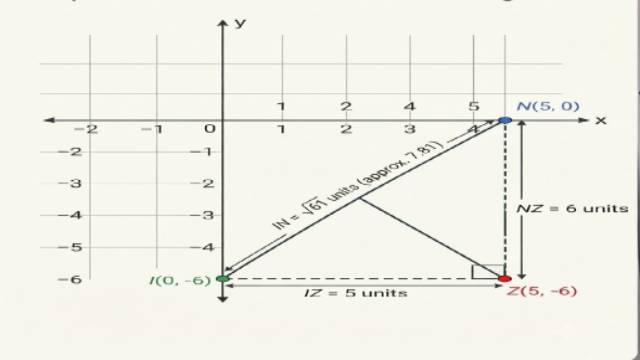
Example:4.Plot point Z (5,-6) on the Cartesian plane.Construct a right-angled triangle IZN and find the lengths of the three sides.(Comment:Answers may differ from person to person.)
Solution:Let I(5,0) and N(6,0)
Ditance between two points
PQ = \sqrt{(x_2 - x_1)^2 + (y_2 - y_1)^2} \\
\Rightarrow IZ = \sqrt{(5 - 0)^2 + (6- 6)^2} \\
= \sqrt{25} = 5 \\
IN = \sqrt{(5 - 0)^2 + (0 +6)^2} \\
\Rightarrow IN = \sqrt{25+36} = \sqrt{61} \\
ZN = \sqrt{(5 - 5)^2 + (0 + 6)^2} \\
= \sqrt{ 36} = 6 \\
\Rightarrow ZN = 6
Example:5.What would a system of coordinates be like if we did not have negative numbers? Would this system allow us to locate all the points on a 2-D plane?
Solution:First quadrant would a system of coordinates be like if we did not have negative numbers.This system would not allow us to locate all the points on a 2-D plane.
Example:6.Are the points M (-3,-4),A (0,0) and G (6,8) on the same straight line? Suggest a method to check this without plotting and joining the points.
Solution:Distance between two points PQ=
PQ = \sqrt{(x_2 - x_1)^2 + (y_2 - y_1)^2} \\
AG = \sqrt{(6 - 0)^2 + (8 - 0)^2} = \sqrt{36 + 64} \\
\Rightarrow AG = \sqrt{100} = 10 \\
MA = \sqrt{(-3 - 0)^2 + (-4 - 0)^2} \\
= \sqrt{9 + 16} = \sqrt{25} \\
\Rightarrow MA = 5 \\
MG = \sqrt{(6 - (-3))^2 + (8 - (-4))^2} \\
= \sqrt{(6 + 3)^2 + (8 + 4)^2} \\
= \sqrt{81 + 144} = \sqrt{225} \\
\Rightarrow MG = 15 \\
AG + MA = MG \Rightarrow 10 + 5 = 15
Hence M,A,G are on the same straight line.
Example:7.Use your method (from Problem 6) to check if the points R (-5,-1), B (-2, -5) and C (4,-12) are on the same straight line.Now plot both sets of points and check your answers.
Solution:Distance between two points
PQ = \sqrt{(x_2 - x_1)^2 + (y_2 - y_1)^2} \\
RB = \sqrt{(-2 - (-5))^2 + (-5 - (-1))^2} \\
= \sqrt{(-2 + 5)^2 + (-5 + 1)^2} \\
= \sqrt{(3)^2 + (-4)^2} \\
RB = \sqrt{9^2 + 16} = \sqrt{25} = 5 \\
BC = \sqrt{(4 - (-2))^2 + (-12 - (-5))^2} \\
= \sqrt{(4 + 2)^2 + (-12 + 5)^2} = \sqrt{(6)^2 + (-7)^2} \\
= \sqrt{36 + 49} = \sqrt{85} \\
\Rightarrow BC = \sqrt{85} \\
RC = \sqrt{(4 - (-5))^2 + (-12 - (-1))^2} \\
= \sqrt{(4 + 5)^2 + (-12 + 1)^2} \\
= \sqrt{9^2 + (-11)^2} = \sqrt{81 + 121} \\
RC = \sqrt{202} \approx 14.212 \\
RB + BC = 5 + \sqrt{85} \approx 5 + 9.219 \\
\Rightarrow RB + BC \approx 14.219 \\
\Rightarrow RB + BC \neq RC
So R,B and C are not on same straight line.
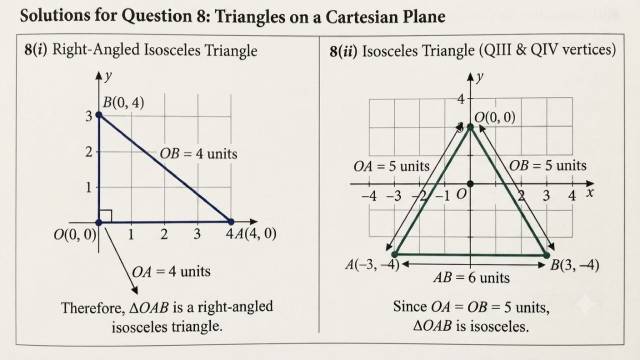
Example:8.Using the origin as one vertex,plot the vertices of:
(i) A right-angled isosceles triangle.
(ii) An isosceles triangle with one vertex in Quadrant III and the other in Quadrant IV.
Solution:Both ploting are following
Example:9.The following table shows the coordinates of points S,M and T.In each case,state whether M is the midpoint of segment ST.Justify your answer.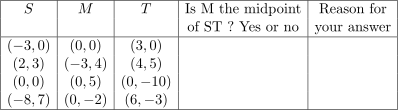
Reason for your answer
When M is the mid-point of ST,can you find any connection between the coordinates of M, S and T?
Solution:I case midpoint of ST = \left(\frac{x_1 + x_2}{2}, \frac{y_1 + y_2}{2}\right) = \left(\frac{-3 + 3}{2}, \frac{0 + 0}{2}\right) \\
= (0, 0) \text{ which is same as } M \\
\text{II case midpoint of } ST = \left(\frac{2 + 4}{2}, \frac{3 + 5}{2}\right) = (3, 4) \\
\text{which is same as M } \\
\text{III case midpoint} = \left(\frac{0 + 0}{2}, \frac{0 - 10}{2}\right) = (0, -5) \\
\text{which is not same as } M \text{ hence} \\
\text{ M is not midpoint} \\
\text{IV case midpoint of } ST \\
= \left(\frac{-8 + 6}{2}, \frac{7 - 3}{2}\right) = \left(\frac{-2}{2}, \frac{4}{2}\right) = (-1, 2)
Which is not same as M.Hence M is not midpoint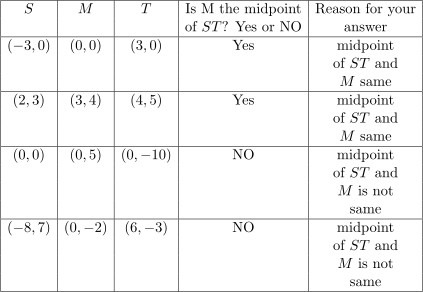
Example:10.Use the connection you found to find the coordinates of B given that M (-7,1) is the midpoint of A (3,-4) and B (x,y).
Solution:Coordinates of midpoint
= \left(\frac{x_1 + x_2}{2}, \frac{y_1 + y_2}{2}\right) \Rightarrow x = \frac{x_1 + x_2}{2}, y = \frac{y_1 + y_2}{2} \\
-7 = \frac{3 + x}{2} \Rightarrow x = -14 - 3 = -17 \\
1 = \frac{4 + y}{2} \Rightarrow y = 2 + 4 = 6
Example:11.Let P, Q be points of trisection of AB,with P closer to A,and Q closer to B. Using your knowledge of how to find the coordinates of the midpoint of a segment, how would you find the coordinates of P and Q? Do this for the case when the points are A (4, 7) and B (16,-2).
Solution:Midpoint of a segment
\left(x = \frac{x_1 + x_2}{2}, y = \frac{y_1 + y_2}{2}\right) \\
\text{Coordinates of } P, x = \frac{m_1 x_2 + m_2 x_1}{m_1 + m_2} \\
\text{and } y = \frac{m_1 y_2 + m_2 y_1}{m_1 + m_2} \\
\text{Where } m_1 = 1, m_2 = 2 \\
x = \frac{1 \times 16 + 2 \times 4}{1 + 2} = \frac{16 + 8}{3} = \frac{24}{3} \\
\Rightarrow x = 8 \\
y = \frac{1 \times -2 + 2 \times 7}{1 + 2} = \frac{-2 + 14}{3} = \frac{12}{3} = 4 \\
P \text{ is } (8, 4) \\
\text{Coordinates of } Q, \text{ here } m_1 = 2, m_2 = 1 \\
x = \frac{2 \times 16 + 1 \times 4}{1 + 2} = \frac{32 + 4}{3} = \frac{36}{3} = 12 \\
y = \frac{2 \times -2 + 1 \times 7}{1 + 2} = \frac{-4 + 7}{3} = \frac{3}{3} = 1
Q is (12,1)
Example:12.(i) Given the points A (1,-8), B(-4,7) and C (-7,-4),show that they lie on a circle K whose center is the origin O (0,0). What is the radius of circle K?
Solution:Coordinates of centre of circle
AO = \sqrt{(1 - 0)^2 + (-8 - 0)^2} = \sqrt{1 + 64} = \sqrt{65} \\
BO = \sqrt{(-4 - 0)^2 + (7 - 0)^2} = \sqrt{16 + 49} = \sqrt{65} \\
CO = \sqrt{(-7 - 0)^2 + (-4 - 0)^2} = \sqrt{49 + 16} = \sqrt{65}
AO=BO=CO
Hence A,B,C lies on the circle whose radius=\sqrt{65}
Example:(ii).Given the points D (-5,6) and E (0,9), check whether D and E lie within the circle,on the circle,or outside the circle K.
Solution: DO = \sqrt{(-5 - 0)^2 + (6 - 0)^2} \\
= \sqrt{25 + 36} = \sqrt{61} \\
\sqrt{61} < \sqrt{65} \text{ hence } D \text{ lies within the circle} \\
EO = \sqrt{(0 - 0)^2 + (9 - 0)^2} = 9 \\
9 > \sqrt{65}
Hence E lies outside the circle
Example:13.The midpoints of the sides of triangle ABC are the points D,E, and F. Given that the coordinates of D,E, and F are (5,1), (6,5), and (0,3), respectively,find the coordinates of A,B and C.
Solution:Let the coordinates of vertices of triangle ABC is and midpoint of AB,BC,CA are D(5,1),E(6,5),F(0,3)
A(x_1, y_1), B(x_2, y_2) \text{ and } C(x_3, y_3) \\
\text{midpoint of } AB, BC, CA \text{ are} \\
D(5, 1), E(6, 5), F(0, 3) \\
\frac{x_1 + x_2}{2} = 5 \text{ and } \frac{y_1 + y_2}{2} = 1 \\
\Rightarrow \frac{x_1 + x_2}{2} = 5 \text{ and } \frac{y_1 + y_2}{2} = 1 \quad \text{--- } (1) \\
\frac{x_2 + x_3}{2} = 6 \text{ and } \frac{y_2 + y_3}{2} = 5 \\
\Rightarrow x_2 + x_3 = 12 \text{ and } y_2 + y_3 = 10 \quad \text{--- } (2) \\
\frac{x_1 + x_3}{2} = 0 \text{ and } \frac{y_1 + y_3}{2} = 3 \\
\Rightarrow x_1 + x_3 = 0 \text{ and } y_1 + y_3 = 6 \quad \text{--- } (3) \\
\text{Adding } (1), (2) \text{ and } (3) \\
(x_1 + x_2) + (x_2 + x_3) + (x_1 + x_3) = 10 + 12 + 0 \\
\Rightarrow x_1 + x_2 + x_3 = 11 \quad \text{--- } (4) \\
(y_1 + y_2) + (y_2 + y_3) + (y_1 + y_3) = 2 + 10 + 6 \\
\Rightarrow y_1 + y_2 + y_3 = 9 \quad \text{--- } (5) \\
\text{From } (1), (4), (5) : x_3 = 1, y_3 = 7 \Rightarrow F(1, 7) \\
\text{From } (2), (4), (5) : x_1 = -1, y_1 = 1 \Rightarrow D(4, 1) \\
\text{From } (3), (4), (5) : x_2 = 11, y_2 = 3 \Rightarrow E(11, 3)
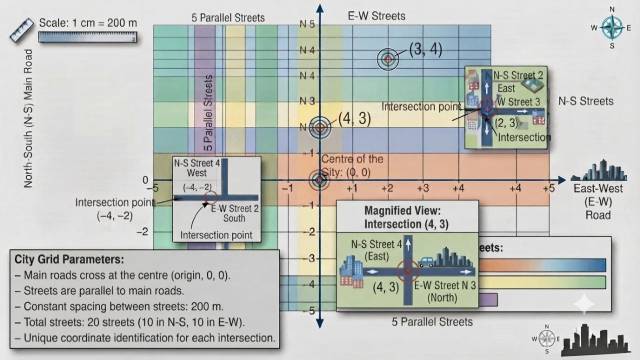
Example:14.A city has two main roads which cross each other at the centre of the city.These two roads are along the North-South (N-S) direction and East-West (E-W) direction.All the other streets of the city run parallel to these roads and are 200m apart.There are 10 streets in each direction.
Example:14(i)Using 1 cm=200 m,draw a model of the city in your notebook. Represent the roads/streets by single lines.
Example:14(ii) There are street intersections in the model.Each street intersection is formed by two streets-one running in the N-S direction and another in the E-W direction.Each street intersection is reffered to in the following manner:If the second street running in the N-S direction and 5th street in the E-W direction meet at some crossing,then we call this street intersection (2,5). Using this convention, find:
(a) how many street intersections can be referred to as (4,3).
(b) how many street intersections can be referred to as (3,4).
Solution:To get to the cross-street here (4,3) we choose the fourth road going in a north-south direction and the third road going in an east-west direction.Then the cross street directed from (4,3) is marked by the point \odot as shown in the figure above.
Similarly the point directed from (3,4) is marked with \odot.
Thus, both cross-streets are uniquely obtained.Because in the two reference lines \updownarrow_{S}^{N} and W \longleftrightarrow E we have used for location.
Example:15.A computer graphics program displays images on a rectangular screen whose coordinate system has the origin at the bottom-left corner.The screen is 800 pixels wide and 600 pixels high.A circular icon of radius 80 pixels is drawn with its centre at the point A(100,150).Another circular icon of radius 100 pixels is drawn with its centre at the point B (250,230). Determine:
(i) whether any part of either circle lies outside the screen.
(ii) whether the two circles intersect each other.
Solution:(i)Coordinates of computer screen (0,0),(800,0),(800,600),(0,600)
Distance from left side=100 pixels
and distance from Right side=800-100=700
Distance from top side=600-150=450
Distance from bottom side=150
All are greater than radius 80 pixels hence circle is totally inside in computer screen.
Another circle
Distance from left side=250
Distance from right side=800-250=550
Distance from bottom side=250
Distance from top side=600-250=350
All are greater than radius 100 hence it is totally inside in Computer screen.
(ii)Distance between centres
AB = \sqrt{(250 - 100)^2 + (250 - 150)^2} \\
= \sqrt{(150)^2 + (100)^2} = \sqrt{22500 + 6400} \\
= \sqrt{28900} = 170 \text{ pixels} \\
\text{and } r_1 + r_2 = 80 + 100 = 180 \text{ pixels} \\
r_1 + r_2 > AB
Hence both circles intersect each other.
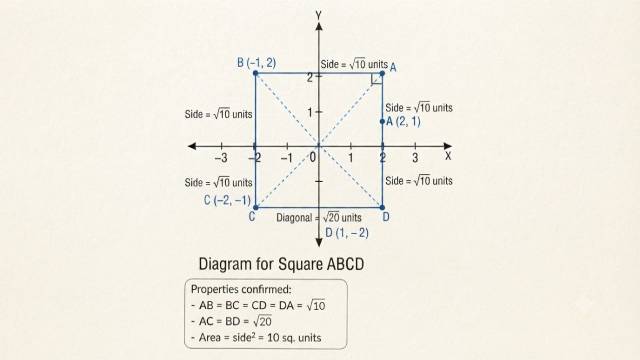
Example:16.Plot the points A (2,1),B (-1,2), C (-2,-1), and D (1,2) in the coordinate plane.Is ABCD a square? Can you explain why? What is the area of this square?
Solution: AB = \sqrt{(-1 - 2)^2 + (2 - 1)^2} \\
\Rightarrow AB = \sqrt{(-3)^2 + (1)^2} = \sqrt{10} \\
BC = \sqrt{(-2 - (-1))^2 + (-1 - 2)^2} \\
\Rightarrow BC = \sqrt{(-2 + 1)^2 + (-3)^2} = \sqrt{1 + 9} = \sqrt{10} \\
CD = \sqrt{(1 - (-2))^2 + (-2 - (-1))^2} \\
\Rightarrow CD = \sqrt{(1 + 2)^2 + (-2 + 1)^2} = \sqrt{9 + 1} = \sqrt{10} \\
DA = \sqrt{(2 - 1)^2 + (1 - (-2))^2} \\
\Rightarrow DA = \sqrt{(1)^2 + (1 + 2)^2} = \sqrt{10}
AB=BC=CD=DA
All sides are equal.Hence it is square.
By solving the above examples, one can understand the Distance Between Two Points Class 9 Maths:Formula,Examples & Solutions.
4.Practice Problems for Students
(1.)Prove that the four points whose co-ordinates are (5,-1,1),(7,-4,7),(1,-6,10),(-1,3,4) are vertices of a rhombus.
(2.)Prove that the four points A,B,C,D whose coordinates are (1,1,1),(-2,4,1),(-1,5,5) and (2,2,5) are the vertices of a square.
[Hint : use formula \sqrt{(x_1 - x_2)^2 + (y_1 - y_2)^2 + (z_1 - z_2)^2} ]
By solving the above questions, one can understand the Distance Between Two Points Class 9 Maths:Formula,Examples & Solutions well because the concept is well understood when you solve the questions practically.
### 📢 If you liked this math article:
* 👥 **Share with Friends:** Knowledge grows by sharing, so be sure to share it with your friends.
* 🔔 **Follow the Website:** If this is your first time here, follow our **email subscription** so that you get instant notifications for every new article.
* 💬 **Give Your Suggestions:** If you have any issues or would like to make any suggestions, do let us know by **commenting** below.
*Welcome to read the full article!*
5.Frequently Asked Questions Related to Distance Between Two Points Class 9 Maths:Formula,Examples & Solutions
Q:1.State the property of the co-ordinates of point lying on x-axis
Ans:The y coordinates of all points on the x-axis are zero.
Q:2.The formula for distance between two points is based on which theorem?
Ans:Distance formula based on Baudhayana-Pythagoras Theorem.
Q:3.What do you mean by reflection?
Ans:Replacing each point in the reflected configuration by a point symmetric to the given point with respect to the point, e.g.the reflection of the point (x,y) is the point (x,-y).
By answering the above questions,you can know about the primary terms of Distance Between Two Points Class 9 Maths:Formula,Examples & Solutions.
6.छात्र-छात्राओं से आज प्रश्न (Today’s Questions to Students):
🎯 Winner’s Corner:Kya aap is sawal ka sahi jawab de sakte hain? Apne naam ke saath niche comment karein! Sahi jawab dene wale top students ke naam hamari agli post/is article ke update mein Photo ya Special Mention ke sath publish kiye jayenge.Apna jawab abhi darj karein!
एक आदमी जो 5 किमी प्रति घंटा की गति से चल रहा है,एक पुल को 15 मिनट में पार करता है।पुल की लम्बाई (मीटरों में) ज्ञात कीजिए।
(A man who is walking at a speed of 5 kmph crosses a bridge in 15 minutes. Find the length (in metres) of the bridge.)
*पिछली प्रश्नोत्तरी का उत्तर*
दिव्या और स्नेहा के पास कुल धन=55
माना दिव्या के पास धन=x
माना स्नेहा के पास धन=55 - x \\
\frac{1}{4}x = \frac{1}{6}(55 - x) \\
\Rightarrow 6x = 4(55 - x) \\
\Rightarrow 6x = 220 - 4x \\
\Rightarrow 10x = 220 \Rightarrow x = \frac{220}{10} = 22
स्नेहा के पास धन=55-22=33
दोनों के धन में अन्तर=33-22=11
*Previous Quiz Solution*
Total wealth with Divya and Sneha = 55
Suppose Divya has wealth = x
Suppose Sneha has wealth=55 - x \\
\frac{1}{4}x = \frac{1}{6}(55 - x) \\
\Rightarrow 6x = 4(55 - x) \\
\Rightarrow 6x = 220 - 4x \\
\Rightarrow 10x = 220 \Rightarrow x = \frac{220}{10} = 22
Sneha has wealth = 55-22=33
Difference in the amount of money between the two=33-22=11
*”This article has been prepared by **Satyam Coaching Centre** on the **Satyam Mathematics** blog.”*




About Author

Sanjay Kumawat
(1.)**Satyam Narain Kumawat** **Website Name:Satyam Mathematics** *Owner:satyamcoachingcentre.in* *Sthan:Manoharpur,Jaipur (Rajasthan)* **Teaching Mathematics aur Anya Anubhav** ***Shiksha:**B.sc.,B.Ed.,(M.sc. star Ke Mathematics Ko Padhane ka Anubhav),B.com.,M.com. Ke vishayon Ko Padhane ka Anubhav,Philosophy,Psychology,Religious,sanskriti Mein Gahri Ruchi aur Adhyayan ***Anubhav:**phichale 23 varshon se M.sc.,M.com.,Angreji aur Vigyan Vishayon Mein Shikshaka Ka Lamba Anubhav ***Visheshagyata:*Maths,Adhyatma (spiritual),Yog vishayon ka vistrit Gyan* ****In Brief:I have read about M.sc. books,psychology,philosophy,spiritual, vedic,religious,yoga,health and different many knowledgeable books.A dedicated math expert with 23+ years of teaching experience upto M.sc. ,M.com.,English and science.After guiding thousands of students through Satyam Coaching Center,now share Mathematics,Trigonometry (Upto M.sc) and Educational Strategies in simple language on this blog from December 2018.* (2.)**(Technical Expert & Co-Admin):** ***Name:Sanjay Kumawat* *Qualification:Graduate in Mechanical Engineering (B.Tec) in 2013* *Profession:Physics Lecturer* *Teaching Experience:15 Years and Teaching to NEET,JEE Students* *Technical Experience:5 Years Coding and Article Editing,Classic Photo Editing by Laptop in Satyam Coaching Centre Blog* *A school lecturer and digital content strategist.On this blog,he handles all the responsibility of coding,image editing,SEO, and technical management,so that the mathematical content reaches the readers in a very accurate and beautiful form.* Updated on 15.06.2026

