Menu

Simultaneous Equations B.Sc Maths

1.Simultaneous Equations B.Sc Maths -Differential Equations of First Order and First Degree

Learn how to solve Simultaneous Differential Equations of First Order and First Degree(Simultaneous Equations B.Sc Maths) with clear steps,formulas and illustrations for mathematics students.

Also Read This Article:-  Differential equation

2.Simultaneous Equations B.Sc Maths Illustrations

Solve the following differential equations
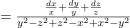
Illustration: 1. \frac{dx}{yz} = \frac{dy}{zx} = \frac{dz}{xy}
Solution: \frac{dx}{yz} = \frac{dy}{zx} = \frac{dz}{xy}
Multiplying each term by xyz, the given equations become
\frac{x\cdot dx}{xyz} = \frac{y\cdot dy}{xyz} = \frac{z\cdot dz}{xyz}
\Rightarrow x\cdot dx = y\cdot dy = z\cdot dz
From first two fractions, we get
2x\cdot dx - 2y\cdot dy = 0
Integrating x^2 - y^2 = c_1
Similarly from last two fractions, we get


2y\cdot dy = 2z\cdot dz
\Rightarrow 2y\cdot dy - 2z\cdot dz = 0
Integrating
\Rightarrow y^2 - z^2 = c_2
Illustration: 2.
\frac{dx}{(mz - ny)} = \frac{dy}{(nx - lz)} = \frac{dz}{(ly - mx)}
Solution:
\frac{dx}{(mz - ny)} = \frac{dy}{(nx - lz)} = \frac{dz}{(ly - mx)}
Choosing l, m, n as the multipliers each of the given fractions

= \frac{l\cdot dx + m\cdot dy + n\cdot dz}{l(mz - ny) + m(nx - lz) + n(ly - mx)}
= \frac{l\cdot dx + m\cdot dy + n\cdot dz}{0}
This gives l\cdot dx + m\cdot dy + n\cdot dz = 0
Integrating lx + my + nz = c_1
Again choosing x, y, z as multipliers, each of the given fractions

= \frac{x\cdot dx + y\cdot dy + z\cdot dz}{x(mz - ny) + y(nx - lz) + z(ly - mx)}
= \frac{x\cdot dx + y\cdot dy + z\cdot dz}{0}
\therefore This gives x\cdot dx + y\cdot dy + z\cdot dz = 0
Integrating x^2 + y^2 + z^2 = c_2
Required complete solution
lx + my + nz = c_1, \ x^2 + y^2 + z^2 = c_2
Illustration: 3.
\frac{dx}{z(x + y)} = \frac{dy}{z(x - y)} = \frac{dz}{x^2 + y^2}
Solution:
\frac{dx}{z(x + y)} = \frac{dy}{z(x - y)} = \frac{dz}{x^2 + y^2}
Choosing x, -y, -z as multipliers, each given fraction
= \frac{x\cdot dx - y\cdot dy - z\cdot dz}{xz(x + y) - yz(x - y) - z(x^2 + y^2)}
= \frac{x\cdot dx - y\cdot dy - z\cdot dz}{0}
which gives 2x\cdot dx - 2y\cdot dy - 2z\cdot dz = 0
Integrating: x^2 - y^2 - z^2 = c_1
​Choosing y, x, -z as multipliers, each given fraction
= \frac{y\cdot dx + x\cdot dy - z\cdot dz}{yz(x + y) + xz(x - y) - z(x^2 + y^2)}
= \frac{y\cdot dx + x\cdot dy - z\cdot dz}{0}
​which gives y\cdot dx + x\cdot dy - z\cdot dz = 0
\Rightarrow 2,d(xy) - 2z\cdot dz = 0
​Integrating
2xy - z^2 = c_2
​The required given solution is given by
x^2 - y^2 - z^2 = c_1, \ 2xy - z^2 = c_2
​Illustration: 4. \frac{a\cdot dx}{(b - c)yz} = \frac{b\cdot dy}{(c - a)zx} = \frac{c\cdot dz}{(a - b)xy}
​Solution:\frac{a\cdot dx}{(b - c)yz} = \frac{b\cdot dy}{(c - a)zx} = \frac{c\cdot dz}{(a - b)xy}
​Choosing x, y, z as multipliers, each of the given
= \frac{ax\cdot dx + by\cdot dy + cz\cdot dz}{bxyz - cxyz + cxyz - axyz + axyz - bxyz}
= \frac{ax\cdot dx + by\cdot dy + cz\cdot dz}{0}
​Integrating, ax^2 + by^2 + cz^2 = c_1
​Again choosing ax, by, cz as multipliers
\frac{a^2x\cdot dx + b^2y\cdot dy + c^2z\cdot dz}{[a(b - c) + b(c - a) + c(a - b)]xyz}
= \frac{a^2x\cdot dx + b^2y\cdot dy + c^2z\cdot dz}{0}
which gives a^2x\cdot dx + b^2y\cdot dy + c^2z\cdot dz = 0
Integrating a^2x^2 + b^2y^2 + c^2z^2 = c_2
The required complete solution is given by

ax^2 + by^2 + cz^2 = c_1, \ a^2x^2 + b^2y^2 + c^2z^2 = c_2
Illustration: 5. \frac{dx}{x(y - z)} = \frac{dy}{y(z - x)} = \frac{dz}{z(x - y)}
Adding to each given fraction
= \frac{dx + dy + dz}{x(y - z) + y(z - x) + z(x - y)}
= \frac{dx + dy + dz}{0}
which gives dx + dy + dz = 0
Integrating x + y + z = c_1
Choosing \frac{1}{x}, \frac{1}{y}, \frac{1}{z} as multipliers, each given fraction
\frac{\frac{1}{x}\cdot dx + \frac{1}{y}\cdot dy + \frac{1}{z}\cdot dz}{(y - z) + (z - x) + (x - y)} = \frac{\frac{1}{x}\cdot dx + \frac{1}{y}\cdot dy + \frac{1}{z}\cdot dz}{0}
which gives \frac{1}{x}\cdot dx + \frac{1}{y}\cdot dy + \frac{1}{z}\cdot dz = 0
Integrating \log x + \log y + \log z = \log c_2
\Rightarrow xyz = c_2
The required complete solution is given by
x + y + z = c_1, \ xyz = c_2
Illustration: 6.
\frac{dx}{x(y^2 - z^2)} = \frac{dy}{y(z^2 - x^2)} = \frac{dz}{z(x^2 - y^2)}
Solution:
\frac{dx}{x(y^2 - z^2)} = \frac{dy}{y(z^2 - x^2)} = \frac{dz}{z(x^2 - y^2)}
Choosing x, y, z as multipliers, each of given fraction

= \frac{x\cdot dx + y\cdot dy + z\cdot dz}{x^2(y^2 - z^2) + y^2(z^2 - x^2) + z^2(x^2 - y^2)}
= \frac{x\cdot dx + y\cdot dy + z\cdot dz}{x^2y^2 - x^2z^2 + y^2z^2 - x^2y^2 + z^2x^2 - z^2y^2}
= \frac{x\cdot dx + y\cdot dy + z\cdot dz}{0}
which gives x\cdot dx + y\cdot dy + z\cdot dz = 0
Integrating x^2 + y^2 + z^2 = c_1
Again choosing \frac{1}{x}, \frac{1}{y}, \frac{1}{z} as multipliers, each given fraction
= \frac{\frac{dx}{x} + \frac{dy}{y} + \frac{dz}{z}}{y^2 - z^2 + z^2 - x^2 + x^2 - y^2}
= \frac{\frac{dx}{x} + \frac{dy}{y} + \frac{dz}{z}}{0}
which gives \frac{dx}{x} + \frac{dy}{y} + \frac{dz}{z} = 0
Integrating \log x + \log y + \log z = \log c_2
\Rightarrow xyz = c_2
The required complete solution is given by

x^2 + y^2 + z^2 = c_1, \ xyz = c_2

Illustration: 7. \frac{dx}{\cos(x + y)} = \frac{dy}{\sin(x + y)} = \frac{dz}{z}
Solution:\frac{dx}{\cos(x + y)} = \frac{dy}{\sin(x + y)} = \frac{dz}{z} \quad \text{--- (1)}
Choosing 1, 1, 0 as multipliers, each given fraction
= \frac{dx + dy + 0 \cdot dz}{\cos(x + y) + \sin(x + y) + 0 \cdot z}
= \frac{d(x + y)}{\cos(x + y) + \sin(x + y)}
\text{put } x + y = u \Rightarrow dx + dy = du
= \frac{du}{\cos u + \sin u} \quad \text{--- (2)}
\text{From (1) and (2), we have}
\frac{dz}{z} = \frac{du}{\cos u + \sin u} = \frac{d(x - y)}{\cos u - \sin u} \quad \text{--- (3)}
\text{From last two fractions of (3), we get}
\frac{\cos u - \sin u}{\cos u + \sin u} , du = d(x - y)
\text{Integrating,}
\log(\cos u + \sin u) = (x - y) + \log c_1
\log\left(\frac{\cos u + \sin u}{c_1}\right) = (x - y)
\Rightarrow \frac{\cos u + \sin u}{c_1} = e^{(x - y)}
\Rightarrow \cos(x + y) + \sin(x + y) = c_1 e^{(x - y)}
\text{Also from first two fractions of (3), we get}
\frac{dz}{z} = \frac{du}{\sqrt{2}\left[\frac{1}{\sqrt{2}}\cos u + \frac{1}{\sqrt{2}}\sin u\right]} = \frac{du}{\sqrt{2}\cos\left(u - \frac{\pi}{4}\right)}
\Rightarrow \frac{dz}{z} = \sqrt{2}\sec\left(u - \frac{\pi}{4}\right)du
\text{Integrating,}
\sqrt{2}\log z = \log\left[\sec\left(u - \frac{1}{4}\pi\right) + \tan\left(u - \frac{1}{4}\pi\right)\right] + \log c_2
\Rightarrow z^{\sqrt{2}} = c_2\left[\sec\left(x + y - \frac{1}{4}\pi\right) + \tan\left(x + y - \frac{1}{4}\pi\right)\right]
\text{The required complete solution is given by}
\cos(x + y) + \sin(x + y) = c_1 e^{(x - y)}
z^{\sqrt{2}} = c_2\left[\sec\left(x + y - \frac{1}{4}\pi\right) + \tan\left(x + y - \frac{1}{4}\pi\right)\right]
Illustration: 8 \frac{dx}{x^2 - yz} = \frac{dy}{y^2 - zx} = \frac{dz}{z^2 - xy}
Solution: \frac{dx}{x^2 - yz} = \frac{dy}{y^2 - zx} = \frac{dz}{z^2 - xy}
choosing 1, -1, 0 as multipliers, each given fraction
= \frac{dx - dy + 0 \cdot dz}{(x^2 - yz) - (y^2 - zx) + 0} = \frac{d(x - y)}{(x^2 - y^2) + z(x - y)}
= \frac{d(x - y)}{(x - y)(x + y + z)} \quad \text{--- (1)}
And choosing 1, 0, -1 as multipliers, each given fraction
= \frac{dx + 0 \cdot dy - dz}{(x^2 - yz) + 0 - (z^2 - xy)} = \frac{d(x - z)}{(x^2 - z^2) + y(x - z)}
= \frac{d(x - z)}{(x - z)(x + y + z)} \quad \text{--- (2)}
From (1) and (2), we have
\frac{d(x - y)}{(x - y)(x + y + z)} = \frac{d(x - z)}{(x - z)(x + y + z)}
\Rightarrow \frac{d(x - y)}{x - y} = \frac{d(x - z)}{x - z}
Integrating, \log(x - y) = \log(x - z) + \log c_1
\Rightarrow \frac{x - y}{x - z} = c_1
Again choosing 1, 1, 1 as multipliers, each fraction
= \frac{dx + dy + dz}{(x^2 - yz) + (y^2 - zx) + (z^2 - xy)}
= \frac{d(x + y + z)}{x^2 + y^2 + z^2 - xy - yz - zx}
And choosing x, y, z as multipliers, each fraction
= \frac{x\cdot dx + y\cdot dy + z\cdot dz}{x(x^2 - yz) + y(y^2 - zx) + z(z^2 - xy)}
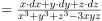
= \frac{x\cdot dx + y\cdot dy + z\cdot dz}{x^3 + y^3 + z^3 - 3xyz}
= \frac{x\cdot dx + y\cdot dy + z\cdot dz}{(x + y + z)(x^2 + y^2 + z^2 - yz - zx - xy)} \quad \text{--- (4)}
From (3) and (4) we have
\frac{d(x + y + z)}{x^2 + y^2 + z^2 - yz - zx - xy} = \frac{x\cdot dx + y\cdot dy + z\cdot dz}{(x + y + z)(x^2 + y^2 + z^2 - xy - yz - zx)}
\Rightarrow 2(x + y + z)d(x + y + z) = 2x\cdot dx + 2y\cdot dy + 2z\cdot dz
\Rightarrow 2u,du = d(x^2 + y^2 + z^2), \text{ where } u = x + y + z
Integrating,
u^2 = x^2 + y^2 + z^2 + 2c_2
\Rightarrow (x + y + z)^2 = x^2 + y^2 + z^2 + 2c_2
\Rightarrow yz + zx + xy = c_2
The required complete solution is given by
\frac{x - y}{x - z} = c_1, \ yz + zx + xy = c_2
Illustration: 9. \frac{dx}{y^2} = \frac{dy}{x^2} = \frac{dz}{x^2y^2z^2}
Solution: \frac{dx}{y^2} = \frac{dy}{x^2} = \frac{dz}{x^2y^2z^2}
Choose x^2, y^2, -\frac{2}{z^2} as multipliers, and each given fraction

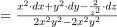
= \frac{x^2\cdot dx}{x^2y^2} = \frac{y^2\cdot dy}{x^2y^2} = \frac{-\frac{2}{z^2}\cdot dz}{-2x^2y^2}
From first two fraction
= \frac{x^2\cdot dx}{x^2y^2} = \frac{y^2\cdot dy}{x^2y^2}
\Rightarrow x^2\cdot dx = y^2\cdot dy
x^3 - y^3 = c_1
From first, second and third fraction:
= \frac{x^2\cdot dx + y^2\cdot dy - \frac{2}{z^2}\cdot dz}{2x^2y^2 - 2x^2y^2}
= x^2\cdot dx + y^2\cdot dy - \frac{2}{z^2}\cdot dz
\Rightarrow x^2 dx + y^2 dy - \frac{2}{z^2}\cdot dz = 0
Integrating,
x^3 + y^3 + \frac{6}{z} = c_2
The required complete solution is given by

x^3 - y^3 = c_1, \ x^3 + y^3 + \frac{6}{z} = c_2
Illustration: 10. \frac{dx}{x} = \frac{dy}{y} = \frac{dz}{z - a\sqrt{x^2 + y^2 + z^2}}
Solution: \frac{dx}{x} = \frac{dy}{y} = \frac{dz}{z - a\sqrt{x^2 + y^2 + z^2}} \quad \text{--- (1)}
From first two fractions, we have
\frac{dx}{x} = \frac{dy}{y}
Integrating, \log x = \log y + \log c_1
\Rightarrow \frac{x}{y} = c_1
Again choosing x, y, z as multipliers, each fraction of (1)
= \frac{x dx + ydy + zdz}{x^2 + y^2 + z^2 - az\sqrt{x^2 + y^2 + z^2}}
= \frac{u du}{u^2 - az \cdot u}, \text{ putting } u^2 = x^2 + y^2 + z^2 \quad \text{--- (2)}
\text{i.e. } u \cdot du = x\cdot dx + y\cdot dy + z\cdot dz
= \frac{du}{u - az} \quad \text{--- (3)}
From (1) and (3), we get
\frac{dx}{x} = \frac{dz}{z - au} = \frac{du}{u - az} \quad \text{--- (4) using (2)}
Choosing 0, 1, 1 as multipliers,
= \frac{0 \cdot dx + dz + du}{0 \cdot x + z - au + u - az}
= \frac{d(z + u)}{(1 - a)(z + u)} \quad \text{--- (5)}
\text{From (4), (5) we have}
\frac{dx}{x} = \frac{dv}{(1 - a)v}, \text{ where } v = z + u
\Rightarrow (1 - a)\log x - \log v = \log c_2, \text{ on integrating}
\Rightarrow x^{1 - a} = c_2 v
\Rightarrow x^{1 - a} = c_2(u + z) \quad \because v = u + z
\Rightarrow x^{1 - a}\left[z + \sqrt{x^2 + y^2 + z^2}\right] = c_2
\text{The required complete solution is given by}

\frac{x}{y} = c_1, \ x^{1 - a}\left[z + \sqrt{x^2 + y^2 + z^2}\right] = c_2
Illustration: 11. \frac{dx}{y + z} = \frac{dy}{z + x} = \frac{dz}{x + y}
Solution: \frac{dx}{y + z} = \frac{dy}{z + x} = \frac{dz}{x + y}
\text{choosing } 1, -1, 0 \text{ as multipliers, each given fraction}
= \frac{dx - dy + 0 \cdot dz}{(y + z) + (-1)(z + x) + 0(x + y)} = \frac{dx - dy}{y - x} \quad \text{--- (1)}
\text{choosing } 1, 0, -1 \text{ as multipliers, each of given fraction}
= \frac{dx + 0 \cdot dy - 1 \cdot dz}{(y + z) + 0 \cdot (z + x) - 1(x + y)} = \frac{dx - dz}{z - x} \quad \text{--- (2)}
\text{similarly taking } 1, 1, 1 \text{ as multipliers, each of given fractions}
= \frac{dx + dy + dz}{(y + z) + (z + x) + (x + y)} = \frac{d(x + y + z)}{2(x + y + z)} \quad \text{--- (3)}
From (1), (2) and (3) we get
\frac{dx - dy}{y - x} = \frac{dx - dz}{z - x} = \frac{d(x + y + z)}{2(x + y + z)} \quad \text{--- (4)}
From first two fractions of (4), we get
\frac{d(x - y)}{x - y} = \frac{d(x - z)}{x - z}
Integrating,
\log(x - y) = \log(x - z) + \log c_1
\Rightarrow x - y = (x - z)c_1
Similarly from last two fractions of (4), we get
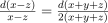
\frac{d(x - z)}{x - z} = \frac{d(x + y + z)}{2(x + y + z)}
Integrating,
\log(x - z) + \frac{1}{2}\log(x + y + z) = \log c_2
\Rightarrow (x - z)(x + y + z)^{\frac{1}{2}} = c_2
The required complete solution is given by

x - y = (x - z)c_1, \ (x - z)(x + y + z)^{\frac{1}{2}} = c_2
By solving the above illutrations,one can understand the Simultaneous Differential Equations of First Order and First Degree(Simultaneous Equations B.Sc Maths).

Also Read This Article:- Singular Solutions,Envelope and Cusp Locus-B.Sc. Maths

3.Practice Problems of Simultaneous Equations B.Sc Maths for Students

(1.) Solve \frac{dx}{y - z} = \frac{dy}{z - x} = \frac{dz}{x - y}

(2.) Solve \frac{dx}{x^2} = \frac{dy}{y^2} = \frac{dz}{nxy}
Answers:
(1.) x + y + z = c_1,  x^2 + y^2 + z^2 = c_2
(2.) y-x = c_1 xy, z =\frac{nxy}{y-x} \log (\frac{y}{x})  c_2
By solving the above questions,you can understand the Simultaneous Differential Equations of First Order and First Degree well because the concept is well understood when you solve it practically.
### 📢 If you liked this math article:
* 👥 **Share with Friends:** Knowledge grows by sharing, so be sure to share it with your friends.
* 🔔 **Follow the Website:** If this is your first time here, follow our **email subscription** so that you get instant notifications for every new article.
* 💬 **Give Your Suggestions:** If you have any issues or would like to make any suggestions, do let us know by **commenting** below.
*Welcome to read the full article!*

Also Read This Article:-  Simultaneous Differential Equation Bsc Maths

4.Frequently Asked Questions Related to Simultaneous Equations B.Sc Maths

Q:1.What is the standard form of Simultaneous Equations B.Sc Maths between three variables?

Ans:Simultaneous equations of the first order and first degree in the derivatives can sometimes be solved by the method which will be given here.Here it is being given for only those equations involving three variables.
P_1,dx + Q_1,dy + R_1,dz = 0
P_2,dx + Q_2,dy + R_2,dz = 0

Q:2.How do simultaneous differential equations solve?

Ans:By any two terms of the three terms of \frac{dx}{P} = \frac{dy}{Q} = \frac{dz}{R} ,we may be able to get an equation in only two variables.
Simultaneous Equations B.Sc Maths

Q:3.What is the combination method of solving Simultaneous Equations B.Sc Maths?

Ans:Any combination of methods given in I,II,III will help us in getting two independent relations between the variables,each containing an arbitrary constant.These two solutions will constitute the complete solution.
Simultaneous Differential Equations of First Order and First Degree
By answering the above questions,you can know about the primary terms of Simultaneous Differential Equations of First Order and First Degree(Simultaneous Equations B.Sc Maths).

5.छात्र-छात्राओं से आज का प्रश्न (Today’s Question to Students):

🎯 विनर्स कॉर्नर:क्या आप इस सवाल का सही जवाब दे सकते हैं?अपने नाम के साथ नीचे कमेंट करें!सही जवाब देने वाले Top Students के नाम हमारी आगे post/is article ke update में Photo ya Special Mention के साथ publish की जाएगी।अपना जवाब अभी दर्ज करें!👇
यदि दो अंकों की एक संख्या और उस संख्या के अंकों के योग के बीच क्रमशः अनुपात 7:1 है।यदि दहाई के स्थान पर जो अंक है वह ईकाई के अंक से एक अधिक है,तो वह संख्या क्या है?
(If the ratio between a two-digit number and the sum of the digits of that number is 7 : 1 respectively. If the digit in place of tens is one more than the digit of the unit, then what is that number?):
*पिछली प्रश्नोत्तरी का हल*
जिस प्रकार
Rendered by QuickLaTeX.com

उसी प्रकार

Rendered by QuickLaTeX.com

*Previous Quiz Solution*
The way

Rendered by QuickLaTeX.com

In the same way

Rendered by QuickLaTeX.com

*”This article has been prepared by **Satyam Coaching Centre** on the **Satyam Mathematics** blog.”*


Leave a Reply

Your email address will not be published. Required fields are marked *