Principal Value: Inverse Trig Class 12
1.Principal Value: Inverse Trig Class 12
In this article,”Principal Value: Inverse Trig Class 12″, we will learn to find out the principal value of inverse trigonometric functions.
Also Read This Article :- Parametric Function Derivative Example:Solved Example and Formula
2.Key Points Summary of Inverse Trig Class 12
(1.)Basic Condition of Inverse Function
(i)The inverse (f^{-1}) of any function f is only possible if it is ‘one-one’ and ‘onto’ (i.e. bijective).
(ii)Trigonometric functions in the natural domain are not bijective,so they cannot be directly inversed.
(2.)Restrictions on Domain & Principal Value Branch
(i)The domains of trigonometric functions are restricted to extract the inverse so that they become one-one and onto.
(ii)On the basis of limited domains,many branches are formed,the main branch of which is called ‘Principal Value Branch’.
(3.)Inverse Trigonometric Functions:
(i)Domain and Range (Principal Value Branch)
(ii)Below is the standard reference table for Principal Value
Inverse Trigonometric Functions: Domain and Range (Principal Value Branch)
Below is the standard reference table for Principal Value Branches:
\begin{array}{|l|l|l|}
\hline \textbf{Inverse Function} & \textbf{Domain} & \textbf{Range (PVB)} \\ \hline
\sin^{-1}(x) & [-1, 1] & \left[-\frac{\pi}{2}, \frac{\pi}{2}\right] \\ \hline
\cos^{-1} x & [-1, 1] & [0, \pi] \\ \hline
\tan^{-1} x & \mathbb{R} & \left(-\frac{\pi}{2}, \frac{\pi}{2}\right) \\ \hline
\cot^{-1} x & \mathbb{R} & (0, \pi) \\ \hline
\sec^{-1}(x) & \mathbb{R} - (-1, 1) & (0, \pi] - \left\{\frac{\pi}{2}\right\} \\ \hline
\operatorname{cosec}^{-1}(x) & \mathbb{R} - (-1, 1) & \left[-\frac{\pi}{2}, \frac{\pi}{2}\right] - \{0\} \\ \hline
\end{array}
(4.)Graph transformation (Graph Highlights)
(i)The graph of y = f^{-1}(x) is obtained by interchanging the X and Y axes in the graph of y=f(x).
(ii)This graph is a mirror image of the original function along the line y=x.
(5.)Key Properties
\sin\left(\sin^{-1}(x)\right) = x (where x \in [-1, 1])
\sin^{-1}(\sin x) = x (where x \in \left[-\frac{\pi}{2}, \frac{\pi}{2}\right])
Also Read This Article:- Inverse trigonometric functions
3.Examples Based on Principal Value: Inverse Trig Class 12
Example: 1. \sin^{-1}\left(-\frac{1}{2}\right)
Solution: \sin^{-1}\left(-\frac{1}{2}\right)
Let \sin^{-1}\left(-\frac{1}{2}\right) = x
\Rightarrow \sin x = -\frac{1}{2}
\Rightarrow \sin x = \sin\left(-\frac{\pi}{6}\right)
x = -\frac{\pi}{6} \in \left[-\frac{\pi}{2}, \frac{\pi}{2}\right]
Hence principal value of \sin^{-1}\left(-\frac{1}{2}\right) is -\frac{\pi}{6}
Example: 2. \cos^{-1}\left(\frac{\sqrt{3}}{2}\right)
Solution: \cos^{-1}\left(\frac{\sqrt{3}}{2}\right)
Let \cos^{-1}\left(\frac{\sqrt{3}}{2}\right) = x
\Rightarrow \cos x = \frac{\sqrt{3}}{2}
\Rightarrow \cos x = \cos\left(\frac{\pi}{6}\right)
x = \frac{\pi}{6} \in [0, \pi]
Hence Principal value of \cos^{-1}\left(\frac{\sqrt{3}}{2}\right) is \frac{\pi}{6}
Example: 3. \operatorname{cosec}^{-1}(2)
Solution: \operatorname{cosec}^{-1}(2)
Let \operatorname{cosec}^{-1}(2) = x
\Rightarrow \operatorname{cosec} x = 2
\Rightarrow \operatorname{cosec} x = \operatorname{cosec}\left(\frac{\pi}{6}\right)
\Rightarrow x = \frac{\pi}{6} \in \left[-\frac{\pi}{2}, \frac{\pi}{2}\right]
Hence principal value of \operatorname{cosec}^{-1}(2) is \frac{\pi}{6}
Example: 4. \tan^{-1}(-\sqrt{3})
Solution: \tan^{-1}(-\sqrt{3})
Let \tan^{-1}(-\sqrt{3}) = x
\Rightarrow \tan x = -\sqrt{3}
\Rightarrow \tan x = -\tan\left(\frac{\pi}{3}\right)
\Rightarrow \tan x = \tan\left(-\frac{\pi}{3}\right)
\Rightarrow x = -\frac{\pi}{3} \in \left(-\frac{\pi}{2}, \frac{\pi}{2}\right)
Hence principal value of \tan^{-1}(-\sqrt{3}) is -\frac{\pi}{3}
Example: 5. \cos^{-1}\left(-\frac{1}{2}\right)
Solution: \cos^{-1}\left(-\frac{1}{2}\right)
Let \cos^{-1}\left(-\frac{1}{2}\right) = x
\Rightarrow \cos x = -\frac{1}{2}
\Rightarrow \cos x = -\cos\left(\frac{\pi}{3}\right)
= \cos\left(\pi - \frac{\pi}{3}\right)
\Rightarrow \cos x = \cos\left(\frac{2\pi}{3}\right)
x = \frac{2\pi}{3}
Hence principal value of
\cos^{-1}\left(-\frac{1}{2}\right) is \frac{2\pi}{3}
Example: 6. \tan^{-1}(-1)
Solution: \tan^{-1}(-1)
Let \tan^{-1}(-1) = x
\Rightarrow \tan x = -1
\Rightarrow \tan x = -\tan\left(\frac{\pi}{4}\right)
\Rightarrow \tan x = \tan\left(-\frac{\pi}{4}\right)
x = -\frac{\pi}{4} \in \left(-\frac{\pi}{2}, \frac{\pi}{2}\right)
Hence principal value of
\tan^{-1}(-1) is -\frac{\pi}{4}
Example: 7. \sec^{-1}\left(\frac{2}{\sqrt{3}}\right)
Solution: \sec^{-1}\left(\frac{2}{\sqrt{3}}\right)
Let \sec^{-1}\left(\frac{2}{\sqrt{3}}\right) = x
\Rightarrow \sec x = \frac{2}{\sqrt{3}}
\Rightarrow \sec x = \sec\left(\frac{\pi}{6}\right)
x = \frac{\pi}{6} \in [0, \pi]
Hence principal value of
\sec^{-1}\left(\frac{2}{\sqrt{3}}\right) is \frac{\pi}{6}
Example: 8. \cot^{-1}(\sqrt{3})
Solution: \cot^{-1}(\sqrt{3})
Let \cot^{-1}(\sqrt{3}) = x
\Rightarrow \cot x = \sqrt{3}
\Rightarrow \cot x = \cot\left(\frac{\pi}{6}\right)
x = \frac{\pi}{6} \in (0, \pi]
Hence principal value of
\cot^{-1}(\sqrt{3}) is \frac{\pi}{6}
Example: 9. \cos^{-1}\left(-\frac{1}{\sqrt{2}}\right)
Solution: \cos^{-1}\left(-\frac{1}{\sqrt{2}}\right)
Let \cos^{-1}\left(-\frac{1}{\sqrt{2}}\right) = x
\Rightarrow \cos x = -\frac{1}{\sqrt{2}}
\Rightarrow \cos x = -\cos\left(\frac{\pi}{4}\right)
\Rightarrow \cos x = \cos\left(\pi - \frac{\pi}{4}\right)
\Rightarrow \cos x = \cos\left(\frac{3\pi}{4}\right)
x = \frac{3\pi}{4} \in [0, \pi]
Hence principal value of
\cos^{-1}\left(-\frac{1}{\sqrt{2}}\right) is \frac{3\pi}{4}
Example: 10. \operatorname{cosec}^{-1}(-\sqrt{2})
Solution: \operatorname{cosec}^{-1}(-\sqrt{2})
Let \operatorname{cosec}^{-1}(-\sqrt{2}) = x
\Rightarrow \operatorname{cosec} x = -\sqrt{2}
\Rightarrow \operatorname{cosec} x = -\operatorname{cosec} \frac{\pi}{4}
\Rightarrow \operatorname{cosec} x = \operatorname{cosec}\left(-\frac{\pi}{4}\right)
x = -\frac{\pi}{4} \in \left[-\frac{\pi}{2}, \frac{\pi}{2}\right]
Hence principal value of
\operatorname{cosec}^{-1}(-\sqrt{2}) is \left(-\frac{\pi}{4}\right)
Find the values of the following:
Example: 11. \tan^{-1}(1) + \cos^{-1}\left(-\frac{1}{2}\right) + \sin^{-1}\left(-\frac{1}{2}\right)
Solution: \tan^{-1}(1) + \cos^{-1}\left(-\frac{1}{2}\right) + \sin^{-1}\left(-\frac{1}{2}\right)
Principal value of
\tan^{-1}(1) = \frac{\pi}{4}, \cos^{-1}\left(-\frac{1}{2}\right) = \frac{2\pi}{3},
\sin^{-1}\left(-\frac{1}{2}\right) = -\frac{\pi}{6}
\tan^{-1}(1) + \cos^{-1}\left(-\frac{1}{2}\right) + \sin^{-1}\left(-\frac{1}{2}\right)
= \frac{\pi}{4} + \frac{2\pi}{3} - \frac{\pi}{6}
= \frac{3\pi + 8\pi - 2\pi}{12}
= \frac{9\pi}{12} = \frac{3\pi}{4}
Example: 12. \cos^{-1}\left(\frac{1}{2}\right) + 2\sin^{-1}\left(\frac{1}{2}\right)
Solution: \cos^{-1}\frac{1}{2} + 2\sin^{-1}\frac{1}{2}
Principal value of \cos^{-1}\frac{1}{2} = \frac{\pi}{3}
\sin^{-1}\left(\frac{1}{2}\right) = \frac{\pi}{6}
Hence \cos^{-1}\left(\frac{1}{2}\right) + 2\sin^{-1}\left(\frac{1}{2}\right) = \frac{\pi}{3} + 2 \times \frac{\pi}{6}
= \frac{\pi}{3} + \frac{\pi}{3} = \frac{2\pi}{3}
Example: 13. If \sin^{-1} x = y, then
(A) 0 \le y \le \pi (B) -\frac{\pi}{2} \le y \le \frac{\pi}{2}
(C) 0 < y < \pi (D) -\frac{\pi}{2} < y < \frac{\pi}{2}
Solution: \sin^{-1} x = y \in \left[-\frac{\pi}{2}, \frac{\pi}{2}\right]
Hence -\frac{\pi}{2} \le y \le \frac{\pi}{2}
Alternate (B) is true.
Example: 14. \tan^{-1}(\sqrt{3}) - \sec^{-1}(-2) is equal to
(A) \pi (B) -\frac{\pi}{3} (C) \frac{\pi}{3} (D) \frac{2\pi}{3}
Solution: \tan^{-1}(\sqrt{3}) - \sec^{-1}(-2)
= \frac{\pi}{3} - \frac{2\pi}{3} = \frac{4\pi - 9\pi}{12} = -\frac{5\pi}{12}
evaluating \tan^{-1}(\sqrt{3}) = \frac{\pi}{3} and \sec^{-1}(-2) = \pi - \frac{\pi}{3} = \frac{2\pi}{3},
so \frac{\pi}{3} - \frac{2\pi}{3} = -\frac{\pi}{3}
= -\frac{\pi}{3}
Alternate (B) is true
By solving the above examples,one can understand the Principal Value: Inverse Trig Class 12.
Also Read This Article:- Types of Functions in Class 12
4.Practice Questions of Principal Value: Inverse Trig Class 12 for Students

Find the principal value of the following
(1.) \sec^{-1}(\sqrt{2}) (2.) \operatorname{cosec}^{-1}(-1)
(3.) \sec^{-1}(-\sqrt{2})
Answers: (1.) \frac{\pi}{4} (2.) -\frac{\pi}{2} (3.) \frac{3\pi}{4}
By solving the above questions,you can understand the Principal Value: Inverse Trig Class 12 well because the concept is well understood when you solve it practically.
### 📢 If you liked this math article:
* 👥 **Share with Friends:** Knowledge grows by sharing, so be sure to share it with your friends.
* 🔔 **Follow the Website:** If this is your first time here, follow our **email subscription** so that you get instant notifications for every new article.
* 💬 **Give Your Suggestions:** If you have any issues or would like to make any suggestions, do let us know by **commenting** below.
*Welcome to read the full article!*
5.Frequentaly Asked Questions Related to Principal Value: Inverse Trig Class 12
Q:1.In which subjects (Fields) is the use of the inverse trogonometric function?
Ans:The inverse trogonometric functions play an important role in calculus for they serve to define many integrals.The concepts of inverse trogonometric functions is also in science and engineering.
Q:2.What do you mean by principal value branch?
Ans:The value of an inverse trogonometric functions which lies in the range of principal value of that inverse trogonometric functions.
Q:3.Write down the specific points of inverse trigonometric functions.
Ans: (1) \sin x should not be confused with (\sin x)^{-1}. In fact (\sin x)^{-1} = \frac{1}{\sin x} and similarly for other trigonometric functions.
(2.) Whenever no branch of an inverse trigonometric functions is mentioned, we mean the principal value branch of that function.
By answering the above questions,you can know about the primary terms of Principal Value: Inverse Trig Class 12.
6.छात्र-छात्राओं से आज का प्रश्न (Today’s Question to Students):
🎯 विनर्स कॉर्नर:क्या आप इस सवाल का सही जवाब दे सकते हैं?अपने नाम के साथ नीचे कमेंट करें!सही जवाब देने वाले Top Students के नाम हमारी आगे post/is article ke update में Photo ya Special Mention के साथ publish की जाएगी।अपना जवाब अभी दर्ज करें!👇
*”331 का \frac{3}{8} आसन्न मान क्या होगा?
(What is the adjacent value of \frac{3}{8} of 331?)
*पिछली प्रश्नोत्तरी का उत्तर* 82
दी गई संख्या श्रृंखला का क्रम इस प्रकार है: [82]
70 \quad 68 \quad 74 \quad 68 \quad 78 \quad ? \quad 68
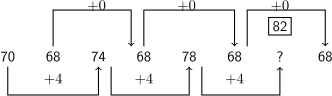
अतः प्रश्नचिन्ह (?) के स्थान पर संख्या 82 आएगी।
*Previous Quiz Solution*
The order of the given series is as follows: 82
Hence, the question mark (?) will be replaced by the number 82.
*”This article has been prepared by **Satyam Coaching Centre** on the **Satyam Mathematics** blog.”*
About Author

Sanjay Kumawat
(1.)**Satyam Narain Kumawat** **Website Name:Satyam Mathematics** *Owner:satyamcoachingcentre.in* *Sthan:Manoharpur,Jaipur (Rajasthan)* **Teaching Mathematics aur Anya Anubhav** ***Shiksha:**B.sc.,B.Ed.,(M.sc. star Ke Mathematics Ko Padhane ka Anubhav),B.com.,M.com. Ke vishayon Ko Padhane ka Anubhav,Philosophy,Psychology,Religious,sanskriti Mein Gahri Ruchi aur Adhyayan ***Anubhav:**phichale 23 varshon se M.sc.,M.com.,Angreji aur Vigyan Vishayon Mein Shikshaka Ka Lamba Anubhav ***Visheshagyata:*Maths,Adhyatma (spiritual),Yog vishayon ka vistrit Gyan* ****In Brief:I have read about M.sc. books,psychology,philosophy,spiritual, vedic,religious,yoga,health and different many knowledgeable books.A dedicated math expert with 23+ years of teaching experience upto M.sc. ,M.com.,English and science.After guiding thousands of students through Satyam Coaching Center,now share Mathematics,Trigonometry (Upto M.sc) and Educational Strategies in simple language on this blog from December 2018.* (2.)**(Technical Expert & Co-Admin):** ***Name:Sanjay Kumawat* *Qualification:Graduate in Mechanical Engineering (B.Tec) in 2013* *Profession:Physics Lecturer* *Teaching Experience:15 Years and Teaching to NEET,JEE Students* *Technical Experience:5 Years Coding and Article Editing,Classic Photo Editing by Laptop in Satyam Coaching Centre Blog* *A school lecturer and digital content strategist.On this blog,he handles all the responsibility of coding,image editing,SEO, and technical management,so that the mathematical content reaches the readers in a very accurate and beautiful form.* Updated on 15.06.2026

