Subsets in Class 11
1.Subsets in Class 11
In this article Subsets in Class 11,we will read about subsets.You should know how to represent intervals as subsets of R.We will solve Questions on subsets.
“Before diving into these solutions, make sure you understand the foundational concept of “Sets and Their Representation Class 11” and have reviewed the essential “Types of Sets Class 11th“. This will make following today’s step-by-step solutions much easier.”
2.Subsets in Class 11 Solved Examples
\text{ Example 1. Make correct statements by filling in the symbols or in the blank spaces: } \\ \text{(i) } \{2, 3, 4\} \ldots \{1, 2, 3, 4, 5\} \\ \text{ (ii) } \{a, b, c\} \ldots \{b, c, d\} \\ \text{ (iii) } \{x : x \text{ is a student of class XI of your school } \} \ldots \{x : x \text{ student of your school} \} \\ \text{ (iv) } \{x : x \text{ is a circle in the plane} \} \ldots \ldots \{x : x \text{ is a circle in the same plane with radius 1 unit} \} \\ \text{ (v) } \{x : x \text{ is a triangle in a plane} \} \ldots \ldots \{x : x \text{ is a rectangle in the plane} \} \\ \text{ (vi) } \{x : x \text{ is an equilateral triangle in a plane}\} \ldots \ldots \{x : x \text{ is a triangle in the same plane} \} \\ \text{ (vii) } \{x : x \text{ is an even natural number } \} \ldots \ldots \{x : x \text{ is an integer} \} \\ \text{ Solution}: \text{(i) } \{1, 2, 3, 4\} \subset \{1, 2, 3, 4, 5\} \\ \text{ (ii) } \{a, b, c\} \not\subset \{b, c, d\} \\ \text{ (iii) } \{x : x \text{ is a student of class XI}\\ \text{ (iv) } \{x : x \text{ is a circle in the plane}\} \not \subset \{x : x \text{ is a circle in the same plane with radius 1 unit } \} \\ \text{ (v) } \{x : x \text{ is a triangle in a plane}\} \not \subset \{x : x \text{ is a rectangle in the plane} \} \\ \text{ (vi) } \{x : x \text{ is an equilateral triangle in a plane}\} \subset \{x : x \text{ is a triangle in the same plane} \} \\ \text{ (vii) } \{x : x \text{ is an even natural number}\} \subset \{x : x \text{ is an integer } \} \\ \text{ Example 2. Examine whether the following statements are true or false: } \\ \text{(i) } \{a, b\} \not\subset \{b, c, a\} \\ \text{ (ii) } \{a, e\} \subset \{x : x \text{ is a vowel in the English alphabet } \} \\ \text{ (iii) } \{1, 2, 3\} \subset \{1, 3, 5\} \\ \text{ (iv) } \{a\} \subset \{a, b, c\} \\ \text{ (v) } \{a\} \in \{a, b, c\} \\ \text{ (vi) } \{x : x \text{ is an even natural number less than 6 } \} \subset \{x : x \text{ is a natural number which divides 36 } \} \\ \text{ Solution}:\text{ \text{(i) } False \text{ (ii) } True \text{ (iii) } False \text{ (iv) } True \text{ (v) } False \text{ (vi) } True } \text{ Example } 3. \text{Let A } = \{1, 2, \{3, 4\}, 5\} \\ \text{ Which of the following statements are incorrect and why? } \\ \text{(i) } \{3, 4\} \subset A \\ \text{ (ii) } \{3, 4\} \in A \\ \text{ (iii) } \{\{3, 4\}\} \subset A \\ \text{ (iv) } 1 \in A \\ \text{ (v) } 1 \subset A \\ \text{ (vi) } \{1, 2, 5\} \subset A \\ \text{ (vii) } \{1, 2, 5\} \in A \\ (viii) \{1, 2, 3\} \subset A \\ \text{ (ix) } \phi \in A \\ \text{ (x) } \phi \subset A \\ \text{ (xi) } \{\phi\} \subset A \\ \text{ Solution}: \text{(i) } \text{ incorrect because } \{3, 4\} \in A \text{ and 3, 4 not element of A } \\ \text{ (v) } \text{ incorrect because sets and subsets are represent in \{ \} bracket } \\ \text{ (vii) } \{1, 2, 5\} \in A \text{ is incorrect because } \{1, 2, 5\} \text{ is not element of A } \\ (viii) \{1, 2, 3\} \subset A \text{ is incorrect because 3 is not element of A } \\ \text{ (ix) } \phi \in A \text{ is incorrect because } \phi \text{ is not element of A } \\ \text{ (xi) } \{\phi\} \subset \text{ A is incorrect because } \{\phi\} \text{ is not subset of A. } \\ \text{ Example } 4. \text{ Write down all the subsets of the following sets } \\ \text{ Example } 4\text{(i) }. \{a\} \\ \text{ Solution}: \phi, \{a\} \\ \text{ Example } 4\text{ (ii) }. \{a, b\} \\ \text{ Solution}: \phi, \{a\}, \{b\}, \{a, b\} \\ \text{ Example } 4\text{ (iii) }. \{1, 2, 3\} \\ \text{ Solution}: \phi, \{1\}, \{2\}, \{3\}, \{1, 2\}, \{1, 3\}, \{2, 3\} \\ \text{ Example } 4\text{ (iv) }. \phi \\ \text{ Solution}: \phi \\ \text{ Example } 5. \text{ Write the following as intervals:} \\ \text{ Example } 5\text{(i) }. \{x : x \in \mathbb{R}, -4 < x \le 6\} \\ \text{ Solution}: (-4, 6] \\ \text{ Example } 5\text{ (ii) }. \{x : x \in \mathbb{R}, -12 < x < -10\} \\ \text{ Solution}: (-12, -10) \\ \text{ Example } 5\text{ (iii) }. \{x : x \in \mathbb{R}, 0 \le x < 7\} \\ \text{ Solution}: [0, 7) \\ \text{ Example } 5\text{ (iv) }. \{x : x \in \mathbb{R}, 3 \le x \le 4\} \\ \text{ Solution}: [3, 4] \\ \text{ Example } 6. \text{Write the following intervals in set-builder form } \\ \text{ Example } 6\text{(i) }. (-3, 0) \\ \text{ Solution}: \{x : x \in \mathbb{R}, -3 < x < 0\} \\ \text{ Example } 6\text{ (ii) }. [6, 12] \\ \text{ Solution}: \{x : x \in \mathbb{R}, 6 \le x \le 12\} \\ \text{ Example } 6\text{ (iii) }. (6, 12] \\ \text{ Solution}: \{x : x \in \mathbb{R}, 6 < x \le 12\} \\ \text{ Example } 6\text{ (iv) }. [-23, 5) \\ \text{ Solution}: \{x : x \in \mathbb{R}, -23 \le x < 5\} \\ \text{ Example } 7. \text{What universal set(s) would you } \\ \text{ propose for each of the following? }\\ \text{ Example } 7\text{(i) }.\text{ The set of right triangles} \\ \text{ Solution}: U = \{x : x \text{ is all triangles in a plane}\} \\ \text{ Example } 7\text{ (ii) }. \text{The set of isosceles triangles } \\ \text{ Solution}: U = \{x : x \text{ is a triangle in a plane}\} \\ \text{ Example } 8.\text{ Given the sets A } = \{1, 3, 5\}, B = \{2, 4, 6\} \text{ and } C = \{0, 2, 4, 6, 8\}, \text{which of the } \\ \text{ following may be considered as universal } \\ \text{set(s) for all the three sets A, B and C } \\ \text{ Solution} \text{(i) } \{0, 1, 2, 3, 4, 5, 6\} \\ \text{ (ii) } \phi \text{ (iii) } \{0, 1, 2, 3, 4, 5, 6, 7, 8, 9, 10\} \\ \text{ (iv) } \{1, 2, 3, 4, 5, 6, 7, 8\} \\ \text{ Solution}: \text{ (iii) } \{0, 1, 2, 3, 4, 5, 6, 7, 8, 9, 10\}
3.Practice Problems of Substs in Class 11 for Students
Make the following statements correct by inserting the appropriate symbol \in or \notin in the blank spaces
(1.)3…{1,2,3,4,5} (2.)2.5…N
Answers:(1) \in (2) \notin
By solving the above questions,you can understand the Subsets in Class 11 well because the concept is well understood when you solve it practically.
Also Read This Article:- Subset
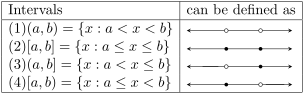
4.Subsets of R as Interval Interval Table
interval Table
### 📢 If you liked this math article:
* 👥 **Share with Friends:** Knowledge grows by sharing, so be sure to share it with your friends.
* 🔔 **Follow the Website:** If this is your first time here, follow our **email subscription** so that you get instant notifications for every new article.
* 💬 **Give Your Suggestions:** If you have any issues or would like to make any suggestions, do let us know by **commenting** below.
*Welcome to read the full article!*
5.Frequently Asked Questions Related to Subsets in Class 11
Q:1.Define the Subset
Ans:A set A is said to be a subset of set B if every element of A is also an element of B.In rotation form,it is written as and read as ‘A is subset of B’.
Q:2.What is a Universal Set?
Ans:All the sets which are under consideration are subsets of same set then this set is called a universal set.
Q:3.What is Power Set?
Ans:The collection of all subsets of any set A is called the power set of A.The power set of A is denoted by P(A).
By answering the above questions,you can know about the primary terms of Subsets in Class 11.
**छात्र-छात्राओं से आज का सवाल**
“*एक आलमारी में रखी पुस्तके प्रतिदिन दुगुनी हो जाती है।वह 24 दिन में पूरी भर जाती है,तो बताओ चौथाई आलमारी कितने दिनों में भरी होगी।”*
**Today’s Question to Students**
*”The books kept in a cupboard double every day. It is full in 24 days, so tell me in how many days will the quarter-cupboard be full?”*
*पिछली प्रश्नोत्तरी का उत्तर*4
308 = 2^2 \times 7 \times 11 \\
24 = 2^3 \times 3 \\
\text{ HCF } = 2^2 = 4
*Previous Quiz Solution*
308 = 2^2 \times 7 \times 11 \\
24 = 2^3 \times 3 \\
\text{ HCF } = 2^2 = 4
*”This article has been prepared by **Satyam Coaching Centre** on the **Satyam Mathematics** blog.”*
About Author

Sanjay Kumawat
(1.)**Satyam Narain Kumawat** **Website Name:Satyam Mathematics** *Owner:satyamcoachingcentre.in* *Sthan:Manoharpur,Jaipur (Rajasthan)* **Teaching Mathematics aur Anya Anubhav** ***Shiksha:**B.sc.,B.Ed.,(M.sc. star Ke Mathematics Ko Padhane ka Anubhav),B.com.,M.com. Ke vishayon Ko Padhane ka Anubhav,Philosophy,Psychology,Religious,sanskriti Mein Gahri Ruchi aur Adhyayan ***Anubhav:**phichale 23 varshon se M.sc.,M.com.,Angreji aur Vigyan Vishayon Mein Shikshaka Ka Lamba Anubhav ***Visheshagyata:*Maths,Adhyatma (spiritual),Yog vishayon ka vistrit Gyan* ****In Brief:I have read about M.sc. books,psychology,philosophy,spiritual, vedic,religious,yoga,health and different many knowledgeable books.A dedicated math expert with 23+ years of teaching experience upto M.sc. ,M.com.,English and science.After guiding thousands of students through Satyam Coaching Center,now share Mathematics,Trigonometry (Upto M.sc) and Educational Strategies in simple language on this blog from December 2018.* (2.)**(Technical Expert & Co-Admin):** ***Name:Sanjay Kumawat* *Qualification:Graduate in Mechanical Engineering (B.Tec) in 2013* *Profession:Physics Lecturer* *Teaching Experience:15 Years and Teaching to NEET,JEE Students* *Technical Experience:5 Years Coding and Article Editing,Classic Photo Editing by Laptop in Satyam Coaching Centre Blog* *A school lecturer and digital content strategist.On this blog,he handles all the responsibility of coding,image editing,SEO, and technical management,so that the mathematical content reaches the readers in a very accurate and beautiful form.* Updated on 15.06.2026

