Motion Under Inverse Square Law
1.व्युत्क्रम वर्ग नियम के अधीन गति (Motion Under Inverse Square Law),गति विज्ञान में व्युत्क्रम वर्ग नियम के अधीन गति (Motion Under Inverse Square Law in Dynamics):
व्युत्क्रम वर्ग नियम के अधीन गति (Motion Under Inverse Square Law) के इस आर्टिकल व्युत्क्रम वर्ग नियम पर आधारित सवालों को हल करने के बारे में अध्ययन करेंगे।
आपको यह जानकारी रोचक व ज्ञानवर्धक लगे तो अपने मित्रों के साथ इस गणित के आर्टिकल को शेयर करें।यदि आप इस वेबसाइट पर पहली बार आए हैं तो वेबसाइट को फॉलो करें और ईमेल सब्सक्रिप्शन को भी फॉलो करें।जिससे नए आर्टिकल का नोटिफिकेशन आपको मिल सके।यदि आर्टिकल पसन्द आए तो अपने मित्रों के साथ शेयर और लाईक करें जिससे वे भी लाभ उठाए।आपकी कोई समस्या हो या कोई सुझाव देना चाहते हैं तो कमेंट करके बताएं।इस आर्टिकल को पूरा पढ़ें।
Also Read This Article:- Motion Under Repulsion Varying
2.व्युत्क्रम वर्ग नियम के अधीन गति के साधित उदाहरण (Motion Under Inverse Square Law Solved Examples):
Example:1.एक कण पृथ्वी के अन्दर गति करते हुए पृथ्वी के केन्द्र की तरफ अग्रसर है तो इसकी गति का समीकरण लिखिए।
(A particle moving inside the earth and going towards the centre of the earth.Write its equation of motion.)
Solution:पृथ्वी के केन्द्र की ओर अग्रसर कण की गति का समीकरण होगाः
\Rightarrow m \frac{d^2 x}{d t^2}=-m \mu x \\ \Rightarrow \frac{d^2 x}{d t^2}=-\mu x
Example:2.m संहति का एक कण आकर्षण बल m \mu \times \text{ (दूरी)}^{-2} के अधीन एक सरल रेखा में चलता है।सिद्ध करो कि यदि प्रारम्भिक दूरी बल केन्द्र से 2a हो,तो उसकी ‘a’ दूरी \left(\frac{\pi}{2}+1\right) \left(\frac{a^3}{\mu}\right)^{\frac{1}{2}} समय पश्चात होगी।
(A particle of mass moves in a straight line under an attractive force m \mu \times \text{(distance)} ^{-2} .Show that if its initial distance from the centre be 2a,then it will be at a distance a after a time \left(\frac{\pi}{2}+1\right)\left(\frac{a^3}{\mu}\right)^{\frac{1}{2}} .)
Solution:कण की गति का समीकरण
m \frac{d^2 x}{d t^2}=-\frac{m \mu}{x^2} \\ \Rightarrow \frac{d^2 x}{d t^2}=-\frac{\mu}{x^2}
दोनों पक्षों को 2 \frac{d x}{d t} से गुणा करके समाकलन करने परः
\int 2 \frac{d x}{d t} \cdot \frac{d^2 x}{d t^2}=-\int \frac{\mu}{x^2} \cdot 2 \frac{d x}{d t} \\ \Rightarrow\left(\frac{d x}{d t}\right)^2=\frac{2 \mu}{x}+A \\ \Rightarrow v^2=\frac{2 \mu}{x}+A
प्रारम्भ में जब v=0 तो x=2a
0=\frac{2 \mu}{2 a}+A \\ \Rightarrow A=-\frac{\mu}{a} \\ \Rightarrow \left(\frac{d x}{d t}\right)^2=\frac{2 \mu}{x}-\frac{\mu}{a} \\ \Rightarrow \frac{d x}{d t}=-\sqrt{\mu}\left(\frac{2}{x}-\frac{1}{a}\right)
[ऋणात्मक चिन्ह x के घटने की दिशा में गति होने के कारण]
\Rightarrow \frac{d x}{d t}=-\sqrt{\mu} \sqrt{\frac{2 a-x}{a x}} \\ \Rightarrow \int_0^T \sqrt{\mu} d t=-\int_{2a}^{a} \sqrt{\frac{a x}{2 a-x}} d x \\ \Rightarrow[t]_0^T \sqrt{\mu}=-\int_{2 a}^a \sqrt{\frac{a x}{2 a-x}} d x
Put x=2 a \sin ^2 \theta \Rightarrow d x=4 a \sin \theta \cos \theta d \theta
जब x=2a तो 2a=2 a \sin ^2 \theta \\ \Rightarrow 1=\sin ^2 \theta \Rightarrow \sin ^2 \theta=\sin ^2 \frac{\pi}{2} \Rightarrow \theta=\frac{\pi}{2}
जब x=a तो a=2 a \sin ^2 \theta \\ \Rightarrow \frac{1}{2}=\sin ^2 \theta \Rightarrow \sin \theta= \frac{1}{\sqrt{2}} \\ \Rightarrow \sin \theta=\sin \frac{\pi}{4} \Rightarrow \theta=\frac{\pi}{4} \\ \sqrt{\mu} T=-\int_{\frac{\pi}{2}}^{\frac{\pi}{4}} \sqrt{a} \sqrt{\frac{2 a \sin ^2 \theta}{2 a-2 a \sin ^2 \theta}} \cdot 4 a \sin \theta \cos \theta d \theta \\ =-\sqrt{a} \int_{\frac{\pi}{2}}^{\frac{\pi}{4}} \sqrt{\frac{2 a \sin ^2 \theta}{2 a(1-\sin ^2 \theta)}} \cdot 4 a \sin \theta \cos \theta d \theta \\ =-4 a^{\frac{3}{2}} \int_{\frac{\pi}{2}}^{\frac{\pi}{4}} \sqrt{\frac{\sin ^2 \theta}{\cos^2 \theta} } \cdot \sin \theta \cos \theta d \theta \\ =-4 a^{\frac{3}{2}} \int_{\frac{\pi}{2}}^{\frac{\pi}{4}} \frac{\sin \theta}{\cos \theta} \cdot \sin \theta \cos \theta d \theta \\ =-4 a^{\frac{3}{2}} \int_{\frac{\pi}{4}}^{\frac{\pi}{4}} \sin^2 \theta d \theta \\ =-4 a^{\frac{3}{2}} \left[\frac{1-\cos 2 \theta}{2}\right]_{\frac{\pi}{2}}^{\frac{\pi}{4}} \\ =-\frac{4 a^{\frac{3}{2}}}{2}\left[\theta-\frac{\sin 2 \theta}{2}\right]_{\frac{\pi}{2}}^{\frac{\pi}{4}} \\ =-2 a^{\frac{3}{2}}\left[\frac{\pi}{4}-\frac{\pi}{2}-\frac{1}{2}\left(\sin \frac{\pi}{2}-\sin \pi\right)\right] \\ =-2 a^{\frac{3}{2}}\left[-\frac{\pi}{4}-\frac{1}{2} \times 1\right] \\ =2 a^{\frac{3}{2}}\left[\frac{\pi}{4}+\frac{1}{2}\right] \\ =\frac{2 a^{\frac{3}{2}}}{2} \left(\frac{\pi}{2}+1\right) \\ \Rightarrow \sqrt{\mu} T=a^{\frac{3}{2}}\left(\frac{\pi}{2}+1\right) \\ \Rightarrow T=\left(\frac{a^3}{\mu}\right)^{\frac{1}{2}}\left(\frac{\pi}{2}+1\right)
Example:3.एक कण किसी सरल रेखा में वर्ग व्युत्क्रमानुपाती बल के अधीन गमन करता है।सिद्ध करो कि विरामावस्था से अनन्त दूरी से a तक चलने में प्राप्त उसका वेग,a दूरी \frac{a}{2} से दूरी तक चलने में प्राप्त वेग के बराबर होगा।
(A particle moves in a straight line under a force varying inversely as the square of distance. Show that its velocity in falling from rest at infinity to a distance a is equal to that acquired from rest at a distance a to a distance \frac{a}{2}.)
Solution:कण की गति का समीकरण
m \frac{d^2 x}{d t^2}=-\frac{k}{x^2} \\ \Rightarrow \frac{d^2 x}{d t^2}=-\frac{k}{m} \cdot \frac{1}{x^2} \\ \Rightarrow \frac{d^2 x}{d t^2}=-\frac{\mu}{x^2} \quad\left[\because \mu=\frac{k}{m}\right] \\ v \frac{d v}{d x}=-\mu x^2
समाकलन करने परः
\int v d v=-\mu \int x^{-2} d x \\ \Rightarrow \frac{v^2}{2}=\frac{\mu}{x}+A \cdots(1)
जब v=0 तो x=\infty अतः A=0
\Rightarrow v^2=\frac{2 \mu}{x} \\ v=\sqrt{\frac{2 \mu}{x}}
जब कण x=a दूरी पर है तो वेग
V_1=\sqrt{\frac{2 \mu}{a}} \cdots(2)
पुनः जब कण x=a दूरी से गिरता है तो v=0
समीकरण (1) सेः 0=\frac{\mu}{a}+A \Rightarrow A=-\frac{\mu}{a} \\ \therefore \frac{v^2}{2}=\frac{a \mu}{x}-\frac{\mu}{a}
x=\frac{a}{2} दूरी पर पहुँचने पर कण का वेग V_2 हो तो
V_2^2=2\left(\frac{\mu}{\frac{a}{2}}-\frac{\mu}{a}\right) \\ =2\left(\frac{2 \mu}{a}-\frac{\mu}{a}\right) \\ =\frac{2 \mu}{a} \\ \Rightarrow V_2 =\sqrt{\frac{2 \mu}{a}} \cdots(3)
(2) व (3) सेः
V_1=V_2=\sqrt{\frac{2 \mu}{a}}

Example:4.यदि पृथ्वी का आकर्षण पृथ्वी के केन्द्र की दूरी के वर्ग व्युत्क्रमानुपाती हो तथा इसका मान पृथ्वी की धरातल पर g है।यदि पृथ्वी की त्रिज्या a हो तो प्रदर्शित कीजिए कि पृथ्वी की धरातल से h ऊँचाई पर से पृथ्वी धरातल पर गिरने का समय निम्न होगा:
(If the earth’s attraction varies inversely as the square of distance from the centre and g be its magnitude at the surface. If a be the radius of the earth, show that the time of falling from a height h above the earth’s surface to the earth’s surface is):
\sqrt{\left(\frac{a+h}{2 g}\right)}\left[\left(\frac{a+h}{a}\right) \sin ^{-1} \sqrt{\frac{h}{a+h}}+ \sqrt{\frac{h}{a}}\right]
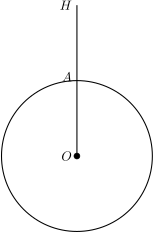
Solution: AH=h तथा OH=a+h
कण की गति का समीकरण
\frac{d^2 x}{d t^2}=-\frac{\mu}{x^2} \\ \Rightarrow v \frac{d v}{d x}=-\frac{\mu}{x^2} \cdots(1) \\ \therefore \frac{v^2}{2}=\frac{\mu}{x}+A \\ \Rightarrow v^2=\frac{2 \mu}{x}+C
जब x=a+h तो कण h ऊँचाई पर होगा तब v=0
\therefore 0=\frac{2 \mu}{a+h}+C \Rightarrow C=-\frac{2 \mu}{a+h} \\ \therefore v^2=2 \mu\left[\frac{1}{x}-\frac{1}{a+h}\right] \cdots(2)
पृथ्वी के धरातल पर x=a
\therefore v^2=2 \mu\left(\frac{1}{a}-\frac{1}{a+h}\right)=2 \mu \frac{h}{a(a+h)}
परन्तु \frac{\mu}{a^2}=g (पृथ्वी के धरातल पर)
\mu=g a^2 \\ \therefore v^2=2 g \frac{a h}{a+h} \cdots(3)
समाकलन की सुविधा के लिए a+h=r माना
\frac{d x}{d t}=v=-\sqrt{\left(\frac{2 \mu}{r}\right)} \sqrt{\frac{r-x}{x}} \\ \int_0^t \sqrt{\left(\frac{2 \mu}{r}\right)} d t=-\int \sqrt{\left(\frac{x}{r-x}\right)} d x
put x=r \cos ^2 \theta \Rightarrow d x=-2 r \cos \theta \sin \theta d \theta \\ \left[\sqrt{\left(\frac{2 \mu}{r}\right)} t\right]_0^t=-\int \sqrt{\frac{r \cos ^2 \theta}{r-r \cos^2 \theta}} \cdot (-2 r \cos \theta \sin \theta)\\ \Rightarrow \sqrt{\left(\frac{2 \mu}{r}\right)} t=2 r \int \sqrt{\frac{\cos ^2 \theta}{1-\cos ^2 \theta}} \cos \theta \sin \theta d \theta \\ =2 r \int \sqrt{\frac{\cos ^2 \theta}{\sin ^2 \theta}} \cos \theta \sin \theta d \theta \\ =2 r \int \frac{\cos \theta}{\sin \theta} \cdot \cos \theta \sin \theta d \theta \\ =2 r \int \cos^2 \theta d \theta \\ =r \int(1+\cos 2 \theta) d \theta \\ =r\left(\theta+\frac{\sin 2 \theta}{2}\right)=r(\theta+\sin \theta \cos \theta)
put \cos \theta=\sqrt{\frac{x}{r}} तथा \sin \theta=\sqrt{\frac{r-x}{r}} \\ \Rightarrow \sqrt{\frac{2 \mu}{r}} t=r\left[\cos ^{-1} \sqrt{\frac{x}{r}}+\sqrt{\frac{x}{r}} \sqrt{\frac{r-x}{r}}\right]_a^r \\ =\left[r \cos ^{-1} \sqrt{\frac{x}{r}}+\sqrt{r x-x^2}\right]_a^r \\ =\left[r \sin ^{-1} \sqrt{1-\frac{x}{r}}+\sqrt{r x-x^2} \right]_a^r\\ \left[\text{ put } \mu=g a^2 \text { तथा } \cos ^{-1} y=\sin ^{-1} \sqrt{\left(1-y^2\right)} \right] \\ \Rightarrow \sqrt{\frac{2 g a^2}{r}} t=\left[\left(a+h\right) \sin^{-1} \sqrt{1-\frac{x}{a+h}}+ \sqrt{(a+h) x-x^2}\right]_a^{a+h} \\ \Rightarrow \sqrt{\frac{2 g a^2}{a+h}} \text { t }=\left[(a+h) \sin^{-1}\sqrt{(1-1)}-(a+h) \sin^{-1}\sqrt{1-\frac{a}{a+h}}\right.+\left.\sqrt{(a+h)(a+h)-(a+h)^2} -\sqrt{(a+h) a-a^2}\right] \\ \Rightarrow \sqrt{\frac{2 g a^2}{a+h}} t=\left[-(a+h) \sin ^{-1} \sqrt{\frac{h}{a+h}}-\sqrt{a h}\right] \\ \Rightarrow t=\sqrt{\frac{a+h}{2 g}}\left[\left(\frac{a+h}{a}\right) \sin ^{-1} \sqrt{\frac{h}{a+h}}+\frac{\sqrt{a h}}{a}\right] \\ \Rightarrow t=\sqrt{\frac{a+h}{2 g}}\left[\left(\frac{a+h}{a}\right) \sin ^{-1} \sqrt{\frac{h}{a+h}}+\sqrt{\frac{h}{a}}\right]
Example:5.व्युत्क्रम वर्ग नियम \frac{\mu}{x^2} के अन्तर्गत सरल रेखा में चलता हुआ कोई कण बल केन्द्र से a दूरी पर विरामावस्था से रवाना होता है।प्रदर्शित कीजिए कि केन्द्र से x दूरी पर स्थित बिन्दु तक पहुँचने में निम्न समय लगेगा:
(Show that the time taken by a body,moving under the acceleration \frac{\mu}{x^2} towards the origin at a distance x,to fall from rest at distance a to a distance x from the attracting Centre is)
\sqrt{\left(\frac{a^3}{2 \mu}\right)}\left[\cos ^{-1} \sqrt{\frac{x}{a}}+\sqrt{\frac{x}{a}} \cdot \left\{\frac{x}{a}\left(1-\frac{x}{a}\right)\right\}^{\frac{1}{2}}\right]
साथ में यह भी सिद्ध करो x=\frac{3a}{4} कि दूरी से x=\frac{a}{4} दूरी तक चलने में लगा हुआ समय केन्द्र तक पहुँचने के समय का एक-तिहाई होगा।
(Also prove that the time occupied from x=\frac{3a}{4} to x=\frac{a}{4} is one-third of the whole time of descent up to centre.)

Solution:माना A’P’OPA सरल रेखा पर निश्चित बिन्दु O है।माना कि कण t समय बाद P पर है जहाँ OP=x;तब \frac{d^2 x}{d t^2} या v \frac{d v}{d x} ,x के बढ़ने की दिशा में त्वरण है।परन्तु हमें दिया है कि आकर्षण बल O बिन्दु से कण की दूरी के व्युत्क्रम वर्ग के समानुपाती है अतः यह \frac{\mu}{x^2} है जहाँ \mu नियतांक है।आकर्षण बल O की तरफ है,अतः कण की गति का समीकरण
\frac{d^2 x}{d t^2}=v \frac{d v}{d x}=-\frac{\mu}{x^2} \cdots(1)
दोनों पक्षों का समाकलन करने परः
\int v d v=-\mu \int \frac{1}{x^2} d x \\ \frac{v^2}{2}=\frac{\mu}{x}+A \Rightarrow v^2=\frac{2 \mu}{x}+C (जहाँ C अचर है) ………(2)
माना कि कण A से प्रारम्भ होता है तथा OA=a और इस प्रकार जब x=a,v=0
\therefore 0=\frac{2 \mu}{a}+C \Rightarrow C=-\frac{2 \mu}{a} \\ \therefore v^2=2 \mu\left(\frac{1}{x}-\frac{1}{a}\right) \\ \therefore v=\frac{d x}{d t}=-\sqrt{\left(\frac{2 \mu}{a}\right)} \sqrt{\left(\frac{a-x}{x}\right)} \cdots(3)
कण का वेग O की तरफ है जब कण A से O की तरफ चलता है अर्थात् x घटता है जबकि \frac{d x}{d t} धनात्मक है जब x बढ़ता है और हम ऋणात्मक चिन्ह लेते हैं:
समीकरण (2) सेः
\int \sqrt{\left(\frac{2 \mu}{a}\right)} d t=-\int \sqrt{\left(\frac{x}{a-x}\right) d x}
समाकलन करने परः
\sqrt{\left(\frac{2 \mu}{a}\right) t}=-\int \sqrt{\left(\frac{x}{a-x}\right)} d x+C_1
put x=a \cos ^2 \theta \therefore d x=-2 a \cos \theta \sin \theta d \theta \\ \therefore \sqrt{\left(\frac{2 \mu}{a}\right) t}=\int \frac{\cos \theta}{\sin \theta} \cdot 2 a \cos \theta \sin \theta d \theta _+C_1 \\ =a \int(1+\cos 2 \theta) d \theta+C_1 \\ =a\left(\theta+\frac{\sin 2 \theta}{2}\right)+C_1 \\ \Rightarrow \sqrt{\left(\frac{2 \mu}{a}\right)} t=a(\theta+\sin \theta \cos \theta)+C_1
put \cos \theta=\sqrt{\left(\frac{x}{a}\right)} \text { and } \sin \theta=\sqrt{\frac{a-x}{a}} \\ =a\left[\cos^{-1} \sqrt{\left(\frac{x}{a}\right)}+\sqrt{\left(\frac{x}{a}\right)} \sqrt{\left.\left(1-\frac{x}{a}\right)\right]}\right]+C_1 \\ =a \cos ^{-1} \sqrt{\left(\frac{x}{a}\right)}+\sqrt{\left(a x-x^2\right)}+C_1
अब जब x=a, तो t=0 और उपर्युक्त में मान रखने परः C_1=0
\therefore t=\sqrt{\left(\frac{a}{2 \mu}\right)} \left[a \cos^{-1} \sqrt{\left(\frac{x}{a}\right)}+ \sqrt{\left(a x-x^2\right)}\right] \cdots(4)
मूलबिन्दु पर कण के पहुँचने पर लगने वाला समय होगा जब x=0,(3) में रखने परः
\therefore t=\sqrt{\left(\frac{a}{2 \mu}\right)}\left[a \cdot\frac{\pi}{2}+0\right]=\frac{\pi a^{\frac{3}{2}}}{2 \sqrt{(2 \mu)}}
(3) में x=0 रखने पर यह अनन्त है अतः कण केन्द्र पर अनन्त वेग से पहुँचता है।
समीकरण (2) सेः
\int^T_0 \sqrt{\left(\frac{2 \mu}{a}\right)} d t=-\int_{\frac{3 a}{4}}^{\frac{a}{4}} \sqrt{\left(\frac{x}{a-x}\right)} d x
Put x=a \cos ^2 \theta \Rightarrow d x=-2 a \cos \theta \sin \theta d \theta
जब x=\frac{3 a}{4} तो \frac{3 a}{4}=a \cos ^2 \theta \Rightarrow \theta=30^{\circ}
जब x=\frac{a}{4} तो \frac{a}{4}=a \cos ^2 \theta \Rightarrow \theta=60^{\circ} \\ \sqrt{\left(\frac{2 \mu}{a}\right)} T=\int_{30^{\circ}}^{60^{\circ}} \frac{\cos \theta}{\sin \theta} \cdot 2 a \cos \theta \sin \theta d \theta \\ =a \int_{30^{\circ}}^{60^{\circ}}(1+\cos 2 \theta) d \theta=a \left[\theta+\frac{\sin 2 \theta}{2}\right]_{30^{\circ}}^{60^{\circ}} \\ =a\left[30^{\circ}+\frac{1}{2} \left(\frac{\sqrt{3}}{2}-\frac{\sqrt{3}}{2}\right)\right]=a \cdot \frac{\pi}{6} \\ \Rightarrow T=\frac{\pi a^{\frac{3}{2}}}{6 \sqrt{(2 \mu)}}
जो कि (4) द्वारा A से O तक लिए गए समय का \frac{1}{3} है।
उपर्युक्त उदाहरणों के द्वारा व्युत्क्रम वर्ग नियम के अधीन गति (Motion Under Inverse Square Law),गति विज्ञान में व्युत्क्रम वर्ग नियम के अधीन गति (Motion Under Inverse Square Law in Dynamics) को समझ सकते हैं।
3.व्युत्क्रम वर्ग नियम के अधीन गति पर आधारित समस्या (Problem Based on Motion Under Inverse Square Law):

(1.)यदि r पृथ्वी की त्रिज्या और पृथ्वी की सतह से अनंत तक प्रक्षेपित पिंड को ले जाने के लिए आवश्यक न्यूनतम वेग V को दर्शाता है; दर्शाइए कि एक पिंड जिसे पृथ्वी की सतह से 2V वेग से प्रक्षेपित किया जाता है, पृथ्वी के केंद्र से h की दूरी तक पहुँचने में लिया गया समय है:
(If r denotes the earth’s radius and V the minimum velocity required to carry a body projected from the earth’s surface to infinity;Show that the time taken by a body which is projected from the earth’s surface with a velocity 2V to reach a distance h from the earth’s centre is):
\frac{1}{3} v\left[\sqrt{[h(3 h+r)]}-2 r-\frac{r}{\sqrt{3}} \log \left[\frac{\sqrt{(3 h)}+\sqrt{(3 h+r)}}{(\sqrt{3}+2) \sqrt{r}}\right]\right]
उपर्युक्त सवाल को हल करने पर व्युत्क्रम वर्ग नियम के अधीन गति (Motion Under Inverse Square Law),गति विज्ञान में व्युत्क्रम वर्ग नियम के अधीन गति (Motion Under Inverse Square Law in Dynamics) को ठीक से समझ सकते हैं।
Also Read This Article:- Motion Under Repulsion
4.व्युत्क्रम वर्ग नियम के अधीन गति (Frequently Asked Questions Related to Motion Under Inverse Square Law),गति विज्ञान में व्युत्क्रम वर्ग नियम के अधीन गति (Motion Under Inverse Square Law in Dynamics) से सम्बन्धित अक्सर पूछे जाने वाले प्रश्न:
प्रश्न:1.व्युत्क्रम वर्ग नियम के अधीन गति का कथन लिखो। (Write a Statement of Motion Under Inverse Square Law):
उत्तर:एक कण एक सरल रेखा में गतिमान है और इस पर स्थित एक बल केन्द्र कण को ऐसे बल से आकर्षित करता है कि कण की इस केन्द्र से दूरी के वर्ग के व्युत्क्रमानुपाती है।कण की गति की विवेचना कीजिए।
प्रश्न:2.व्युत्क्रम वर्ग नियम के अधीन गति के वेग का सूत्र लिखो। (Write the Formula for the Velocity of Motion Under Inverse Square Law):
उत्तर: V= \pm \sqrt{(2 \mu)} \sqrt{\left(\frac{1}{x}-\frac{1}{a}\right)}
यदि गति का समीकरण m \cdot \frac{d^2 x}{d t^2}=-\frac{\lambda}{x^2} है।
प्रश्न:3.व्युत्क्रम वर्ग नियम के अधीन गति के समय का सूत्र लिखो। (Write the Formula for the Time of Motion Under Inverse Square Law):
उत्तरःयदि गति का समीकरण m \frac{d^2 x}{d t^2}=-\frac{\lambda}{x^2} है तो किसी बिन्दु तक कण द्वारा लिया गया समयः
t=\sqrt{\left(\frac{a}{2 \mu}\right)}\left[a \cos^{-1} \sqrt{\left(\frac{x}{a}\right)}+ \sqrt{\left(a x-x^2\right)}\right]
उपर्युक्त प्रश्नों के उत्तर द्वारा व्युत्क्रम वर्ग नियम के अधीन गति (Motion Under Inverse Square Law),गति विज्ञान में व्युत्क्रम वर्ग नियम के अधीन गति (Motion Under Inverse Square Law in Dynamics) के बारे में और अधिक जानकारी प्राप्त कर सकते हैं।
| No. | Social Media | Url |
|---|---|---|
| 1. | click here | |
| 2. | you tube | click here |
| 3. | click here | |
| 4. | click here | |
| 5. | Facebook Page | click here |
| 6. | click here | |
| 7. | click here |
Motion Under Inverse Square Law
व्युत्क्रम वर्ग नियम के अधीन गति
(Motion Under Inverse Square Law)
Motion Under Inverse Square Law

व्युत्क्रम वर्ग नियम के अधीन गति (Motion Under Inverse Square Law) के इस
आर्टिकल व्युत्क्रम वर्ग नियम पर आधारित सवालों को हल करने के बारे में अध्ययन करेंगे।




About Author

Satyam
About my self I am owner of Mathematics Satyam website.I am satya narain kumawat from manoharpur district-jaipur (Rajasthan) India pin code-303104.My qualification -B.SC. B.ed. I have read about m.sc. books,psychology,philosophy,spiritual, vedic,religious,yoga,health and different many knowledgeable books.I have about 15 years teaching experience upto M.sc. ,M.com.,English and science.

