Derivatives in Real Analysis
1.वास्तविक विश्लेषण में अवकलज (Derivatives in Real Analysis):
वास्तविक विश्लेषण में अवकलज (Derivatives in Real Analysis) की बेसिक थ्योरी तो 12th के समान ही है।इसमें हम कुछ एडवांस थ्योरी और उस पर आधारित प्रोब्लम्स को हल करेंगे।
Also Read This Article:- Limits of Functions of Two Variables
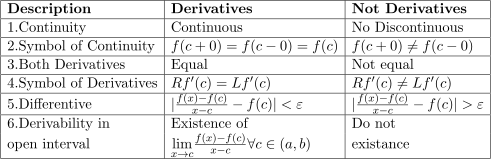
2.अवकलनीयता की तुलनात्मक सारणी (Comparison Table of Differentiability):
3.वास्तविक विश्लेषण में अवकलज के साधित उदाहरण (Derivatives in Real Analysis Solved Examples):
Example:1.प्रदर्शित कीजिए कि निम्न लिखित फलन सर्वत्र अवकलनीय हैं:
(Solve that the following functions are differentiable everywhere):
Example:1(i).तत्समक फलन (Identity function),f(x)=x
Solution:f(x)=x
माना कि a \in R कोई स्वेच्छ वास्तविक संख्या है।सर्वप्रथम माना कि a>0 एवं h पर्याप्त छोटी संख्या है ताकि a+h >0 एवं a-h>0 अतः
Rf'(a)=\underset{x \to a^+}{\lim} \frac{f(x) - f(a)}{x - a} \\ =\underset{h \to 0}{\lim} \frac{f(a+h) - f(a)}{a+h - a} \\ =\underset{h \to 0}{\lim} \frac{a+h - a}{h} \quad [\because f(x) = x] \\= \underset{h \to 0}{\lim} \left(\frac{h}{h}\right) \\=\underset{h \to 0}{\lim} (1) \\ \Rightarrow Rf'(a)=1 \\ \Rightarrow Rf'(a) = 1
तथा Lf'(a)=\underset{x \to a^-}{\lim} \frac{f(x) - f(a)}{x - a} \\ =\underset{h \to 0}{\lim} \frac{f(a-h) - f(a)}{a-h-a} \\ =\underset{h \to 0}{\lim} \frac{a-h-a}{a-h-a} \quad [\because f(x) = x] \\ =\underset{h \to 0}{\lim} (1) \\ \Rightarrow Lf'(a) = 1 \\ Rf'(a) = Lf'(a) = 1 \quad \cdots(1)
अतः यदि a>0 तो f'(a)=1
पुनः यदि a<0 तथा h पर्याप्त छोटी संख्या हो,तो a+h<0 एवं a-h<0
अतः Rf'(a)=\underset{h \to 0}{\lim} \frac{f(a+h) - f(a)}{h} \\ =\underset{h \to 0}{\lim} \frac{a+h-a}{h} \\ =\underset{h \to 0}{\lim} \left(\frac{h}{h}\right) = \underset{h \to 0}{\lim} (1) \\ \Rightarrow Rf'(a) = 1
एवं Lf'(a)=\underset{h \to 0}{\lim} \frac{f(a-h) - f(a)}{-h} \\ =\underset{h \to 0}{\lim} \frac{a-h-a}{-h} \\ \Rightarrow Lf'(a) = 1 \\ Rf'(a) = Lf'(a) = 1 \quad \cdots(2)
अतः यदि a<0 तो f'(a)=1
अतः यदि तो f'(a)=1
पुनः यदि x=0 तो
f'(0) =\underset{x \to 0}{\lim} \frac{f(x) - f(0)}{x - 0} \\ =\underset{x \to 0}{\lim} \frac{x}{x} \\ =\underset{x \to 0}{\lim} (1) \\ \Rightarrow f'(0)=1 \cdots(3)
(1),(2) और (3) सेः
फलन f(x) सर्वत्र संतत है।
Example:1(ii).अचर फलन (Constant function),f(x)
Solution:f(x)=k
f(c+h)=k=f(c-h)
Rf'(c)=\underset{h \to 0}{\lim} \frac{f(c+h) - f(c)}{h} \\ =\underset{h \to 0}{\lim} \frac{k - k}{h} \\ =\underset{h \to 0}{\lim} \left(\frac{0}{h}\right) = 0 \\ \Rightarrow Rf'(c) = 0
तथा Lf'(c)=\underset{h \to 0}{\lim} \frac{f(c-h) - f(c)}{-h} \\ =\underset{h \to 0}{\lim} \left(\frac{k - k}{-h}\right) \\ =\underset{h \to 0}{\lim} \left(\frac{0}{-h}\right) \\ \Rightarrow Lf'(c) = 0
Rf'(c)=Lf'(c)=0
अतः फलन f(x) सर्वत्र अवकलनीय है।
Example:1(iii). f(x) = e^x
Solution: f(x) = e^x \\ f(c+h) = e^{c+h} \\ f(c-h) = e^{c-h}, \quad f(c)=e^c \\ Rf'(c) = \lim_{h \to 0} \frac{f(c+h) - f(c)}{h} \\ =\underset{h \to 0}{\lim} \frac{e^{c+h} - e^c}{h} \\ =\underset{h \to 0}{\lim} \frac{e^c \cdot e^h - e^c}{h} \\ =\underset{h \to 0}{\lim} \frac{e^c(e^h - 1)}{h} \\ =\underset{h \to 0}{\lim} \frac{e^c \left( 1 + h + \frac{h^2}{2!} + \frac{h^3}{3!} + \dots - 1 \right)}{h} \\ =\underset{h \to 0}{\lim} \frac{e^c \left( h + \frac{h^2}{2!} + \frac{h^3}{3!} + \dots \right)}{h} \\ =\underset{h \to 0}{\lim} \frac{e^c \cdot h \left( 1 + \frac{h}{2!} + \frac{h^2}{3!} + \dots \right)}{h} \\ =\underset{h \to 0}{\lim} e^c \left( 1 + \frac{h}{2!} + \frac{h^2}{3!} + \dots \right) \\ \Rightarrow Rf'(c) = e^c
और Lf'(c)= \lim_{h \to 0} \frac{f(c-h) - f(c)}{-h} \\ =\underset{h \to 0}{\lim} \frac{e^{c-h} - e^c}{-h} \\= \underset{h \to 0}{\lim} \frac{e^c \cdot e^{-h} - e^c}{-h} \\ =\underset{h \to 0}{\lim} \frac{e^c(e^{-h} - 1)}{-h} \\ =\underset{h \to 0}{\lim} \frac{e^c \left( 1 - h + \frac{h^2}{2!} - \frac{h^3}{3!} + \dots - 1 \right)}{-h} \\ =\underset{h \to 0}{\lim} \frac{e^c \left( -h + \frac{h^2}{2!} - \frac{h^3}{3!} + \dots \right)}{-h} \\ =\underset{h \to 0}{\lim} \frac{e^c (-h) \left( 1 - \frac{h}{2!} + \frac{h^2}{3!} - \dots \right)}{-h} \\ =\underset{h \to 0}{\lim} e^c \left( 1 - \frac{h}{2!} + \frac{h^2}{3!} - \dots \right) \\ \Rightarrow Lf'(c) = e^c
Rf'(c)=Lf'(c) = e^c
अतः फलन f(x) सर्वत्र अवकलनीय है।

Example:1(iv). f(x) = \sin x
Solution: f(x) = \sin x \\ f(c+h)=\sin(c+h) \\ f(c-h) = \sin(c-h) \\ f(c) = \sin c \\ Rf'(c)=\underset{h \to 0}{\lim} \frac{f(c+h) - f(c)}{h} \\ =\underset{h \to 0}{\lim} \frac{\sin(c+h) - \sin c}{h} \\ =\underset{h \to 0}{\lim} \frac{2 \cos\left(\frac{c+h+c}{2}\right) \sin\left(\frac{c+h-c}{2}\right)}{h} \\ =\underset{h \to 0}{\lim} \frac{2 \cos(c+\frac{h}{2}) \sin(\frac{h}{2})}{h} \\ =\underset{h \to 0}{\lim} \cos(c+\frac{h}{2}) \cdot \lim_{h \to 0} \frac{\sin(\frac{h}{2})}{\frac{h}{2}} \\ = \cos c \cdot (1) \quad \left[ \because \underset{x \to 0}{\lim} \frac{\sin x}{x} = 1 \right] \\ \Rightarrow Rf'(c) = \cos c
तथा Lf'(c) =\underset{h \to 0}{\lim} \frac{f(c-h) - f(c)}{-h} \\ =\underset{h \to 0}{\lim} \frac{\sin(c-h) - \sin c}{-h} \\ =\underset{h \to 0}{\lim} \frac{2 \cos\left(\frac{c-h+c}{2}\right) \sin\left(\frac{c-h-c}{2}\right)}{-h} \\ =\underset{h \to 0}{\lim} \cos(c-\frac{h}{2}) \cdot \underset{h \to 0}{\lim} \frac{\sin(-\frac{h}{2})}{-\frac{h}{2}} \\ = \cos c \cdot 1 \\ \Rightarrow Lf'(c) = \cos c
Rf'(c) = Lf'(c) = \cos c
अतः फलन f(x) सर्वत्र अवकलनीय है।
Example:2.सिद्ध कीजिए कि फलन f(x) = |x| मूलबिन्दु पर संतत है परन्तु अवकलनीय नहीं है।
(Prove that the function f(x) = |x| is continuous but not differentiable at x=0):
Solution: f(x) = |x|
x=0
f(0) = |0| = 0 \\ f(0^+) = \underset{h \to 0}{\lim} |0+h| =\underset{h \to 0}{\lim} h = 0 \\ f(0^-) = \underset{h \to 0}{\lim} |0-h| =\underset{h \to 0}{\lim} | -h | = \underset{h \to 0}{\lim} h = 0 \\ \therefore f(0^+) = f(0^-)=f(0)=0
अतः फलन मूलबिन्दु पर संतत है।
Rf'(0)= \underset{x \to 0^+}{\lim} \frac{f(0+h) - f(0)}{h} \\ =\underset{h \to 0}{\lim} \frac{|0+h| - 0}{h} \\=\underset{h \to 0}{\lim} \frac{h}{h} = 1 \\ \Rightarrow Rf'(0)=1 \\ Lf'(0)=\underset{h \to 0^-}{\lim} \frac{f(0-h) - f(0)}{-h} \\ =\underset{h \to 0}{\lim} \frac{|0-h| - 0}{-h} \\ =\underset{h \to 0}{\lim} \frac{h}{-h} = -1 \\ \Rightarrow Lf'(0) = -1 \\ Rf'(0) \neq Lf'(0)
अतः फलन मूलबिन्दु पर अवकलनीय नहीं है।
Example:3.प्रदर्शित कीजिए कि निम्न फलन x के प्रत्येक मान के लिए अवकलनीय है और f'(0)=0.यह भी सिद्ध कीजिए कि f'(x) मूलबिन्दु पर द्वितीय प्रकार का असंतत है।
(Show that the function has a derivative for all values of x and that f'(0)=0.Also prove that f'(0) has a discontinuity of second kind at the origin.)
यदि f(x)=\begin{cases} x^2 \sin\left(\frac{1}{x}\right) & \text{यदि (if) } x \neq 0 \\ 0 & \text{यदि (if) } x = 0 \end{cases}
Solution: f(x)=\begin{cases} x^2 \sin\left(\frac{1}{x}\right) & \text{यदि (if) } x \neq 0 \\ 0 & \text{यदि (if) } x = 0 \end{cases} \\ f(0+0)=\underset{h \to 0}{\lim} (0+h)^2 \sin\left(\frac{1}{0+h}\right) \\ =\underset{h \to 0}{\lim} h^2 \sin\left(\frac{1}{h}\right) = 0 \\ \Rightarrow f(0+0)=0 \\ f(0-0)= \underset{h \to 0}{\lim} f(0-h) =\underset{h \to 0}{\lim} (0-h)^2 \sin\left(\frac{1}{0-h}\right) \\ =\underset{h \to 0}{\lim} h^2 \sin\left(-\frac{1}{h}\right) \\ =\underset{h \to 0}{\lim} \left[ -h^2 \sin\left(\frac{1}{h}\right) \right] = 0 \\ \Rightarrow f(0-0) = 0 तथा f(a)=0 \\ \Rightarrow f(0+0)=f(0-0) = f(0) = 0
अतः फलन x=0 पर संतत है।
अब Rf'(0)=\underset{h \to 0}{\lim} \frac{f(0+h) - f(0)}{h} \\ =\underset{h \to 0}{\lim} \frac{f(h)-f(0)}{h} \\ =\underset{h \to 0}{\lim} \frac{h^2 \sin\left(\frac{1}{h}\right) - 0}{h} \\ = \underset{h \to 0}{\lim} h \sin\left(\frac{1}{h}\right) = 0 \\ \Rightarrow Rf'(0) = 0
तथा Lf'(0)=\underset{h \to 0}{\lim} \frac{f(0-h) - f(0)}{-h} \\ =\underset{h \to 0}{\lim} \frac{(-h)^2 \sin\left(\frac{1}{0-h}\right)-0}{-h} \\ =\underset{h \to 0}{\lim} \frac{h^2 \sin\left(\frac{1}{-h}\right)}{-h} \\ =\underset{h \to 0}{\lim} (-h) \left(- \sin\frac{1}{h}\right) \\ =\underset{h \to 0}{\lim} \left(h \sin\frac{1}{h}\right)=0 \\ \Rightarrow Lf'(0) = 0
अतः Rf'(0)= Lf'(0)=0
अतः f(x),x=0 पर अवकलनीय है।
x=0 के अतिरिक्त अन्य बिन्दुओं पर पर 2x \sin\left(\frac{1}{x}\right) - \cos\left(\frac{1}{x}\right) , x \neq 0 तथा f'(0)=0
\underset{h \to 0}{\lim} f'(0+h) = \underset{h \to 0}{\lim} f'(h) \\=\underset{h \to 0}{\lim} \left[ 2h \sin\left(\frac{1}{h}\right) - \cos\left(\frac{1}{h}\right) \right] \rightarrow does exist
इसी प्रकार f'(0-0) \rightarrow does not exist.
अतः f’,मूलबिन्दु पर असंतत है।जबकि दोनों सीमाएँ f'(0+0) तथा f'(0-0)
\rightarrow does not exist.
अतः द्वितीय प्रकार का असंतत है।
Example:4.प्रदर्शित कीजिए कि फलन
(Show that the function)
f(x) = \begin{cases} 1+x & \text{if } x < 2 \\ 5-x & \text{if } x > 2 \end{cases}
x=2 पर संतत है परन्तु अवकलनीय नहीं है।
(is continuous but not differentiable at x=2)
Solution:x=2 पर सांतत्य
f(2)=5-x=5-2=3
f(2+0)=\underset{x \to 2^+}{\lim} f(x) = \underset{h \to 0}{\lim} f(2+h) \\ =\underset{h \to 0}{\lim} [5 - (2+h)] \\ = \underset{h \to 0}{\lim} (5 - 2 - h) \\ = \underset{h \to 0}{\lim} (3 - h) \\ = 3 \\ \Rightarrow f(2+0) = 3 \\ f(2-0)=\underset{x \to 2^-}{\lim} f(x) =\underset{h \to 0}{\lim} f(2-h) \\=\underset{h \to 0}{\lim} [1 + (2-h)] \\ =\underset{h \to 0}{\lim} (3 - h) \\ \Rightarrow f(2-0) = 3 \\ f(2+0) = f(2-0) = f(2) = 3
अतः फलन f(x),x=2 पर संतत है।
x=2 पर अवकलनीयता
Rf'(2)=\underset{x \to 2^+}{\lim} \frac{f(x) - f(2)}{x-2} \\= \lim_{h \to 0} \frac{f(2+h) - f(2)}{h} \\ =\underset{h \to 0}{\lim} \frac{[5 - (2+h)] - (5-2)}{h} \\ =\underset{h \to 0}{\lim} \frac{5 - 2 - h - 3}{h} \\ = \underset{h \to 0}{\lim} \frac{-h}{h} = -1 \\ \Rightarrow Rf'(2) = -1 \\ Lf'(2)=\underset{x \to 2^-}{\lim} \frac{f(x) - f(2)}{x-2} = \lim_{h \to 0} \frac{f(2-h) - f(2)}{-h} \\ =\underset{h \to 0}{\lim} \frac{[1 + (2-h)] - (5-2)}{-h} \\ =\underset{h \to 0}{\lim} \frac{3 - h - 3}{-h} \\ = \underset{h \to 0}{\lim} \frac{-h}{-h} = 1 \\ \Rightarrow Lf'(2) = 1 \\ Rf'(2) \neq Lf'(2)
अतः फलन f(x),x=2 पर अवकलनीय नहीं है।
उपर्युक्त उदाहरणों के द्वारा वास्तविक विश्लेषण में अवकलज (Derivatives in Real Analysis) को समझ सकते हैं।
### 📢 यदि आपको यह गणित का आर्टिकल पसंद आया हो: * 👥 **मित्रों के साथ शेयर करें:** ज्ञान बांटने से बढ़ता है,इसलिए इसे अपने दोस्तों के साथ ज़रूर साझा करें। * 🔔 **वेबसाइट को फॉलो करें:** अगर आप यहाँ पहली बार आए हैं, तो हमारे **ईमेल सब्सक्रिप्शन** को फॉलो करें ताकि हर नए आर्टिकल का नोटिफिकेशन आपको तुरंत मिले। * 💬 **अपने सुझाव दें:** यदि आपकी कोई समस्या है या कोई सुझाव देना चाहते हैं,तो नीचे **कमेंट** करके हमें ज़रूर बताएं। *पूरा आर्टिकल पढ़ने के लिए आपका वेलकम है!*
Also Read This Article:- Continuity of Function of Two Variable
4.वास्तविक विश्लेषण में अवकलज (Frequently Asked Questions Related to Derivatives in Real Analysis) से सम्बन्धित अक्सर पूछे जाने वाले प्रश्न:
प्रश्न:1.फलन के अवकलज की परिभाषा क्या है? (Function ke derivative ki paribhasha kya hai?):
उत्तर:एक वास्तविक फलन f: (a,b) \rightarrow R बिन्दु C \in (a,b) पर अवकलनीय (Differential or derivative) कहलाता है,यदि
\underset{x \rightarrow c}{\lim} \frac{f(x)-f(c)}{x-c}
परिमित रूप से विद्यमान हो।यह सीमा फलन f का बिन्दु c पर अवकलज कहलाती है तथा संकेत f'(c) से व्यक्त की जाती है।
प्रश्न:2.अवकलज के अन्य संकेत क्या हैं? (Derivatives ke anya sanket kya hain?):
उत्तर:संकेत \frac{d}{dx} f(x) या \frac{d}{dc} [f(c)] या D[f(c)]
प्रश्न:3.संवृत्त अन्तराल में फलन की अवकलनीयता (Differentiability of a function in closed interval):
उत्तर:किसी संवृत्त अन्तराल [a,b] में अवकलनीय होगा यदि
(i)f(c), विद्यमान है जबकि c \in (a,b)
(ii)Rf'(a) विद्यमान है
(iii)Lf'(a) विद्यमान है
***छात्र-छात्राओं से एक सवाल (Students Se Ek Sawal)***
“फलन f(x);x=1 पर अवकलनीय है तो a तथा b का मान क्या होगा?
“Comment Karake Batayein.”
| No. | Social Media | Url |
|---|---|---|
| 1. | click here | |
| 2. | you tube | click here |
| 3. | click here | |
| 4. | click here | |
| 5. | Facebook Page | click here |
| 6. | click here | |
| 7. | click here |
Derivatives in Real Analysis
वास्तविक विश्लेषण में अवकलज
(Derivatives in Real Analysis)
Derivatives in Real Analysis

वास्तविक विश्लेषण में अवकलज (Derivatives in Real Analysis) की बेसिक थ्योरी तो 12th
के समान ही है।इसमें हम कुछ एडवांस थ्योरी और उस पर आधारित प्रोब्लम्स को हल करेंगे।





About Author

Satyam
Lekhak Ke Baare Mein (About the Author) **Satyam Narain Kumawat** **Website Name:Satyam Mathematics** *Owner:satyamcoachingcentre.in* *Sthan:Manoharpur,Jaipur (Rajasthan)* **Teaching Mathematics aur Anya Anubhav** ***Shiksha:**B.sc.,B.Ed.,(M.sc. star Ke Mathematics Ko Padhane ka Anubhav),B.com.,M.com. Ke vishayon Ko Padhane ka Anubhav,Philosophy,Psychology,Religious,sanskriti Mein Gahri Ruchi aur Adhyayan ***Anubhav:**phichale 23 varshon se M.sc.,M.com.,Angreji aur Vigyan Vishayon Mein Shikshaka Ka Lamba Anubhav ***Visheshagyata:*Maths,Adhyatma (spiritual),Yog vishayon ka vistrit Gyan* ****In Brief:I have read about M.sc. books,psychology,philosophy,spiritual, vedic,religious,yoga,health and different many knowledgeable books.I have about 23 years teaching experience upto M.sc. ,M.com.,English and science. Updated on 18.06.2026

