Geometrical Construction of Complex Numbers on Argand Plane
1.Geometrical Construction of Complex Numbers on Argand Plane
In this article “Geometrical Construction of Complex Numbers on Argand Plane”,we will read about addition,multiplication,subtraction and divide of complex numbers.Do you think that addition and multiplication is only algebraic? In this article we will visualize (physically) by geometry and Argand plane.
“Before moving to Part 2,read our basic introduction to Properties of Complex Numbers.”
2.Geometrical Representation of Complex Numbers
Just as a real number may be represented by a point on a line so a complex number z=x + iy can be represented geometrically as a point in the plane,a fact which is not only useful but virtually indispensable.Introducing a rectangular coordinate system in the plane,we can identify the complex number z= x + iy with the point P=(x,y), as shown in Figure.
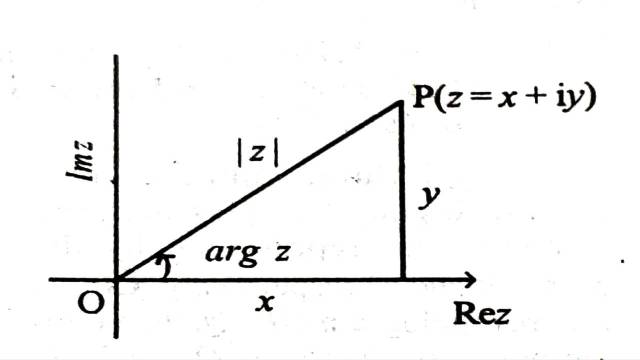
In this way we establish a one-to-one correspondence between the set of all complex numbers and the set of all points in the plane.Clearly,under this mapping,the set of all real numbers correspond to the x-axis (hence called the real axis) and the set of all purely imaginary numbers correspond to the y-axis (hence called the imaginary axis).Moreover, the complex number 0=0 +i0 corresponds to the point of intersection of the x-axis and y-axis i.e. the origin of coordinates.The plane whose points represent the complex numbers is called the complex plane or Argand plane,or Guassian plane as well as the z-plane,the w-plane,etc. depending on which letter denotes the complex number.With the understanding that such a complex plane has been constructed, the
“complex number z = x +iy” and “point z=(x,y)” will be used interchangeably.
There is yet another interpretation for complex numbers.Each point (x,y) of the complex plane determines a two-dimensional vector (directed line segment) may be represented by a vector \overrightarrow{OP} ,where P is a point in the complex plane corresponding to complex number z. The initial point of this vector is (0,0) and terminal point is (x,y).The magnitude of this vector is |z|.
We have discussed about the magnitude of the vector z=x+iy but not the direction. The angle \theta that the vector z (≠0) makes with the positive real axis is called the argument of complex number z (see Figure).
Thus we may express the point z=(x,y) in the form (r \cos \theta ,r \sin \theta) which is just the polar co-ordinate representation for the complex number z.We have the familiar relations
r =|z|=\sqrt(x^2+y^2)
and \tan\theta=\dfrac{y}{x} or \arg z=\tan^{-1} \left(\dfrac{y}{x}\right)
Also z=r(\cos\theta+i\sin\theta), which is polar form representation of complex number z. Notice that \theta plus any multiple of 2\pi can be substituted for \theta in the above equation. Because of this ambiguity of \theta, \arg z is not a function. This inconvenience can sometimes be ignored by distinguishing (arbitrarily) one particular value of \arg z. We use the symbol \operatorname{Arg}z to stand for the unique determination of \theta for which -\pi < \operatorname{Arg}z \leq \pi.
The value of \theta is called the principal value of the argument. Again since e^{i\theta}=\cos\theta+i\sin\theta therefore z=re^{i\theta} which is called exponential form of z.
3.The Points on the Argand Plane Representing the Sum,Difference,Product and Quotient of two Complex Numbers.
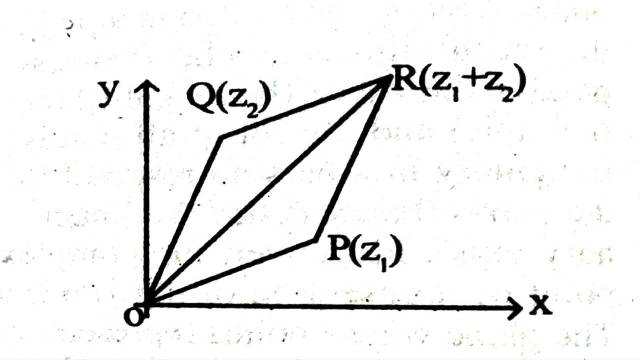
(1) sum : suppose that on argand plane complex numbers z_1 and z_2 are represented by the points P and Q, respectively. Construct parallelogram OPRQ, then middle points of diagonals OR and PQ are same.
But mid point of diagonal PQ is \left(\dfrac{x_1+x_2}{2},\dfrac{y_1+y_2}{2}\right), therefore
R is : (x_1+x_2,\;y_1+y_2) i.e. R represents the complex number.
(x_1+x_2)+i(y_1+y_2)=(x_1+iy_1)+(x_2+iy_2)
In vector notations
z_1+z_2=\overrightarrow{OP}+\overrightarrow{OQ}=\overrightarrow{OP}+\overrightarrow{PR}=\overrightarrow{OR}
(2) Difference : Firstly we represent the complex number -z_2 by Q’. For this we take mid point of QQ’ as O. Construct parallelogram OPRQ’, then point R represent z_1-z_2. Middle points of PQ’ and OR coincide since OQ’ is parallel and equal to RP, therefore ORPQ’ is a parallelogram.
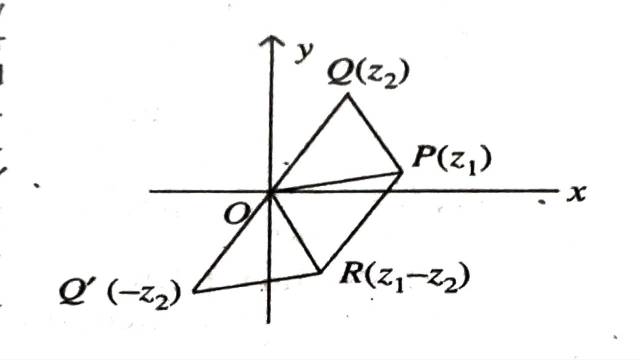
Thus \overrightarrow{OR}=\overrightarrow{Q'P}. In vector notation
z_1-z_2=\overrightarrow{OP}-\overrightarrow{OQ}
=\overrightarrow{OP}+\overrightarrow{QO}
=\overrightarrow{OP}+\overrightarrow{PR}
=\overrightarrow{OR}
=\overrightarrow{Q'P}
Obviously the complex number z_1-z_2 is represented by the vector \overrightarrow{Q'P} where complex numbers z_1 and z_2 are represented by points P and Q respectively.
Remarks. (i) \text{ Obviously } QP = |z_1 - z_2| \text{ and } \arg(z_1 - z_2) \text{ is the} \\
\text{angle through which } OX \text{ rotates in anti-clockwise direction. So that } OX \\
\text{becomes parallel to } QP. \text{ If we take origin as } z_0 \text{ then by polar representation} \\
z - z_0 = \rho(\cos \phi + i\sin \phi) = \rho e^{i\phi} \text{ where } \rho = |z - z_0| \text{ and } \phi \text{ is the angle} \\
\text{made by the vector } z - z_0 \text{ with real axis. Again if vector } z - z_0 \text{ is rotated in} \\
\text{anti-clockwise direction through angle } \theta \text{ relative to } z_0 \text{ and new position of } z \\
\text{is } z', \text{ then} \\
z' - z_0 = \rho e^{i(\theta + \phi)} = \rho e^{i\phi} \cdot e^{i\theta} \\
= (z - z_0) e^{i\theta}
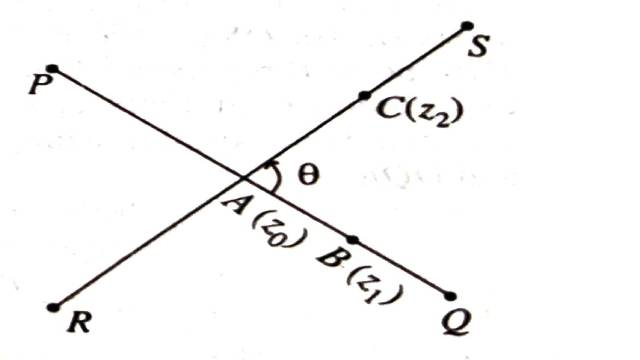
(ii) Let two lines PQ and
RS \text{ intersect at } A(z_0). \text{ Also suppose} \\
\text{that two points } B(z_1) \text{ and } C(z_2) \text{ are} \\
\text{on } PQ \text{ and } RS \text{ respectively. If } \theta \text{ is} \\
\text{the angle between } PQ \text{ and } RS, \text{ then} \\
\theta = \arg(z_2 - z_0) - \arg(z_1 - z_0) \\
= \arg\left(\frac{z_2 - z_0}{z_1 - z_0}\right) \\
\text{Here we have taken principal value of the argument. If straight} \\
\text{lines } PQ \text{ and } RS \text{ coincide then} \\
\arg\left(\frac{z_2 - z_0}{z_1 - z_0}\right) = 0 \text{ or } \pi \\
\Rightarrow \frac{(z_2 - z_0)}{(z_1 - z_0)} \text{ is purely real} \\
\Rightarrow P, Q, R \text{ and } S \text{ are collinear.} \\
\text{Again if } PQ \text{ and } RS \text{ are perpendicular, then} \\
\arg\left(\frac{z_2 - z_0}{z_1 - z_0}\right) = \pm\frac{\pi}{2} \\
\Rightarrow \frac{(z_2 - z_0)}{(z_1 - z_0)} \text{ is purely imaginary.}
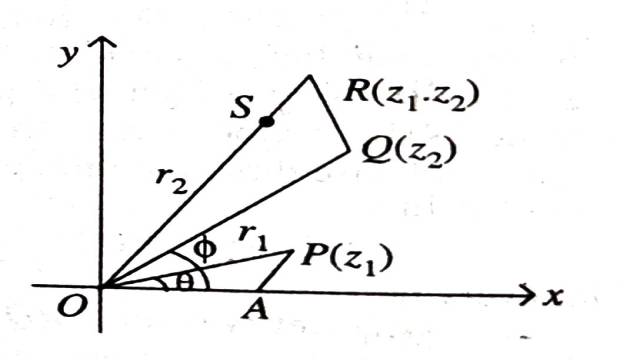
(iii)Product : Let
z_1 = r_1(\cos\theta + i\sin\theta) \\
\text{and} \quad\quad\quad z_2 = r_2(\cos\phi + i\sin\phi), \\
\text{then} \quad\quad\quad z_1z_2 = r_1r_2[\cos(\theta + \phi) + i\sin(\theta + \phi)] \\
\text{Here } r_1r_2 = |z_1z_2| \text{ and } \theta + \phi = \arg(z_1z_2). \\
\text{Now for the point } R \text{ representing the complex number } z_1z_2, \text{ const-} \\
\text{ruct} \quad OP = r_1, \ OQ = r_2, \ \angle POX = \theta \text{ and } \angle QOX = \phi. \\
\text{Take a point } A \text{ on real axis} \\ OX \text{ so that } OA = 1. \text{ Join } PA. \text{ Now} \\
\text{turn } OP \text{ through angle } \phi = \arg z_2 \text{ in} \\
\text{anti clockwise direction. Let new} \\
\text{position of } OP \text{ is } OS. \text{ Draw a line} \\
\text{from } Q \text{ which makes with } OQ \text{ an} \\
\text{angle equal to } \angle OAP. \text{ Let this line} \\
\text{meets } OS \text{ (or } OS \text{ produced) in point } R. \\
\text{Then point } R \text{ represents the product of} \\
\text{two complex numbers } z_1 \text{ and } z_2. \text{ We} \\
\text{see that from similar triangles } OAP \\
\text{and } OQR, \\
\frac{OR}{OQ} = \frac{OP}{OA} \\
\text{i.e.} \quad\quad\quad OR = \frac{OP \cdot OQ}{OA} = r_1r_2 \quad\quad\quad [\because OA = 1] \\
\text{and} \quad \angle ROQ = \angle ROQ' + \angle QOX \\
\quad\quad\quad\quad = \angle POX + \angle QOX = \theta + \phi
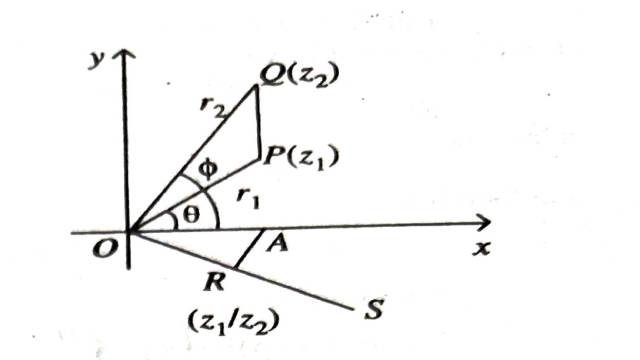
(iv)Division : Since
\frac{z_1}{z_2} = \frac{r_1}{r_2}[\cos(\theta - \phi) + i\sin(\theta - \phi)] \quad\quad\quad (z_2 \neq 0) \\
\text{Complex Numbers } \\
\text{Let } P \text{ represents the complex} \\
\text{number } z_1. \text{ Let } OS \text{ be the new position} \\
\text{of } OP \text{ when it is turned through an} \\
\text{angle } \arg z_2 = \phi \text{ in clockwise direc-} \\
\text{tion. Suppose that } OA = 1. \\
\text{Now draw a line from } A \\
\text{which makes an angle } \angle OOQP \text{ with} \\
OA \text{ and meets } OS \text{ in } R \text{ then } R \text{ repre-} \\
\text{sents the complex number } \left(\frac{z_1}{z_2}\right). \text{ For} \\
\text{this consider the similar triangles } OPQ \\
\text{and } OAR, \\
\frac{OR}{OA} = \frac{OP}{OQ} \Rightarrow OR = \frac{r_1}{r_2} \hspace{4cm} [\because OA = 1] \\
\text{and } \angle AOR = \angle POR - \angle POX = \phi - \theta. \\
\text{Suppose that the complex numbers } z_1 \text{ and } z_2 \text{ have the polar repre-} \\
\text{sentations} \\
\quad\quad\quad\quad z_1 = r_1(\cos\theta_1 + i\sin\theta_1) \\
\text{and} \quad\quad\quad z_2 = r_2(\cos\theta_2 + i\sin\theta_2). \\
\text{Then } \quad z_1 \cdot z_2 = r_1r_2(\cos\theta_1 + i\sin\theta_1)(\cos\theta_2 + i\sin\theta_2) \\
\quad\quad\quad\quad\quad = r_1r_2\{\cos(\theta_1 + \theta_2) + i\sin(\theta_1 + \theta_2)\} \\
\text{By induction we get, if } z_k = r_k(\cos\theta_k + i\sin\theta_k), 1 \leq k \leq n, \text{ then} \\
z_1 z_2 ... z_n = r_1r_2 ... r_n \{\cos(\theta_1 + \theta_2 + ... + \theta_n) + i\sin(\theta_1 + \theta_2 + ... + \theta_n)\} \\
\text{In particular if we have } z_1 = z_2 = ... = z_n = z, \text{ we obtain} \\
z^n = r^n(\cos n\theta + i\sin n\theta) \dots(1.3.1) \\
\text{for every integer } n > 0. \\
\text{Moreover if } z \neq 0, \text{ then} \\
z \left[ \frac{1}{r}(\cos\theta + i\sin\theta) \right] = 1 \\
\text{i.e.} \quad\quad\quad z^{-1} = \frac{1}{r}(\cos\theta - i\sin\theta) \\
\text{so that (1.3.1) holds for all integers } n, \text{ positive, negative, and zero, if } z \neq 0. \\
\text{As a special case of (1.3.1) when } |z| = 1, \text{ we get DeMoivre's formula} \\
(\cos\theta + i\sin\theta)^n = \cos n\theta + i\sin n\theta.
Also Read This Article:- Complex plane
4.Roots of a Complex Number
The possibility of finding n^{\text{th}} root of a complex number is suggested by (1). A complex number z is n^{\text{th}} root of a complex number w, if z^n=w, written as z=\sqrt[n]{w},
Let w=\rho(\cos\alpha+i\sin\alpha) and
z=r(\cos\theta+i\sin\theta). Then by (1), we must have
r^n(\cos n\theta+i\sin n\theta)=\rho(\cos\alpha+i\sin\alpha)
Since |\cos\alpha+i\sin\alpha|=1 for all real \alpha, (1) yield the relations
r^n=\rho and
\cos n\theta+i\sin n\theta=\cos\alpha+i\sin\alpha
and therefore
|z| = r = \rho^{1/n} \text{ and } \theta = \frac{\alpha + 2k\pi}{n}, k \in \mathbb{Z}
So we have
z = \omega^{1/n} = (\rho)^{1/n} \left[ \cos\left(\frac{\alpha + 2k\pi}{n}\right) + i \sin\left(\frac{\alpha + 2k\pi}{n}\right) \right], k \in \mathbb{Z} \\
\text{for each } k, (k = 0, 1, 2, ..., n-1), \text{ there} \\
\text{is a different value of } z. \text{ We leave it for the reader to} \\
\text{verify that there are no} \\
\text{more solutions. Thus, given} \\
\omega \neq 0, \text{ there are exactly} \\
n \text{ distinct complex numbers} \\
z \text{ such that } z^n = \omega. \\
\text{if } \omega = 1, \text{ we may find the} \\
n^{\text{th}} \text{ roots of unity. If } z^n = 1, \\
\text{then} \\
z = \cos\frac{2k\pi}{n} + i\sin\frac{2k\pi}{n}, k = 0, 1, ..., n-1 \\
\text{Also the cube root of unity are} \\
1, \frac{-1+\sqrt{3}i}{2}, \frac{-1-\sqrt{3}i}{2} \\
\text{Obviously if } \omega \text{ is one of} \\
\text{complex cube roots of unity,} \\
\text{then} \\
1 + \omega + \omega^2 = 0, \text{ and } \omega^3 = 1 \\
\text{Finally } z^{\frac{p}{q}} = (z^{\frac{1}{q}})^p \\
\text{so } z^{\frac{p}{q}} \text{ has also } q \text{ values.}

5.Circles in terms of Complex Numbers
\text{Numbers} \\ \text{If } z \text{ be any point on the circle} \\ \text{with centre at } z_1 \text{ and radius at} \\ r, \text{ then} \quad |z - z_1| = r \\ \text{or } (z - z_1)(\overline{z} - \overline{z_1}) = r^2 \\ \text{or } z\overline{z} - \overline{z_1}z - z_1\overline{z} + (z_1\overline{z_1} - r^2) = 0 \\ \text{which can be written in the} \\ \text{following form} z\overline{z} + \overline{\alpha}z + \alpha\overline{z} + k = 0 \quad (k \text{ is real}) \dots(1) \\ \text{Also rewriting (1) as} \\ (z + \alpha)(\overline{z} + \overline{\alpha}) = \alpha\overline{\alpha} - k \\ \text{or } |z + \alpha|^2 = \alpha\overline{\alpha} - k \\ \text{Thus we find that (1) always} \\ \text{represents a circle if } k \text{ is real} \\ \text{and } \alpha\overline{\alpha} - k \geqslant 0 \\ \text{We shall now prove that the} \\ \text{equation} \\ a z\overline{z} + \alpha z + \overline{\alpha}\overline{z} + c = 0 \dots(2) \\ \text{represents a real circle when} \\ a \neq 0, \text{ or a straight line} \\ \text{when } a = 0 \text{ and provided} \\ \alpha\overline{\alpha} > ac \dots(3) \\ \text{where } a, c \text{ are real constants} \\ \alpha \text{ is a complex constant} \\ \text{and } z \text{ is a complex variable} \\ \text{If we write } \alpha = a_1 + ia_2 \text{ and } \overline{\alpha} = \\ a_1 - ia_2, z = x + iy \text{ and } \overline{z} = x - iy \\ \text{the equation (2) becomes} \\ a(x^2 + y^2) + (a_1 + ia_2)(x + iy) + (a_1 - ia_2) \\ (x - iy) + c = 0 \\ \text{or } a(x^2 + y^2) + 2a_1x - 2a_2y + c = 0 \dots(4) \\ \text{which is a real circle if its} \\ \text{radius is positive.} \\ \text{The centre and radius of (4) are} \\ \left(-\frac{a_1}{a}, \frac{a_2}{a}\right) \text{ and } \sqrt{\frac{a_1^2 + a_2^2 - ac}{a^2}} \\ \text{Hence the centre and the radius} \\ \text{of the circle in the form (2) are} \\ -\frac{a_1 - ia_2}{a} = -\frac{\overline{\alpha}}{a} \text{ and } \sqrt{\left(\frac{\alpha\overline{\alpha} - ac}{a^2}\right)} \\ \text{Thus (2) represents a real circle} \\ \text{when } a \neq 0 \text{ or a straight line} \\ \text{when } a = 0 \text{ and } \alpha\overline{\alpha} > ac.### 📢 If you liked this math article:
* 👥 **Share with Friends:** Knowledge grows by sharing, so be sure to share it with your friends.
* 🔔 **Follow the Website:** If this is your first time here, follow our **email subscription** so that you get instant notifications for every new article.
* 💬 **Give Your Suggestions:** If you have any issues or would like to make any suggestions, do let us know by **commenting** below.
*Welcome to read the full article!*
Also Read This Article:- Complex Number in Complex Analysis
6.Frequently Asked Questions Related to Geometrical Construction of Complex Numbers on Argand Plane
Q:1.What is Argand plane?
Ans:The plane whose points represent the complex numbers is called the complex plane or Argand plane or Guassian plane as well as the z-plane,the w-plane etc. depending on which letter denotes the complex number
Q:2.What is an argument?
Ans:The angle that the vector z makes with the positive real axis is called the argument of complex number z.
Q:3.How do you convert the cartesian form of a complex into a polar form?
Ans:we may express the point z=(x,y) in the form,which is just the polar co-ordinate representation for the complex number z.We have the familiar relations
r=|z|=\sqrt{x^2+y^2}
and \tan \theta=\frac{y}{x} or \arg Z =\tan ^{-1} (\frac{y}{x})
Also z=r(\cos \theta+ i \sin \theta) ,which is polar form represention of complex number z.
By answering the above questions,you can know about the primary terms of Geometrical Construction of Complex Numbers on Argand Plane.
**छात्र-छात्राओं से आज का प्रश्न**
निम्नलिखित प्रश्न में प्रश्नचिह्न (?) के स्थान पर क्या आसन्न मान आएगा
320\sqrt{5} + 460 \text{ का } ?\% = 1270 - 40 \times \frac{1}{4} - 44 \times 4
**Today’s Question to Students**
What adjacent value should come in place of the question mark (?) in the following question?
320\sqrt{5} + 460 \text{ of } ?\% = 1270 - 40 \times \frac{1}{4} - 44 \times 4
*”पिछली प्रश्नोत्तरी का उत्तर”*
82 की जगह 84 आएगा
*”Previous Quiz Solution”*
It will be 84 instead of 82.
0 + 1^2 + 2^2 = 5, 5 + 2^2 + 3^2 = 18, \\ 18 + 3^2 + 4^2 = 43, 43 + 4^2 + 5^2 = 84, \\ 84 + 5^2 + 6^2 = 145, 145 + 6^2 + 7^2 = 230
This article has been prepared by **Satyam Coaching Centre** on the **Satyam Mathematics** blog.”*




About Author

Sanjay Kumawat
(1.)**Satyam Narain Kumawat** **Website Name:Satyam Mathematics** *Owner:satyamcoachingcentre.in* *Sthan:Manoharpur,Jaipur (Rajasthan)* **Teaching Mathematics aur Anya Anubhav** ***Shiksha:**B.sc.,B.Ed.,(M.sc. star Ke Mathematics Ko Padhane ka Anubhav),B.com.,M.com. Ke vishayon Ko Padhane ka Anubhav,Philosophy,Psychology,Religious,sanskriti Mein Gahri Ruchi aur Adhyayan ***Anubhav:**phichale 23 varshon se M.sc.,M.com.,Angreji aur Vigyan Vishayon Mein Shikshaka Ka Lamba Anubhav ***Visheshagyata:*Maths,Adhyatma (spiritual),Yog vishayon ka vistrit Gyan* ****In Brief:I have read about M.sc. books,psychology,philosophy,spiritual, vedic,religious,yoga,health and different many knowledgeable books.A dedicated math expert with 23+ years of teaching experience upto M.sc. ,M.com.,English and science.After guiding thousands of students through Satyam Coaching Center,now share Mathematics,Trigonometry (Upto M.sc) and Educational Strategies in simple language on this blog from December 2018.* (2.)**(Technical Expert & Co-Admin):** ***Name:Sanjay Kumawat* *Qualification:Graduate in Mechanical Engineering (B.Tec) in 2013* *Profession:Physics Lecturer* *Teaching Experience:15 Years and Teaching to NEET,JEE Students* *Technical Experience:5 Years Coding and Article Editing,Classic Photo Editing by Laptop in Satyam Coaching Centre Blog* *A school lecturer and digital content strategist.On this blog,he handles all the responsibility of coding,image editing,SEO, and technical management,so that the mathematical content reaches the readers in a very accurate and beautiful form.* Updated on 15.06.2026

