Menu

Centre of Curvature BSc Maths

1.Centre of Curvature BSc Maths,Centre of Curvature for Any Point of Curve y=f(x)
In this article,we will learn about,Centre of Curvature BSc Maths i.e. Centre of cuvatue at any point of curve.

Also Read This Article:- Center of curvature

2.Centre of Curvature BSc Maths Illustrations:

illustration 1. Find the centre of curvature of the following curves at the points indicated:
Illustration: 1 (a). y = 3x^3 + 2x^2 - 3 at (0, -3)
Solution: y = 3x^3 + 2x^2 - 3 at (0, -3)
Differentiating the given equation with respect to x, we get:

\frac{dy}{dx} = 9x^2 + 4x \implies \left(\frac{dy}{dx}\right)_{(0, -3)} = 0
Again differentiating with respect to x, we have:

\frac{d^2y}{dx^2} = 18x + 4 \implies \left(\frac{d^2y}{dx^2}\right)_{(0, -3)} = 4
If (\bar{x}, \bar{y}) be the coordinates of the centre of curvature, then:
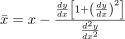
\bar{x} = x - \frac{\frac{dy}{dx} \left[1 + \left(\frac{dy}{dx}\right)^2\right]}{\frac{d^2y}{dx^2}}
= 0 - \frac{0 [1 + (0)^2]}{4} = 0
and \bar{y} = y + \frac{1 + \left(\frac{dy}{dx}\right)^2}{\frac{d^2y}{dx^2}}
= -3 + \frac{1 + (0)^2}{4}
= -3 + \frac{1}{4} = -\frac{11}{4}
Hence centre of curvature in a given direction.
at (0, -3) is the point \left(0, -\frac{11}{4}\right)
Illustration: 1 (b). y = c \cosh\left(\frac{x}{c}\right) at (x, y)
Solution: y = c \cosh\left(\frac{x}{c}\right)
Differentiating with respect to x, we have:
\frac{dy}{dx} = c \sinh\left(\frac{x}{c}\right) \cdot \frac{1}{c}
\implies \left(\frac{dy}{dx}\right) = \sinh\left(\frac{x}{c}\right)
\implies \left(\frac{dy}{dx}\right)_{(x, y)} = \sinh\left(\frac{x}{c}\right)
Again differentiating with respect to x, we get:
\frac{d^2y}{dx^2} = \cosh\left(\frac{x}{c}\right) \cdot \frac{1}{c}
\left(\frac{d^2y}{dx^2}\right)_{(x, y)} = \frac{1}{c} \cosh\left(\frac{x}{c}\right)
If (\bar{x}, \bar{y}) be the co-ordinate of the centre of curvature, then:
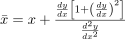
\bar{x} = x - \frac{\frac{dy}{dx} \left[1 + \left(\frac{dy}{dx}\right)^2\right]}{\frac{d^2y}{dx^2}}
= x - \frac{\sinh\frac{x}{c} \left[1 + \sinh^2\frac{x}{c}\right]}{\frac{1}{c} \cosh\left(\frac{x}{c}\right)}
= x - c \tanh\frac{x}{c} \left[\cosh^2\frac{x}{c}\right]
= x - c \sinh\frac{x}{c} \cosh\left(\frac{x}{c}\right)
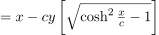
= x - c y \left[\sqrt{\cosh^2 \frac{x}{c} - 1}\right]
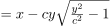
= x - cy \sqrt{\frac{y^2}{c^2} - 1}
\bar{x} = x - y \left(\frac{y^2}{c^2} - 1\right)^{1/2}
\bar{y} = y + \frac{1 + \left(\frac{dy}{dx}\right)^2}{\frac{d^2y}{dx^2}}
= y + \frac{1 + \sinh^2\left(\frac{x}{c}\right)}{\frac{1}{c} \cosh\left(\frac{x}{c}\right)}
= y + c \cdot \left(\frac{\cosh^2 \frac{x}{c}}{\cosh\frac{x}{c}}\right)
= y + c \cosh\frac{x}{c}
= y + y
\bar{y} = 2y
Hence centre of curvature at (x, y) is the point \left[x - y \left(\frac{y^2}{c^2} - 1\right)^{1/2}, 2y\right].
Illustration: 1 (c). xy = c^2 at (x, y)
Solution: xy = c^2
Differentiation w.r.t. x, we have:
y + x \frac{dy}{dx} = 0
\frac{dy}{dx} = -\frac{y}{x}
\left(\frac{dy}{dx}\right)_{(x, y)} = -\frac{y}{x}
Again differentiating with respect to x, we have:
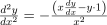
\frac{d^2y}{dx^2} = -\frac{\left(x \frac{dy}{dx} - y \cdot 1\right)}{x^2}
= -\frac{\left(x\left(-\frac{y}{x}\right) - y\right)}{x^2}
= \frac{y + y}{x^2} \implies \left(\frac{d^2y}{dx^2}\right)_{(x, y)} = \frac{2y}{x^2}
\bar{x} = x - \frac{\frac{dy}{dx} \left[1 + \left(\frac{dy}{dx}\right)^2\right]}{\frac{d^2y}{dx^2}}
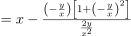
= x - \frac{\left(-\frac{y}{x}\right) \left[1 + \left(-\frac{y}{x}\right)^2\right]}{\frac{2y}{x^2}}
= x + \frac{x}{2} \frac{(x^2 + y^2)}{x^2}
\implies \bar{x} = x + \frac{x^2 + y^2}{2x} = \frac{2x^2 + x^2 + y^2}{2x}= \frac{3x^2  + y^2}{2x}
\bar{y} = y + \frac{1 + \left(\frac{dy}{dx}\right)^2}{\frac{d^2y}{dx^2}}
= y + \frac{1 + \left(-\frac{y}{x}\right)^2}{\left(\frac{2y}{x^2}\right)}
= y + \frac{1 + \frac{y^2}{x^2}}{\frac{2y}{x^2}}
= y + \frac{x^2 + y^2}{x^2} \times \frac{x^2}{2y}
= y + \frac{x^2 + y^2}{2y}
= \frac{2y^2 + x^2 + y^2}{2y}
\implies \bar{y} = \frac{x^2 + 2y^2}{2y}
\bar{x} = \frac{3x^2}{2x} + \frac{y^2}{2x}
\implies \bar{x} = \frac{3}{2}x + \frac{c^4}{x^2 \cdot 2x} = \frac{3}{2}x + \frac{c^4}{2x^3}
\bar{y} = \frac{3y^2}{2y} + \frac{x^2}{2y}
= \frac{3}{2}\frac{c^4}{x} + \frac{x^2}{2 \cdot c^2} = \frac{3}{2} \cdot \frac{c^2}{x} + \frac{x^3}{2c^2}
\bar{y} = \frac{3c^2}{2x} + \frac{x^3}{2c^2}
\left(\frac{3}{2}x + \frac{c^4}{2x^3}, \frac{3c^2}{2x} + \frac{x^3}{2c^2}\right)
Illustration: 1 (d). y = x^3 - 6x^2 + 3x + 1at (1, -1)
Solution: y = x^3 - 6x^2 + 3x + 1at (1, -1)
Differentiating with respect to x, we have:
\frac{dy}{dx} = 3x^2 - 12x + 3
\left(\frac{dy}{dx}\right)_{(1, -1)} = 3(1)^2 - 12(1) + 3 = -6
Again differentiating with respect to x, we get:
\frac{d^2y}{dx^2} = 6x - 12
\left(\frac{d^2y}{dx^2}\right)_{(1, -1)} = 6(1) - 12 = -6
\bar{x} = x + \frac{\frac{dy}{dx}\left[1 + \left(\frac{dy}{dx}\right)^2\right]}{\frac{d^2y}{dx^2}}
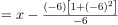
= x - \frac{(-6)\left[1 + (-6)^2\right]}{-6}
= x - (1 + 36)
= 1 - 37
= -36
\bar{y} = y + \frac{1 + \left(\frac{dy}{dx}\right)^2}{\frac{d^2y}{dx^2}}
= y + \frac{1 + (-6)^2}{-6}
= (-1) + \frac{1 + 36}{-6}
= -1 + \frac{37}{-6}
= \frac{-6 + (-37)}{-6} = -\frac{43}{-6} = -\frac{43}{6}
Hence centre of curvature at (1, -1) is the point \left(-36, -\frac{43}{6}\right).

Illustration: 1 (e). a^2y = x^3at (x, y)
Solution: a^2y = x^3at (x, y)
Differentiating with respect to x, we get:
a^2 \frac{dy}{dx} = 3x^2
\left(\frac{dy}{dx}\right)_{(x, y)} = \frac{3x^2}{a^2}
Again differentiating with respect to x, we get:
\frac{d^2y}{dx^2} = \frac{1}{a^2} \cdot 6x \implies \left(\frac{d^2y}{dx^2}\right)_{(x, y)} = \frac{6x}{a^2}
If (\bar{x}, \bar{y}) be the coordinate of the centre of curvature, then:
\bar{x} = x - \frac{\frac{dy}{dx} \left[1 + \left(\frac{dy}{dx}\right)^2\right]}{\frac{d^2y}{dx^2}}
= x - \frac{\frac{3x^2}{a^2} \left[1 + \left(\frac{3x^2}{a^2}\right)^2\right]}{\frac{6x}{a^2}}
= x - \frac{3x^2}{a^2} \times \frac{a^2}{6x} \left[\frac{a^4 + 9x^4}{a^4}\right]
= x - \frac{x}{2a^4} (a^4 + 9x^4)
= x - \frac{1}{2}x - \frac{9x^5}{2a^4}
= \frac{1}{2}x - \frac{9x^5}{2a^4}
\implies \bar{x} = \frac{x}{2}\left(1 - \frac{9x^4}{a^4}\right)
\bar{y} = y + \frac{1 + \left(\frac{dy}{dx}\right)^2}{\frac{d^2y}{dx^2}}
= y + \frac{1 + \left(\frac{3x^2}{a^2}\right)^2}{\frac{6x}{a^2}}
= y + \frac{1 + \frac{9x^4}{a^4}}{\frac{6x}{a^2}}
= y + \frac{a^4 + 9x^4}{a^4} \times \frac{a^2}{6x}
= y + \frac{a^4 + 9x^4}{6x a^2}
= \frac{x^3}{a^2} + \frac{3x^3}{2a^2} + \frac{a^2}{6x}
\implies \bar{y} = \frac{5x^3}{2a^2} + \frac{a^2}{6x}
Hence centre of curvature at (x, y) is the point \left[\frac{x}{2}\left(1 - \frac{9x^4}{a^4}\right), \frac{5x^3}{2a^2} + \frac{a^2}{6x}\right].
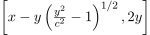
Illustration: 1 (f). y^2 = 4ay at (x, y)
Solution: x^2 = 4ay
Differentiating with respect to x, we get:
4a \frac{dy}{dx} = 2x \implies \frac{dy}{dx} = \frac{x}{2a} \implies \left(\frac{dy}{dx}\right)_{(x, y)} = \frac{x}{2a}
Again differentiating with respect to x, we get:
\frac{d^2y}{dx^2} = \frac{1}{2a} \implies \left(\frac{d^2y}{dx^2}\right)_{(x, y)} = \frac{1}{2a}
If (\bar{x}, \bar{y}) be the coordinates of the centre of the curvature then:
\bar{x} = x - \frac{\frac{dy}{dx}\left[1 + \left(\frac{dy}{dx}\right)^2\right]}{\frac{d^2y}{dx^2}}
= x - \frac{\frac{x}{2a}\left[1 + \left(\frac{x}{2a}\right)^2\right]}{\frac{1}{2a}}
= x - x\left(1 + \frac{x^2}{4a^2}\right)
 = x - x - \frac{x^3}{4a^2}
 \implies \bar{x} = -\frac{x^3}{4a^2}
\bar{y} = y + \frac{1 + \left(\frac{dy}{dx}\right)^2}{\frac{d^2y}{dx^2}}
= \frac{x^2}{4a} + \frac{1 + \left(\frac{x}{2a}\right)^2}{\left(\frac{1}{2a}\right)}
= \frac{x^2}{4a} + \frac{4a^2 + x^2}{4a^2} \times 2a
= \frac{x^2}{4a} + \frac{4a^2 + x^2}{2a}
= \frac{x^2 + 2x^2}{4a} + 2a
\implies \bar{y} = \frac{3x^2}{4a} + 2a
Illustration: 1 (g). \sqrt{x} + \sqrt{y} = \sqrt{a}, at \left(\frac{a}{4}, \frac{a}{4}\right)
Solution: \sqrt{x} + \sqrt{y} = \sqrt{a}, at \left(\frac{a}{4}, \frac{a}{4}\right)
Differentiating with respect to x, we get:
\frac{1}{2\sqrt{x}} + \frac{1}{2\sqrt{y}} \frac{dy}{dx} = 0 \implies \frac{dy}{dx} = -\sqrt{\frac{y}{x}}
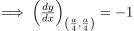
\implies \left(\frac{dy}{dx}\right)_{\left(\frac{a}{4}, \frac{a}{4}\right)} = -1
Again differentiating with respect to x, we get:
\frac{d^2y}{dx^2} = -\frac{\left[\sqrt{x} \cdot \frac{1}{2\sqrt{y}} \frac{dy}{dx} - \sqrt{y} \frac{1}{2\sqrt{x}}\right]}{x}
\left(\frac{d^2y}{dx^2}\right)_{\left(\frac{a}{4}, \frac{a}{4}\right)} = -\frac{\left[\sqrt{x} \cdot \frac{1}{2\sqrt{y}} \left(-\sqrt{\frac{y}{x}}\right) - \frac{\sqrt{y}}{2\sqrt{x}}\right]}{x}
= -\frac{\left[-\frac{1}{2} - \frac{\sqrt{y}}{2\sqrt{x}}\right]}{x}
= \frac{\sqrt{x} + \sqrt{y}}{2 x^{3/2}}
\implies \left(\frac{d^2y}{dx^2}\right)_{\left(\frac{a}{4}, \frac{a}{4}\right)} = \frac{\sqrt{a}}{2 x^{3/2}} = \frac{\sqrt{a}}{2\left(\frac{a}{4}\right)^{3/2}} = \frac{4}{a}
If (\bar{x}, \bar{y}) be the coordinates of the centre of the curvature then:
\bar{x} = x - \frac{\frac{dy}{dx}\left[1 + \left(\frac{dy}{dx}\right)^2\right]}{\frac{d^2y}{dx^2}}
= \frac{a}{4} - (-1)\frac{\left[1 + (-1)^2\right]}{\frac{4}{a}}
= \frac{a}{4} + 1 \times 2 \times \frac{a}{4}
= \frac{a}{4} + \frac{a}{2}
\implies \bar{x} = \frac{3a}{4}
\bar{y} = y + \frac{1 + \left(\frac{dy}{dx}\right)^2}{\frac{d^2y}{dx^2}}
= \frac{a}{4} + \frac{1 + (-1)^2}{\frac{4}{a}}
= \frac{a}{4} + \frac{2}{\frac{4}{a}} = \frac{a}{4} + \frac{a}{2}
\implies \bar{y} = \frac{3a}{4}
Hence centre of curvature at (x, y) is the point \left(\frac{3a}{4}, \frac{3a}{4}\right).
Illustration: 1 (h). x^{\frac{2}{3}} + y^{\frac{2}{3}} = a^{\frac{2}{3}} at (x, y)
Solution: x^{\frac{2}{3}} + y^{\frac{2}{3}} = a^{\frac{2}{3}}
Differentiating with respect to x, we get:
\frac{2}{3}x^{-\frac{1}{3}} + \frac{2}{3}y^{-\frac{1}{3}} \frac{dy}{dx} = 0
\implies \frac{dy}{dx} = -\frac{y^{\frac{1}{3}}}{x^{\frac{1}{3}}} \implies \left(\frac{dy}{dx}\right)_{(x, y)} = -\frac{y^{\frac{1}{3}}}{x^{\frac{1}{3}}}
Again differentiating with respect to x, we get:
\frac{d^2y}{dx^2} = \frac{-\left[x^{\frac{1}{3}} \cdot \frac{1}{3} \frac{dy}{dx} y^{-\frac{2}{3}} - y^{\frac{1}{3}} \cdot \frac{1}{3} x^{-\frac{2}{3}}\right]}{x^{\frac{2}{3}}}
= \frac{-\left[\frac{x^{\frac{1}{3}}}{3} \left(-\frac{y^{\frac{1}{3}}}{x^{\frac{1}{3}}}\right) y^{-\frac{2}{3}} - \frac{y^{\frac{1}{3}}}{3x^{\frac{2}{3}}}\right]}{x^{\frac{2}{3}}} \quad \text{[adjusted for notation]}
\implies \frac{d^2y}{dx^2} = +\frac{\frac{y^{\frac{1}{3}}}{3x^{\frac{2}{3}}} + \frac{y^{\frac{1}{3}}}{3x^{\frac{2}{3}}}}{x^{\frac{2}{3}}} = \frac{2y^{\frac{1}{3}}}{3x^{\frac{4}{3}} a^{\frac{2}{3}}} \quad \text{[or simplified form]}
If (\bar{x}, \bar{y}) be the coordinates of the centre of curvature then
\bar{x} = x - \frac{\frac{dy}{dx}\left[1 + \left(\frac{dy}{dx}\right)^2\right]}{\frac{d^2y}{dx^2}}
= x - \frac{\left(-\frac{y^{\frac{1}{3}}}{x^{\frac{1}{3}}}\right)\left[1 + \left(-\frac{y^{\frac{1}{3}}}{x^{\frac{1}{3}}}\right)^2\right]}{\frac{a^{\frac{2}{3}}}{3x^{\frac{4}{3}}y^{\frac{1}{3}}}}
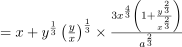
= x + y^{\frac{1}{3}}\left(\frac{y}{x}\right)^{\frac{1}{3}} \times \frac{3x^{\frac{4}{3}}\left(1 + \frac{y^{\frac{2}{3}}}{x^{\frac{2}{3}}}\right)}{a^{\frac{2}{3}}}
= x + 3x\left(\frac{x^{\frac{2}{3}} + y^{\frac{2}{3}}}{x^{\frac{2}{3}}}\right) \cdot \frac{y^{\frac{2}{3}}}{a^{\frac{2}{3}}}
= x + \frac{3x \cdot y^{\frac{2}{3}}}{x^{\frac{2}{3}}} \left(\frac{a^{\frac{2}{3}}}{a^{\frac{2}{3}}}\right) \quad [\because x^{\frac{2}{3}} + y^{\frac{2}{3}} = a^{\frac{2}{3}}]
\implies \bar{x} = x + 3x^{\frac{1}{3}}y^{\frac{2}{3}}
\bar{y} = y + \frac{1 + \left(\frac{dy}{dx}\right)^2}{\frac{d^2y}{dx^2}}
= y + \frac{1 + \left[\left(-\frac{y}{x}\right)^{\frac{1}{3}}\right]^2}{\frac{a^{\frac{2}{3}}}{3x^{\frac{4}{3}}y^{\frac{1}{3}}}}  \\ = y +\frac{\left(x^{\frac{2}{3}} + y^{\frac{2}{3}}\right)}{x^{\frac{2}{3}}} \cdot \frac{3x^{\frac{4}{3}}y^{\frac{1}{3}}}{a^{\frac{2}{3}}}
= y + \frac{3a^{\frac{2}{3}} \cdot x^{\frac{4}{3}}y^{\frac{1}{3}}}{a^{\frac{2}{3}}}
\implies \bar{y} = y + 3x^{\frac{2}{3}}y^{\frac{1}{3}}
Hence centre of curvature at (x, y) is the point \left[x + 3x^{\frac{1}{3}}y^{\frac{2}{3}}, y + 3x^{\frac{2}{3}}y^{\frac{1}{3}}\right].

By solving the above illustrations, one can understand Centre of Curvature BSc Maths,Centre of Curvature for Any Point of Curve y=f(x).

Also Read This Article:- Radius of Curvature at Origin

3.Practice Problems of Centre of Curvature BSc Maths for Students

following curves at the point indicated against them:
(1.) x^3 + y^3 = 3axy; \quad \left(\frac{3a}{2}, \frac{3a}{2}\right)
(2.) \frac{x^2}{a^2} - \frac{y^2}{b^2} = 1; \quad (x, y)
By solving the above questions,you can understand the Centre of Curvature BSc Maths,Centre of Curvature for Any Point of Curve y=f(x) well because the concept is well understood when you solve it practically.
### 📢 If you liked this math article:
* 👥 **Share with Friends:** Knowledge grows by sharing, so be sure to share it with your friends.
* 🔔 **Follow the Website:** If this is your first time here, follow our **email subscription** so that you get instant notifications for every new article.
* 💬 **Give Your Suggestions:** If you have any issues or would like to make any suggestions, do let us know by **commenting** below.
*Welcome to read the full article!*

Also Read This Article:-  Radius of Curvature for Polar Curves

4.Frequently Asked Questions Related to Centre of Curvature BSc Maths,Centre of Curvature for Any Point of Curve y=f(x)

Q: 1. Write the coordinates of the centre of curvature.

 Ans: \bar{x} = x - \frac{y_1(1 + y_1^2)}{y_2}
\bar{y} = y \cdot y+ \frac{1 + y_1^2}{y_2}

Q: 2. Write specific form of curves:
r^n=a^n \cdot \cos n \theta

Ans: (1.) r \cos\theta = a (straight line)
(2.) r = a \cos\theta (circle)
(3.) \frac{2a}{r} = 1 + \cos\theta (parabola)
(4.) r^2 \cos 2\theta = a^2 (rectangular hyperbola)
(5.) 2r = a(1 + \cos\theta) (cardioid)
(6.) r^2 = a^2 \cos 2\theta (lemniscate)
By answering the above questions,you can know about the primary terms of Centre of Curvature BSc Maths,Centre of Curvature for Any Point of Curve y=f(x).

5.छात्र-छात्राओं से आज का प्रश्न (Today’s Question to Students):

🎯 विनर्स कॉर्नर:क्या आप इस सवाल का सही जवाब दे सकते हैं?अपने नाम के साथ नीचे कमेंट करें!सही जवाब देने वाले Top Students के नाम हमारी आगे post/is article ke update में Photo ya Special Mention के साथ publish की जाएगी।अपना जवाब अभी दर्ज करें!👇
*”जब किसी संख्या का 40% प्रतिशत किसी दूसरी संख्या में जोड़ा जाता है,तो दूसरी संख्या बढ़कर अपनी 60 प्रतिशत हो जाती है।पहली और दूसरी संख्या का क्या अनुपात है?”*
(When 40% of the percentage of a number is added to another number, the second number increases to its 60%. What is the ratio of the first and second numbers?)
*पिछली प्रश्नोत्तरी का हल*

\pi = \frac{22}{7}, r = 3.5 \\ 2\pi r^2 = 2 \times \frac{22}{7} \times 3.5 \times 3.5 = 77
*Previous Quiz Solution*
\pi = \frac{22}{7}, r = 3.5 \\  2\pi r^2 = 2 \times \frac{22}{7} \times 3.5 \times 3.5 = 77
*”This article has been prepared by **Satyam Coaching Centre** on the **Satyam Mathematics** blog.”*


Leave a Reply

Your email address will not be published. Required fields are marked *