Skewness and Standard Deviation
1.विषमता और प्रमाप विचलन (Skewness and Standard Deviation),विषमता गुणांक (Coefficient of Skewness):

विषमता और प्रमाप विचलन (Skewness and Standard Deviation) के इस आर्टिकल में विषमता गुणांक और प्रमाप विचलन ज्ञात करने के लिए कुछ सवालों को हल करके समझने का प्रयास करेंगे।
आपको यह जानकारी रोचक व ज्ञानवर्धक लगे तो अपने मित्रों के साथ इस गणित के आर्टिकल को शेयर करें।यदि आप इस वेबसाइट पर पहली बार आए हैं तो वेबसाइट को फॉलो करें और ईमेल सब्सक्रिप्शन को भी फॉलो करें।जिससे नए आर्टिकल का नोटिफिकेशन आपको मिल सके।यदि आर्टिकल पसन्द आए तो अपने मित्रों के साथ शेयर और लाईक करें जिससे वे भी लाभ उठाए।आपकी कोई समस्या हो या कोई सुझाव देना चाहते हैं तो कमेंट करके बताएं।इस आर्टिकल को पूरा पढ़ें।
Also Read This Article:- Coefficient of Skewness and Variation
2.विषमता और प्रमाप विचलन के साधित उदाहरण (Skewness and Standard Deviation Solved Examples):
Example:1.समान्तर माध्य,बहुलांक और प्रमाप विचलन निकालकर कार्ल पियर्सन के विषमता गुणांक को निकालिए:
(Find Karl Pearson’s Coefficient of skewness by calculating arithmetic mean,mode and standard deviation):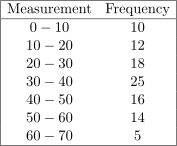
Solution:Calculation Table of Karl Pearson’s Coefficient of Skewness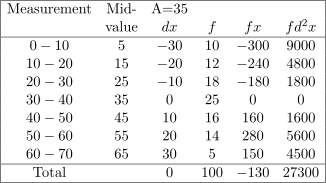
समान्तर माध्य
(\overline{X})=A+\frac{\Sigma f d x}{N} \\ =35+\frac{(-130)}{100} \\ =35-1.3 \\ \Rightarrow \overline{X}=33.7
बहुलक वर्ग 30-40 है क्योंकि सबसे अधिक बारम्बारता इसी वर्ग की है।
f_{0}=18, f_{1}=25 ,f_{2}=16,l=30,i=40-30=10
बहुलक (Z)=l+\left(\frac{f_1-f_0}{2 f_1-f_0-f_2}\right) \times i \\ =30+\left(\frac{25-18}{2 \times 25-18-16}\right) \times 10 \\ =30+\frac{7}{50-34} \times 10 \\ =30+\frac{70}{16}=30+\frac{35}{8} \\ \approx 30+4.375 \\ \Rightarrow Z=34.375
प्रमाप विचलन \sigma=\frac{1}{N} \sqrt{\Sigma fd^2 x \cdot N-(\Sigma fdx)^2} \\ =\frac{1}{100} \sqrt{27300 \times 100-(-130)^2} \\ =\frac{1}{100} \sqrt{2730000-16900} \\ =\frac{1}{100} \sqrt{2713100} \\ \approx \frac{1}{100} \times 1647.149 \\ \Rightarrow \sigma \approx 16.47
विषमता गुणांक
J=\frac{\overline{X}-Z}{\sigma} \\ =\frac{33.7-34.375}{16.47} \\ =-\frac{0.675}{16.47} \\ \Rightarrow J \approx-0.0409
Example:2.निम्न समंकों से कार्ल पियर्सन का विषमता-गुणांक ज्ञात कीजिए:
(From the following figures,find Karl Pearson’s coefficiemt of skewness):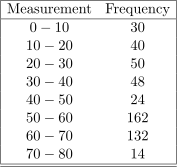
Solution:Calculation Table of Karl Pearson’s Coefficient of Skewness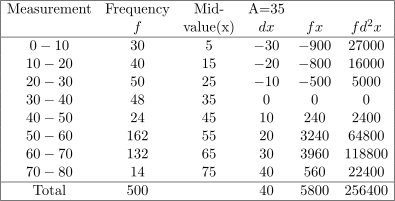
समान्तर माध्य
(\overline{X})=A+\frac{\Sigma fd x}{N} \\ =35+\frac{5800}{500} \\ =35+11.6 \\ \Rightarrow \overline{X}=46.6
सबसे अधिक बारम्बारता 162 वर्ग 50-60 की है अतः बहुलक वर्ग 50-60 है।
l=50,i=60-50=10 ,f_0=24, f_1=162 ,f_2=132
बहुलक Z =l+\left(\frac{f_1-f_0}{2 f_1-f_0-f_2}\right) \times i \\ =50+\frac{162-24}{2 \times 162-24-132} \times 10 \\ =50+\frac{1380}{324-156} \\ =50+\frac{1380}{168} \\ \Rightarrow Z \approx 50+8.214 \approx 58.214
प्रमाप विचलन (\sigma)=\frac{1}{N} \sqrt{\Sigma fd^2 x \cdot N+\left(\Sigma fd x\right)^2} \\ =\frac{1}{500} \sqrt{256400 \times 500-(5800)^2} \\ =\frac{1}{500} \sqrt{128200000-33640000} \\ =\frac{1}{500} \sqrt{94560000} \\ \approx \frac{1}{500} \times 9724.1967 \\ \Rightarrow \sigma \approx 19.448
विषमता गुणांक (J)=\frac{\overline{X}-Z}{\sigma} \\=\frac{46.6-58.214}{19.448} \\ =-\frac{11.614}{19.448} \\ \Rightarrow J \approx-0.597
Example:3.निम्नलिखित आँकड़ों से कार्ल पियर्सन का विषमता गुणांक ज्ञात कीजिए:
(From the following data calculate the Karl Pearson’s coefficient skewness):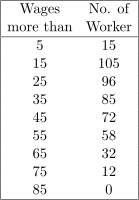
Solution:Calculation Table of Karl Pearson’s Coefficient of Skewness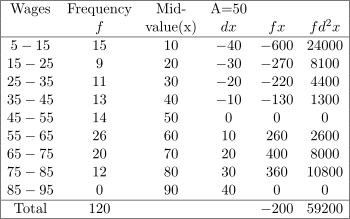
समान्तर माध्य
(\overline{X})=A+\frac{\Sigma f d x}{N} \\ =50+\frac{(-200)}{120} \\ \approx 50-1.667 \\ \Rightarrow \overline{X} \approx 48.333
सबसे अधिक बारम्बारता 26 है अतः बहुलक वर्ग 55-65 है।
l=55,i=65-55=10, f_0=14, f_1=26, f_2=20
बहुलक (Z)=l+\left(\frac{f_1-f_0}{2 f_1-f_0+f_2} \times i\right) \\ =55+\left(\frac{26-14}{2 \times 26-14-20}\right) \times 10 \\ =55+\frac{12}{52-34} \times 10 \\ =55+\frac{120}{18} \\ \approx 55+6.667 \\ \Rightarrow Z \approx 61.667
प्रमाप विचलन (\sigma)=\frac{1}{N} \sqrt{\Sigma f d^2 x \cdot N-(\Sigma f d x)^2} \\ =\frac{1}{120} \sqrt{59200 \times 120-(-200)^2} \\ =\frac{1}{120} \sqrt{7104000-40000} \\ =\frac{1}{120} \sqrt{7064000} \\ \approx \frac{2657.818}{120} \\ \Rightarrow \sigma \approx 22.148
विषमता गुणांक (J)=\frac{\overline{X}-Z}{\sigma} \\ =\frac{48.333-61.667}{22.148} \\ =\frac{-13.334}{22.148} \\ \Rightarrow J \approx -0.602
Example:4.काॅलेज परीक्षा और प्रतियोगितात्मक परीक्षा में परीक्षार्थियों द्वारा प्राप्त अंकों की निम्नांकित श्रेणियों से यह बताइए कि बुद्धिमत्ता में कौन-सा समूह अधिक सजातीय है और कौन-सा असममित है:
(From the following series of marks obtained by candidates in a college examination and a competitive examination,state which group is more homogenous and which is more skew in intelligence.)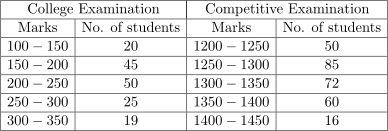
Solution:Calculation Table of Coefficient of Variation and Skewness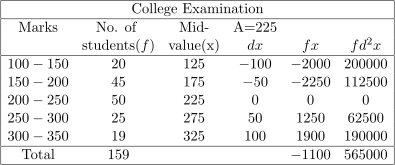
समान्तर माध्य
(\overline{X})=A+\frac{\Sigma f d x}{N} \\ =225+\frac{(-1100)}{159} \\ \approx 225-6.518 \\ \Rightarrow \overline{X} \approx 218.082
सबसे अधिक बारम्बारता 50 है अतः बहुलक वर्ग 200-225 है।
l=200,i=225-200=25 , f_0=45, f_1=50, f_2=25
बहुलक
(Z)=l+\left(\frac{f_1-f_0}{2 f_1-f_0-f_2}\right) \times i \\ =200+\left(\frac{50-45}{2 \times 50-45-25}\right) \times 25 \\ =200+\frac{5}{100-70} \times 25 \\ =200+\frac{125}{30} \\ \approx 200+4.167 \\ \Rightarrow Z \approx 204.167
प्रमाप विचलन
(\sigma)=\frac{1}{N} \sqrt{\Sigma f d^2 x \times N-(\Sigma f d x)^2} \\ =\frac{1}{159} \sqrt{565000 \times 159-(-1100)^2} \\ =\frac{1}{159} \sqrt{89835000-1210000} \\ =\frac{1}{159} \sqrt{88625000} \\ \approx \frac{9414.085}{159} \\ \Rightarrow \sigma \approx 59.208
C.V. of College Exam =\frac{\sigma}{\overline{X}} \times 100 \\ =\frac{59.208}{218.082} \times 100 \\ =\frac{5920.8}{218.082} \approx 27.15 \%
विषमता गुणांक (J)=\frac{\overline{X}-Z}{\sigma} \\ =\frac{218.082-204.167}{59.208} \\ \Rightarrow J=\frac{13.915}{59.208} \approx 0.235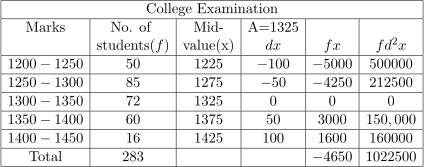
समान्तर माध्य
(\overline{X})=A+\frac{\Sigma f d x}{N} \\ =1325+\frac{(-4650)}{283} \\ \approx 1325-16.431 \\ \Rightarrow \overline{X} \approx 1308.569
सबसे अधिक बारम्बारता 85 है अतः बहुलक वर्ग 1250-1300 है।
l=1250,i=1300-1250=50 ,f_0=50, f_1=85 ,f_2=72
बहुलक (Z)=l+\left(\frac{f_1-f_0}{2 f_1-f_0-f_2}\right) \times i \\ =1300+\left(\frac{85-50}{2 \times 85-50-72}\right) \times 50 \\ =1300+\left(\frac{35}{170-122}\right) \times 50 \\ =1300+\frac{35 \times 50}{48} \\ =1300+\frac{1750}{48} \approx 1300+36.458 \\ \Rightarrow Z \approx 1336.458
प्रमाप विचलन
(\sigma)=\frac{1}{N^2} \sqrt{\Sigma fd^2 x \times N-(\Sigma f d x)^2} \\ =\frac{1}{283} \sqrt{1022500 \times 283-(-4650)^2}\\ =\frac{1}{283} \sqrt{289367500-21622500} \\ =\frac{1}{283} \sqrt{267745000} \\ \approx \frac{1}{283} \times 16362.915
C.V. of competitive Exam
=\frac{\sigma}{\overline{X}} \times 100 \\ =\frac{57.819}{1308.569} \times 100 \\ =\frac{5781.9}{1308.569} \\ \approx 4.42 \%
विषमता गुणांक
(J)=\frac{\overline{X}-Z}{\sigma} \\ =\frac{1308.569-1336.458}{57.819} \\ =-\frac{27.889}{57.819} \\ \Rightarrow J \approx-0.482
प्रतियोगिता परीक्षा अधिक सजातीय और विषम है।
Example:5.निम्न आँकड़ों से सम्पूर्ण समूह का समूहित समान्तर माध्य और समूहित प्रमाप विचलन ज्ञात कीजिए: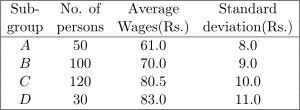
(From the following data,find the combined arithmetic mean and combined standard deviation of the whole group):
Solution:
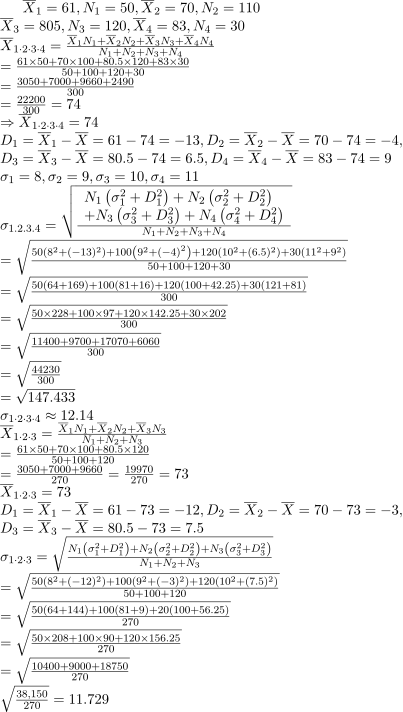
उपर्युक्त उदाहरणों के द्वारा विषमता और प्रमाप विचलन (Skewness and Standard Deviation),विषमता गुणांक (Coefficient of Skewness) को समझ सकते हैं।

Also Read This Article:- Coefficient of Variation
3.विषमता और प्रमाप विचलन (Frequently Asked Questions Related to Skewness and Standard Deviation),विषमता गुणांक (Coefficient of Skewness) से सम्बन्धित अक्सर पूछे जाने वाले प्रश्न:
प्रश्न:1.सामूहिक समान्तर माध्य ज्ञात करने का सूत्र लिखो। (Write the Formula to Find the Combined Arithmetic Mean):
उत्तर:सामूहिक समान्तर माध्य \overline{X}_{1 \cdot 2 \cdot 3}=\frac{\overline{X}_1 N_1+\overline{X}_2 N_2+\overline{X}_3 N_3}{N_1+N_2+N_3}
प्रश्न:2.सामूहिक प्रमाप विचलन ज्ञात करने का सूत्र लिखो। (Write the Formula to Find the Combined Standard Deviation):
Solution:सामूहिक प्रमाप विचलन \sigma_{1 \cdot 2 \cdot 3}=\sqrt{\frac{N_1 \left( \sigma_1^2+D_1^2\right)+N_2\left(\sigma_2^2+D_2^2\right)+N_3\left(\sigma_3^2+D_3^2\right)}{N_1+N_2+N_3}}
जहाँ D_1=\overline{X}_1-\overline{X}_{1 \cdot 2 \cdot 3}, D_2=\overline{X}_2-\overline{X}_{1 \cdot 2 \cdot 3}, D_3={\overline{X}_3-\overline{X}_{1 \cdot 2 \cdot 3}}
प्रश्न:3.प्रमाप विचलन व विचरण गुणांक ज्ञात करने के सूत्र लिखो। (Write the Formulae to Find Standard Deviation and Coefficient of Variation):
Solution:प्रमाप विचलन (\sigma)=\frac{1}{N} \sqrt{\Sigma f d^2 x \cdot N-(\Sigma f d x)^2}
विचरण गुणांक C. of V.=\frac{\sigma}{\overline{X}} \times 100
प्रसरण V=\sigma^2
\sigma=Standard Deviation
उपर्युक्त प्रश्नों के उत्तर द्वारा विषमता और प्रमाप विचलन (Skewness and Standard Deviation),विषमता गुणांक (Coefficient of Skewness) के बारे में और अधिक जानकारी प्राप्त कर सकते हैं।
| No. | Social Media | Url |
|---|---|---|
| 1. | click here | |
| 2. | you tube | click here |
| 3. | click here | |
| 4. | click here | |
| 5. | Facebook Page | click here |
| 6. | click here | |
| 7. | click here |
Skewness and Standard Deviation
विषमता और प्रमाप विचलन
(Skewness and Standard Deviation)
Skewness and Standard Deviation
विषमता और प्रमाप विचलन (Skewness and Standard Deviation) के इस आर्टिकल
में विषमता गुणांक और प्रमाप विचलन ज्ञात करने के लिए कुछ सवालों को हल करके
समझने का प्रयास करेंगे।





About Author

Satyam
About my self I am owner of Mathematics Satyam website.I am satya narain kumawat from manoharpur district-jaipur (Rajasthan) India pin code-303104.My qualification -B.SC. B.ed. I have read about m.sc. books,psychology,philosophy,spiritual, vedic,religious,yoga,health and different many knowledgeable books.I have about 15 years teaching experience upto M.sc. ,M.com.,English and science.

